
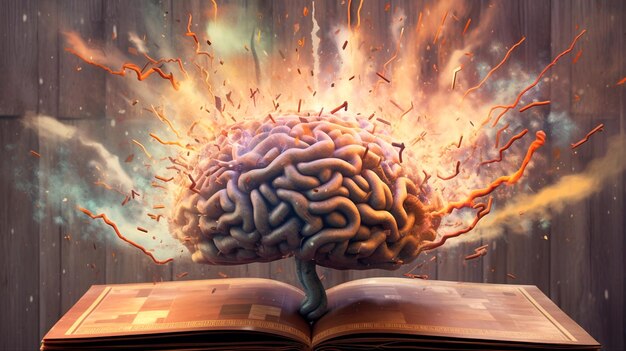
Politics as a Limbic Phenomenon
We now turn to the subject of politics — not the arguments of the day, not who is right or wrong, but the concept of politics itself and why it produces such intense division. People on every side believe their position is correct, and each struggles to understand how the other could possibly see the world differently. The emotional tone often becomes existential: predictions of collapse, warnings of doom, declarations that the other side is destroying everything. The rhetoric escalates, the temperature rises, and the limbic system takes over long before the cortex has a chance to evaluate anything. It is exhausting even to observe.

These are the symptoms. The deeper issue is that we no longer share a common grammar — a shared framework for how to think, how to reason, and how to engage one another. In earlier generations, education included not only academic subjects but also the disciplines that formed emotional and moral intelligence: responsibility, accountability, manners, civic understanding, and the ability to restrain oneself when uncertain. Students learned how government worked, how to check facts, how to disagree without hostility, and how to maintain self‑respect by avoiding claims they could not defend. All this before before 1979. The computer revolution was still four years away. This shared foundation created a common reference point for adulthood.
Today, that foundation is inconsistent. Some communities still cultivate it, but many individuals reach adulthood without the same grounding in civic literacy, emotional regulation, or critical reasoning. The result is not simply disagreement — disagreement is healthy — but incompatibility of reasoning styles. People are not just arguing from different facts; they are arguing from different grammars.
This is why political conflict feels so volatile. What we are witnessing is not merely two sides with different opinions, but two Moral Grammars operating in the same public space. One grammar emphasizes emotional immediacy, identity reinforcement, and limbic‑first interpretation. The other emphasizes restraint, evaluation, and cortical engagement. These grammars collide daily in conversations, news cycles, and online exchanges.
The effects are visible everywhere. Individuals react defensively to ordinary questions. They repeat familiar phrases and talking points because these provide emotional stability. They adopt the tone, posture, and vocabulary of the groups they identify with. And in every case, the person feels absolutely certain — not because they have evaluated the evidence, but because the limbic system produces a sensation of certainty whenever uncertainty is intolerable.
This is the same mechanism that governs phobias and panic. The circuitry does not change simply because the topic is political. When uncertainty rises, the amygdala fires. When the amygdala fires, the cortex is bypassed. When the cortex is bypassed, emotional reflex replaces analysis. And when emotional reflex becomes habitual, it forms a worldview that feels self‑evident from the inside and incomprehensible from the outside. All while the individual believes with all their might that they are right.
Political division, then, is not merely ideological. It is physiological. It is the predictable outcome of a population navigating complex issues with a limbic system that evolved for survival, not for nuance. Without a shared Moral Grammar to stabilize interpretation, uncertainty becomes a threat, disagreement becomes a danger, and politics becomes a stage for limbic storms rather than rational discourse.
No one is immune to physiology. Some people simply have stronger Moral Grammar — the internal habits that allow them to pause, resist emotional escalation, and reason with the faculties available to all of us. Imagine feeling that familiar twist in your gut, the early rumble of a limbic storm, and instead of reacting, you stop and ask, “What exactly is triggering me right now? Why am I about to lose control?” That single moment of awareness interrupts the limbic surge and restores activity in the prefrontal cortex, the part of the brain where reasoning, evaluation, and self‑restraint live.
This distinction — the ability to pause before reacting — is what separates stable discourse from emotional escalation. It is not about intelligence or ideology. It is about physiology. When the limbic system fires first, people experience a sense of absolute certainty, even when the evidence is thin or contradictory. When the cortex re‑engages, that certainty softens, and the person becomes capable of nuance, doubt, and genuine thought.
This same dynamic appears in political life. Not in the sense of who is right or wrong, but in how people process political information. Individuals on every side experience the same physiology: the same limbic surges, the same emotional reflexes, the same narrowing of attention when uncertainty rises. People are not divided because they are fundamentally different; they are divided because they are responding to uncertainty with different levels of cortical engagement. Without a shared Moral Grammar — a shared way of thinking, evaluating, and restraining ourselves — political disagreement becomes a stage for limbic storms rather than rational discourse.
We are all endowed with the same basic rights and the same basic neural architecture. What differs is how we use it. Some people move from one limbic storm to the next, living in a cycle of emotional activation that feels normal from the inside. Others learn to interrupt the storm, breathe, and bring the cortex back online. The difference is not moral superiority; it is training. It is the presence or absence of a grammar that teaches the mind to participate before the body reacts.
And that is the point of this work: not to divide people into camps, but to show that the real divide is physiological, not ideological. Anyone can learn to regain agency over their reactions. Anyone can learn to think before the limbic system decides for them. The tools are simple, the mechanisms are universal, and the transformation begins with a single moment of awareness — the moment you choose to engage your mind before your biology takes over.