
The video you’re watching argues that Chief Justice John Roberts is “more dangerous than Trump” and “the person stopping nonwhite citizens from voting” sec1sec4. It frames him as a singular threat to American democracy, even urging that “If you don’t control the Supreme Court, you control nothing” sec6. These claims are dramatic, emotionally charged, and rhetorically effective — but they rest on a fundamental misunderstanding of the American system itself.
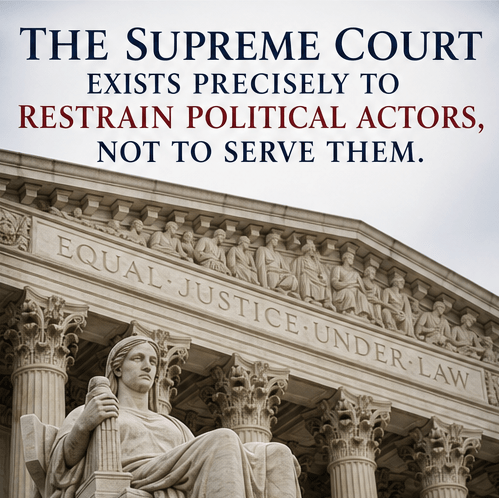
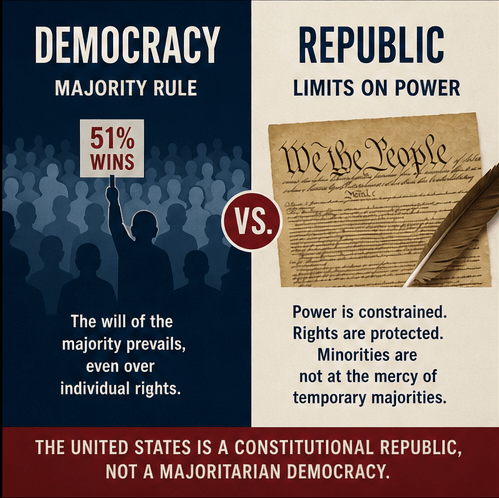
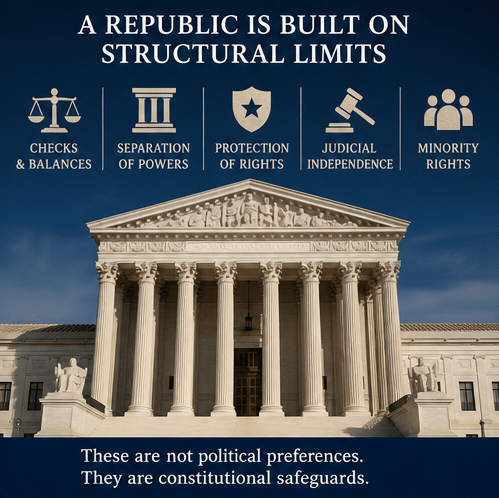
The United States is not a majoritarian democracy. It is a constitutional republic. That distinction is not semantic; it is structural. A democracy prioritizes majority rule. A republic prioritizes limits on power — checks, balances, separation of powers, judicial independence, and the protection of minority rights against temporary political passions. The Supreme Court exists precisely to restrain political actors, not to serve them.
This is why the video’s framing collapses under scrutiny. When it claims Roberts is “stopping nonwhite citizens from voting” sec4, it conflates constitutional interpretation with racial intent. Roberts’ opinions on the Voting Rights Act revolve around federalism, state authority, and statutory scope — not racial exclusion. One may disagree with his jurisprudence, but disagreement is not disenfranchisement. Judicial restraint is not voter suppression.
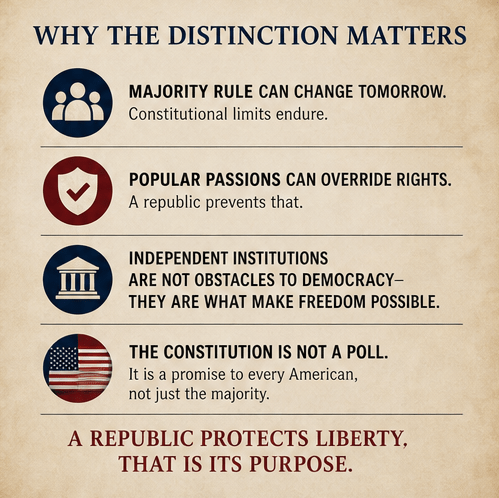
The video’s most revealing line is its insistence that political actors must “control the Supreme Court” sec6. That sentiment is the true threat to a republic. The Court is not meant to be controlled by any party. Its legitimacy depends on independence. To demand control over the judiciary is to demand the collapse of the very architecture that prevents authoritarian drift. Court expansion — openly advocated in the clip sec6[sec11](#sentenceindex-sec11] — is not a democratic reform; it is constitutional hardball that destabilizes the separation of powers and invites retaliatory escalation.
The video also repeatedly describes Roberts as an “institutionalist” who nonetheless authored “radical expansions of executive power” sec2. This contradiction reveals the rhetorical strategy at work: redefine “democracy” as a partisan agenda, then label any institutional constraint as anti‑democratic. In this framing, judicial independence becomes dangerous, constitutional limits become obstacles, and disagreement becomes existential threat.
A republic cannot function under such logic. If “democracy” is redefined to mean “our preferred outcomes,” then any neutral institution becomes an enemy whenever it refuses to deliver those outcomes. That is not democratic thinking; it is factional thinking.
The real danger is not Roberts. It is the impulse to delegitimize constitutional restraints whenever they frustrate political goals. A republic survives through limits, not through the consolidation of power. Judicial independence is not a threat to democracy — it is one of the few remaining safeguards against the erosion of republican order.
Point‑by‑Point Takedown of the Video
1. “More dangerous than Trump.” The video opens with a sensational claim that Roberts is “more dangerous than Trump” sec1. This is rhetorical inflation, not analysis. Roberts is a judge bound by constitutional text and precedent. He does not command armies, write executive orders, or run political campaigns. Calling a Supreme Court justice “more dangerous” than a president is a category error designed to provoke fear, not convey fact.
2. “Radical expansions of executive power.” The clip asserts that Roberts authored “radical expansions of executive power” sec2. Yet it never identifies which cases or doctrines supposedly constitute these expansions. Without specifics, the claim is an accusation without evidence. Roberts’ jurisprudence is often cautious, incremental, and institution‑protective — the opposite of radical.
3. “Stopping nonwhite citizens from voting.” The video’s most inflammatory line claims Roberts is “the person stopping you from voting” if you are a nonwhite citizen sec4. This is not supported by any case law. Roberts’ decisions on the Voting Rights Act concern federal oversight mechanisms, not racial eligibility. To equate statutory interpretation with racial disenfranchisement is to collapse legal reasoning into political messaging.
4. “It has always been Roberts.” The repetition — “it has been, and it always has been, John Roberts” [sec5](#sentenceindex-sec5]sec9 — is a rhetorical device meant to create inevitability and villainy. But it ignores the dozens of actors, institutions, and historical forces involved in voting rights litigation. No single justice “always has been” the cause of anything in a system designed around collective decision‑making.
5. “Democrats must pursue Supreme Court expansion.” The video insists that Democrats must expand the Court [sec6](#sentenceindex-sec6]sec11. Court packing is not a democratic reform; it is a destabilizing escalation that undermines judicial independence. If one party expands the Court to gain control, the other party will do the same when it regains power. The judiciary becomes a partisan weapon rather than a neutral arbiter.
6. “If you don’t control the Supreme Court, you control nothing.” This line is the clearest admission of the video’s worldview [sec6](#sentenceindex-sec6]. It treats the Court as a political instrument to be controlled, not an independent branch meant to restrain political actors. In a republic, you are not supposed to control the Court. You are supposed to respect its independence. The desire for control is itself the threat.
Leave a Reply