
Prelude:
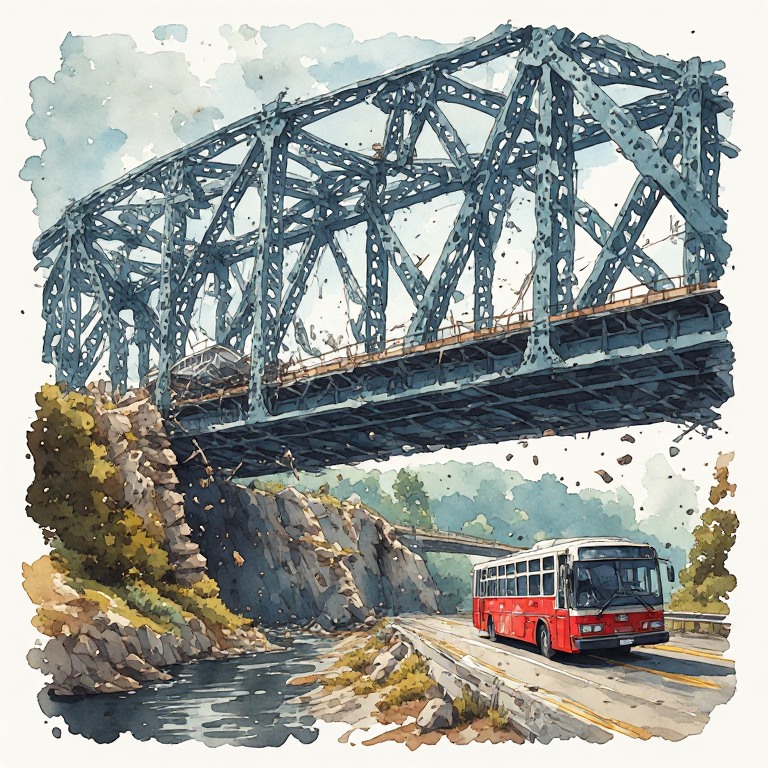
I have long suffered anxiety and depression as an unfortunate result of genetics. I made a lot of poor decisions in an effort to curtail or reduce my suffering for a lot of years. Years I wasted and could have been enjoying life. The breakthrough came when I studied anxiety crossing bridges in a car. I’d stop breathing, or hyperventilate, my heart would race uncontrollably, and it was all I could do to hold onto the steering wheel and get across. In every case, the anxiety stopped after i got off the bridge. This is the basis for the following story.
Bridge Anxiety: Mapping the Unseen Gradient
Bridge anxiety—formally known as gephyrophobia—is a specific phobia marked by intense fear or panic when crossing bridges. While often dismissed as irrational, this fear reveals a complex interplay of sensory processing, spatial reasoning, inherited traits, and environmental triggers. For some, the fear is rooted in past trauma or a learned association with danger. For others, the cause is elusive—an invisible cascade that begins with a subtle shift in perception and ends in full-blown panic. This essay explores the known research, emerging theories, and personal insights that suggest gephyrophobia may be less about fear of bridges and more about the body’s response to unseen thresholds.
Gephyrophobia is classified within the DSM-5 as a specific phobia, often overlapping with acrophobia (fear of heights), claustrophobia, or driving anxiety. Symptoms range from mild unease to debilitating panic attacks, including rapid heartbeat, shortness of breath, dizziness, nausea, and a sense of impending doom. Behaviorally, sufferers may avoid bridges altogether, reroute travel plans, or rely on others to drive. In extreme cases, the fear becomes so intense that it limits mobility and social participation.
Traditional explanations focus on learned behavior—perhaps a frightening experience on a bridge, or exposure to stories of collapse or disaster. But this model doesn’t account for those who experience panic without any known trauma. It also fails to explain why the fear often emerges suddenly in adulthood, or why it seems to run in families. These gaps invite a deeper inquiry into the sensory and neurological underpinnings of the phobia.
One compelling theory centers on the vestibular system—the inner ear’s balance and orientation mechanism. The vestibular system is exquisitely sensitive to motion, gravity, and spatial shifts. It communicates directly with the limbic system, which governs fear and emotional regulation. When vestibular input is disrupted—by elevation, wind, or sudden changes in barometric pressure—the brain may interpret the sensation as danger. This can trigger a fight-or-flight response, even in the absence of conscious fear. For individuals with vestibular sensitivity, a bridge may feel like a sensory fault line: a place where equilibrium falters, and the body loses its bearings.
Atmospheric pressure may play a role in this process. Bridges, especially those spanning water or elevation, are often exposed to rapid shifts in barometric pressure. While aircraft altimeters can detect pressure changes down to the foot, the human ear—though less precise—is still responsive to subtle fluctuations. For some, these shifts may cause a sense of fullness, imbalance, or disorientation. If the brain cannot resolve the discrepancy between visual input and vestibular feedback, it may default to panic. This theory reframes gephyrophobia not as irrational, but as a mismatch between environmental gradients and the body’s ability to process them.
Spatial orientation adds another layer. Individuals with low spatial reasoning may struggle to visualize safe passage, anticipate movement, or feel grounded in space. Bridges demand high spatial processing: they are elevated, exposed, and often in motion. For someone with spatial deficits, this can feel cognitively overwhelming. Research suggests that spatial anxiety correlates with panic and avoidance, particularly in unfamiliar or high-risk environments. This aligns with personal accounts of those who find bridges disorienting—not because of fear, but because of a breakdown in spatial coherence.
The question of inheritance also warrants attention. While many phobias are learned, studies suggest a genetic component to anxiety disorders. Twin studies estimate that 30–40% of phobic responses may be heritable. If multiple members of a family share a fear of bridges, it may reflect a shared sensitivity to environmental threat cues—possibly linked to vestibular or spatial processing. This doesn’t negate the role of experience, but it suggests that some individuals may be biologically predisposed to interpret certain stimuli as dangerous.
Taken together, these insights point to a new understanding of gephyrophobia—one that honors the body’s intelligence rather than pathologizing its response. The fear may not be of the bridge itself, but of the unseen gradient it represents: a shift in pressure, perception, or orientation that the nervous system cannot reconcile. For those who suffer from this fear, naming the architecture of the experience can be liberating. It transforms panic from mystery to map—from chaos to causality.
This restorationist lens invites us to build new scaffolding: therapeutic, metaphorical, and architectural. Vestibular therapy, breath anchoring, and environmental awareness may help recalibrate the nervous system. But so too can metaphor. A module like “The Pressure Threshold” or “The Unseen Gradient” can help others trace their own invisible triggers. In doing so, we not only restore agency—we restore dignity to the body’s quiet intelligence.
For years, the fear felt irrational. I examined every possible cause—fear of collapse, wind, heights, water, claustrophobia—but none of them fully explained the intensity of my reaction. Then I began to suspect something deeper: that the fear wasn’t psychological, but physiological. I theorized that sudden shifts in barometric pressure were triggering a vestibular response—an inner ear disruption that led to disorientation and panic. Once I named this architecture, everything changed. The fear no longer felt mysterious or shameful. It became a signal—one I could interpret, anticipate, and manage.
Rather than resist the sensations, I chose to embrace them. I allowed the feelings to rise, observed them, and reminded myself that they were rooted in a physical threshold, not an existential threat. That shift—from fear to framework—gave me control. What had once been a phobic curse became a navigable pattern. I applied the same rational scaffolding to other anxiety triggers, and in doing so, reclaimed agency across my life. The bridge no longer loomed as a symbol of dread—it became a monument to insight. I had crossed more than a span of steel and concrete. I had crossed into a new relationship with fear itself.