
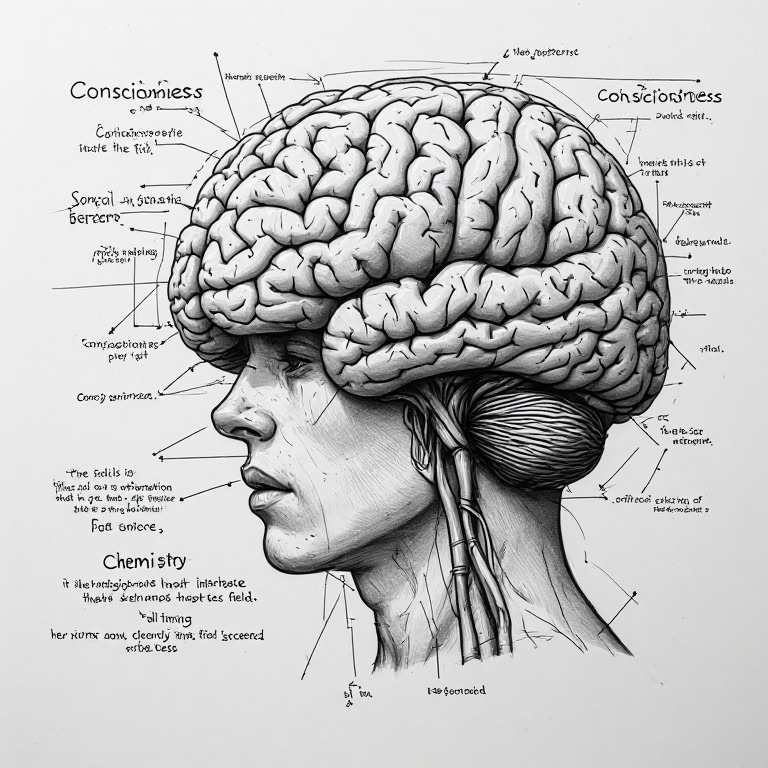
A Restorationist Essay on the Fields of Consiousness
There is a quiet assumption woven through modern thought that knowledge is something human beings create. We speak as though ideas are manufactured, as though mathematics is invented, as though the laws of nature somehow spring into existence only when a scientist writes them down. But the more closely one looks at the structure of reality, the harder that assumption becomes to defend. The universe behaves as though knowledge is not produced by minds, but discovered by them. It behaves as though knowledge already exists.
The laws of physics did not wait for Newton to be born. The structure of DNA did not come into being when Watson and Crick sketched its double helix. The Pythagorean theorem was true long before Pythagoras. Every mathematical relationship, every physical constant, every pattern in nature existed before any human recognized it. We do not create knowledge. We uncover it.
This is the first clue that consciousness is not confined to the brain. If knowledge exists independently of us, then the mind is not a generator of truth but an interface to something larger. It is a receiver, not a manufacturer. And once you see the mind this way, the entire architecture of human cognition begins to make sense.
The brain is a biological instrument with mechanical limits. It has bandwidth constraints, chemical modes, and structural bottlenecks. The prefrontal cortex — the seat of attention, planning, and reasoning — functions like the fovea of the eye. Just as the eye can only bring a narrow slice of the visual world into sharp focus, the prefrontal cortex can only bring a narrow slice of the informational world into conscious clarity. When the body is rested, calm, and chemically balanced, that cognitive “funnel” widens. When stress rises or fatigue sets in, the funnel narrows. The mind becomes reactive, fragmented, and unable to hold more than a sliver of thought at a time.
This is not a moral failure. It is a mechanical one.
Chemistry determines how much of the world the mind can process. It determines whether the brain is tuned to receive the deeper patterns of the universe or whether it is locked into survival mode. When the amygdala fires, the prefrontal cortex loses bandwidth. When meaning appears, dopamine rises and the funnel widens. When purpose is present, attention stabilizes. When fear dominates, attention collapses. The field does not change. The receiver does.
This is why a thirteen‑year‑old can sit in a classroom staring at algebra and feel nothing but confusion and frustration. The knowledge is there. The patterns are there. The relationships are there. But the student’s mind is not tuned to receive them. There is no meaning, no narrative, no emotional resonance to widen the funnel. The symbols float on the page like a foreign language with no country attached to it. The student concludes they are “bad at math,” when in truth the architecture simply hasn’t aligned.
Years later, that same person may encounter algebra again — not as abstraction, but as the language of electronics, circuits, impedance, and real‑world systems. Suddenly the symbols come alive. Suddenly the patterns make sense. Suddenly the mind opens. The field has not changed. The person has. Meaning has appeared, and with it, the chemistry that allows the brain to couple to the deeper structure of reality.
This is the heart of the unified model: consciousness is not produced by the brain. Consciousness is the field of information that permeates the universe. The brain is the biological interface that samples that field. Chemistry is the tuning mechanism that determines how clearly the field can be accessed. And experience is the localized expression of that interaction.
In this view, intuition is not magic. It is resonance. Insight is not invention. It is reception. Creativity is not fabrication. It is coupling. Learning is not the accumulation of new content. It is the widening of the funnel so that more of the field can be perceived.
This model restores dignity to the human mind. It explains why people differ not in worth but in wiring. It explains why meaning matters more than pressure, why curiosity outperforms discipline, why purpose transforms cognition, and why education fails when it ignores the architecture of the mind. It also explains why the Restorationist impulse — the desire to return to something true, stable, and foundational — is not nostalgia but alignment. It is the recognition that the field of knowledge is constant, and that our task is not to invent truth but to tune ourselves to it.
All knowledge exists. All truth exists. All patterns exist. The universe is not waiting for us to create meaning. It is waiting for us to perceive it. And the more we understand the architecture of the mind — the field, the interface, the chemistry, the tuning — the more capable we become of receiving what has always been there.
This is the Restorationist view of consciousness: not a spark trapped inside the skull, but a field that permeates reality, waiting for minds to align with it. The work of restoration is the work of tuning — widening the funnel, quieting the noise, and learning to receive the knowledge that has always been present.