A Restorationist Indictment of the Chief Justice’s Jurisprudence
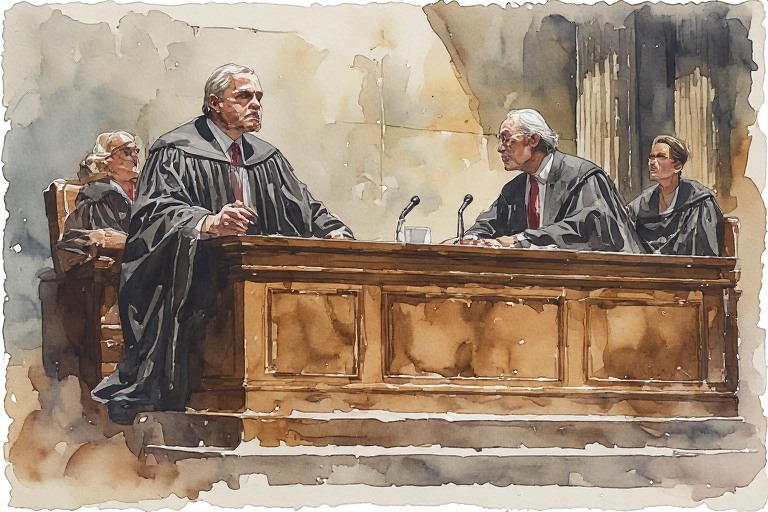
On June 30, 2026, Chief Justice John Roberts did what he has done repeatedly, systematically, and by now almost predictably throughout his tenure at the helm of the Supreme Court: he saved the institution from itself, as he understands his mission, and in so doing betrayed the Constitution he swore to interpret faithfully. In Trump v. Barbara, Roberts authored a 5–4 majority opinion holding that children born in the United States to parents unlawfully or temporarily present are “subject to the jurisdiction thereof” within the meaning of the Fourteenth Amendment’s Citizenship Clause, and are therefore citizens at birth. He was joined by Justice Barrett and the Court’s three liberal members. Dissenting were Justices Thomas, Alito, and Gorsuch — the three members of the Court who, whatever their individual differences, share a commitment to reading the Constitution as it was written rather than as institutional comfort requires. We submit that Trump v. Barbara is not merely a wrong decision. It is the most clarifying decision of the Roberts era. It is the document by which history will understand what John Roberts actually is.
We must be precise about the charge. Roberts is not a liberal justice. He does not pursue a progressive social agenda from the bench. The standard critique of judicial activism — the Warren Court remaking society through constitutional innovation — does not quite apply to him. His failure is more insidious and, from a Restorationist standpoint, more dangerous. Roberts is an institutional activist: a jurist whose overriding jurisprudential loyalty is not to the text of the Constitution, not to the public meaning of its provisions at ratification, and not to the rule of law as distinct from politics, but to the Supreme Court’s own reputation as a neutral and stabilizing institution. He manages the Court the way a central bank manages a currency — not according to fixed principles, but according to what the market will bear. The problem is that constitutional law is not a currency, and the Supreme Court is not a bank. It is a court of law. And courts of law are obligated to follow the law.
The Fourteenth Amendment’s Citizenship Clause reads: “All persons born or naturalized in the United States, and subject to the jurisdiction thereof, are citizens of the United States and of the State wherein they reside.” The phrase “subject to the jurisdiction thereof” is not surplusage. The framers of the Fourteenth Amendment placed it there deliberately, to exclude from birthright citizenship those persons who did not owe full, exclusive allegiance to the United States. Senator Lyman Trumbull, a principal drafter of the Amendment, stated on the floor of the Senate that the phrase meant “not owing allegiance to anybody else.” That is not a fringe historical position. It is the legislative record. Justice Alito, writing in dissent in Trump v. Barbara, called the majority opinion “one of the most important decisions in the history of the Court” and “a serious mistake,” and he was correct on both counts. His insistence that careful textual and historical analysis does not support the extension of birthright citizenship to the children of persons present illegally or only temporarily is grounded in precisely the kind of disciplined constitutional reasoning that this Court, under Roberts’ stewardship, has learned to route around when the political stakes are high enough.
| The dissenters ’ allegiance-based reading of the Citizenship Clause is not radicalism. It is textualism taken seriously. That it was treated by the majority as an outlier position tells us everything about who is actually driving the analysis. |
Roberts’ majority opinion in Trump v. Barbara does not ignore the historical record. That is what makes it so effective and so dishonest. It engages the history, marshals selective precedent, invokes the long practice of treating birthright citizenship as settled, and arrives at a result that just happens to spare the Court from sitting at the center of the most explosive domestic political controversy of the decade. The opinion is smooth. It is confident. It reads like the product of legal reasoning rather than institutional crisis management. But we are not fooled, and neither should anyone be who reads Alito’s dissent alongside it. Roberts foreclosed a genuine and historically defensible constitutional debate not because the text compelled closure, but because reopening it would have made the Supreme Court the instrument of a political outcome he deemed too destabilizing for the institution to survive politically unscathed.
This is not the first time. We have seen this pattern before, and we have learned to recognize it. In NFIB v. Sebelius in 2012, Roberts voted to strike down the individual mandate under the Commerce Clause — the correct result — and then, in the same opinion, rescued the Affordable Care Act by recharacterizing the mandate as a “tax” under Congress’s taxing power, a characterization that the statute’s own authors had specifically rejected during the legislative debate. The Obama administration had argued strenuously in Congress that the mandate was not a tax. Roberts made it one, unilaterally, because the alternative — striking down the signature legislative achievement of a sitting president — would have made the Court look like a partisan actor. In Department of Homeland Security v. Regents in 2020, Roberts sided with the Court’s liberals to block the Trump administration’s rescission of DACA on procedural grounds, stretching the Administrative Procedure Act’s “arbitrary and capricious” standard beyond recognition to avoid a politically charged outcome. And now Trump v. Barbara: the capstone of a jurisprudence that is, at its core, a jurisprudence of institutional self-preservation dressed in the language of constitutional law.
| The Restorationist Indictment The pattern across Sebelius, Regents, and Trump v. Barbara is not coincidence. It is method. When political pressure reaches a threshold Roberts judges to be Court-threatening, the legal analysis bends. The text yields. History becomes selective. And the Constitution’s meaning is determined not by what it says, but by what the institution can afford to say it says. |
We raise as well the deeper democratic injury that Trump v. Barbara inflicts. Birthright citizenship for the children of persons present in the United States illegally was never enacted by Congress. It was never put to the people. It was never explicitly settled by the framers of the Fourteenth Amendment — indeed, as the dissents demonstrate, the historical record cuts against the majority’s reading. The question of what “subject to the jurisdiction thereof” means in this context was, at minimum, an open one — open enough that a good-faith originalist reading could go either way, and open enough that democratic resolution was entirely appropriate. By constitutionalizing the question at the highest level of judicial authority, Roberts has removed it from the reach of Congress, removed it from the reach of the Executive, and removed it from the reach of the people themselves. He has, in the name of institutional restraint, committed the most aggressive act of judicial supremacy available to him: declaring a contested political question permanently settled by constitutional command when the constitutional command is, in fact, genuinely ambiguous. That is not modesty. That is usurpation wearing modesty’s clothes.
Justice Alito’s dissent is, for us, the Restorationist standard. Not because Alito is infallible, and not because the allegiance-based reading is beyond debate, but because Alito’s method is correct: he follows the text, engages the history honestly, reaches a conclusion the political class will find unwelcome, and refuses to flinch. He is willing, in other words, to be called wrong by powerful people — the one indispensable quality of a judge who actually means what he says about constitutional fidelity. Roberts, by contrast, is never willing to be called wrong by powerful people. His genius is in ensuring that he never has to be, by constructing majorities that reach results the establishment can live with and calling it constitutional law. We do not call that genius. We call it the abdication of judicial office.
The Roberts problem, stated plainly: when the Chief Justice of the United States treats the Court’s institutional reputation as a value that can override the Constitution’s text, he does not thereby save constitutionalism. He hollows it out. A Court that decides cases by calculating what it can politically survive teaches the country that constitutional meaning is, at bottom, a function of political pressure — that the Constitution says what the powerful can afford to let it say. That lesson, absorbed over a generation, is more corrosive to constitutional government than any single wrong decision, however significant. Trump v. Barbara is a wrong decision. But the Roberts jurisprudence is a wrong theory of what a court is for. And it is the theory, not merely the case, that we must reckon with.
This section is published as part of the Restorationist Papers series on constitutional commentary. July 2026.



Leave a Reply