
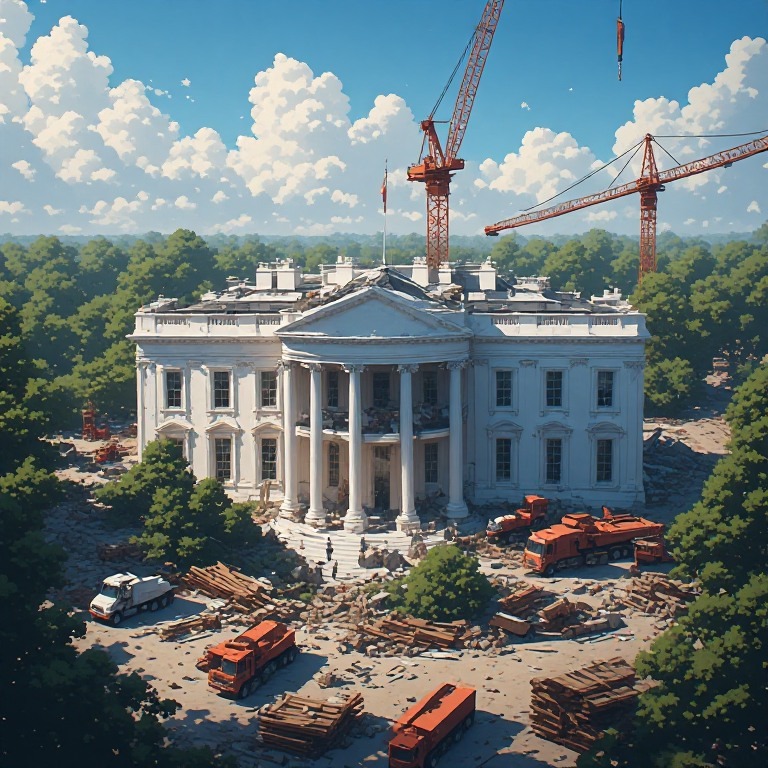
The unfolding dispute over the White House ballroom project has become a case study in how modern regulation can turn even the simplest act of stewardship into a procedural labyrinth. Ground News reports that the National Trust for Historic Preservation — a congressionally chartered nonprofit — has filed a federal lawsuit to halt construction on President Trump’s proposed 90,000‑square‑foot ballroom addition. Their claim is not about the design, the funding, or the purpose of the project. It is about process: the administration allegedly demolished the historic East Wing in October 2025 and began work on the $300 million, privately funded project without completing the legally mandated reviews under the National Capital Planning Act and the National Historic Preservation Act.
 Artist Rendering
The lawsuit seeks a temporary restraining order to pause all work until these steps are completed, with a hearing scheduled for December 16, 2025. The Trust argues that no president — Trump, Biden, or anyone else — is permitted to alter the White House without environmental review, design consultation, public comment, and congressional approval. These requirements include consultations with the National Capital Planning Commission (NCPC) and the Commission of Fine Arts (CFA), both of which review federal projects in Washington, D.C. for environmental impact, design compatibility, and historic preservation concerns.
Regulations—Used to Justify Regulators’ Positions
If the court grants the stay, the project enters the slow‑moving machinery of federal procedure. NCPC reviews typically take 1–6 months, depending on revisions and public input. CFA reviews add another 2–6 months. NHPA Section 106 consultations can take 3–12 months, and if NEPA environmental assessments are required, they can add 6–18 months more. Even when these processes run concurrently — as they often do — the combined timeline is 4–9 months, with litigation delays potentially stretching the process to a full year.
And that’s before the design changes begin. Every review body has its own priorities: NCPC may request site plan adjustments; CFA may require aesthetic revisions; preservation groups may demand material changes; environmental reviewers may require impact mitigation. Each revision cycle adds weeks or months. Each stakeholder introduces new preferences. Each procedural step opens the door to further delay.
Regulatory Pile
This is the knot Congress has tied — a system so layered with procedural safeguards that even a privately funded project on federal land can be slowed to a crawl. The irony is that the ballroom was intended as a gift to the American people, funded by private donors to avoid burdening taxpayers. Yet the regulatory structure ensures that the more ambitious the gift, the more entangled it becomes.
And here lies the paradox: if President Trump were to walk away — to take his plan, his private money, and leave the regulators to “work it out” — the lawsuit would evaporate. A court cannot restrain a project that no longer exists. But the East Wing has already been demolished. The White House is missing critical office space, functional corridors, and historic architecture. The federal government would inherit a half‑destroyed complex, and Congress would be forced to appropriate public funds to rebuild or replace what was lost.
In that scenario, the regulators do not “win.” They inherit a federal liability. The taxpayers, not private donors, would pay the bill. And the political optics become a self‑fulfilling prophecy: an anti‑regulation president thwarted by regulation, leaving the public to absorb the cost of the very procedures that prevented private investment from completing the project.
This is not a story about architecture. It is a story about structure — the structure of federal law, the structure of regulatory oversight, and the structure of a system so complex that even its defenders struggle to navigate it. Whether one sees the ballroom as an overreach or a gift, the deeper lesson is the same: when process becomes the obstacle, the outcome is not preservation or progress, but paralysis.
Glossary:
- NCPC — National Capital Planning Commission; reviews federal projects in D.C.
- CFA — Commission of Fine Arts; evaluates design and aesthetics of federal buildings
- NHPA Section 106 — Federal historic preservation review process.
- NEPA — National Environmental Policy Act; requires environmental assessments.
- Concept / Preliminary / Final Review — Stages of federal design approval.