
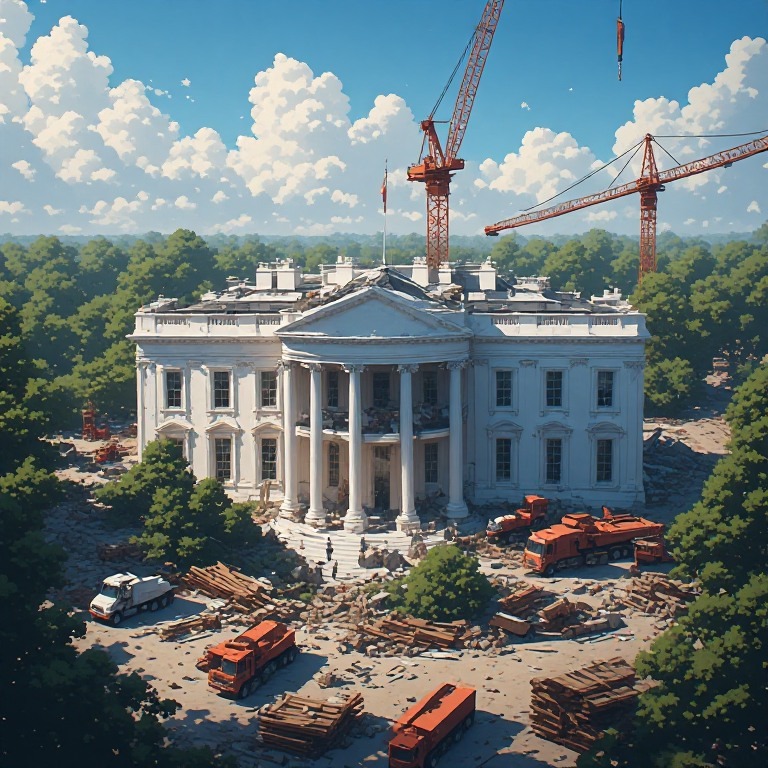
🏛️ Historical Precedent: Renovations Past Presidents Undertook Without Legal Challenge
One of the strangest omissions in the current debate is any serious comparison to the long history of presidential renovations — many of them far more invasive than Trump’s proposed ballroom — that proceeded without lawsuits, injunctions, or preservation battles. The White House has never been a static artifact. It has been rebuilt, expanded, gutted, modernized, fortified, and reimagined repeatedly across administrations. Yet none of those projects triggered the kind of preservation litigation now aimed at Trump.
✅ The Truman Reconstruction: The White House Was Gutted to a Shell
Between 1948 and 1952, the White House was found to be structurally unsound. Floors sagged, beams cracked, and engineers warned of imminent collapse. President Truman made the decision to evacuate the building and undertake the most radical renovation in presidential history.
What followed was nothing short of architectural surgery:
- The entire interior was demolished.
- Only the exterior sandstone walls remained standing.
- A new steel frame was erected inside the shell.
- Every floor, wall, staircase, and structural element was rebuilt.
- The White House became, in effect, a new building wearing the skin of the old one.
This was not a renovation — it was a reconstruction. And yet:
- No preservation lawsuit was filed.
- No outside group sought an injunction.
- No court demanded an environmental review.
- No procedural gauntlet delayed the project.
Congress authorized the work, the executive branch executed it, and the nation accepted it as necessary stewardship.
✅ Other Presidents Made Major Alterations Without Litigation
Across administrations, presidents have overseen significant changes:
- The West Wing expansions under Theodore Roosevelt and William Howard Taft.
- The Oval Office relocation and redesign in 1934.
- Kennedy’s extensive interior redesigns, including the famous redecoration of the State Floor.
- Nixon’s Situation Room overhaul and major security upgrades.
- Reagan and Clinton-era technology retrofits.
- Obama’s and Trump’s cybersecurity and communications infrastructure upgrades.
Many of these projects altered historic fabric, changed layouts, or introduced entirely new systems. None were halted by preservation lawsuits.
✅ Why the Current Case Is Different
The difference is not the scale of the project — Truman’s was far larger. The difference is not the historic sensitivity — earlier presidents altered equally significant spaces. The difference is not the funding — some projects were publicly funded, some privately supported.
The difference is structural and political:
- Modern preservation and environmental laws did not exist in earlier eras. NEPA (1970) and NHPA (1966) created procedural tools that outside groups can now wield.
- The political climate is far more polarized. A construction project by a president who champions deregulation becomes a symbolic battleground.
- The White House itself has become a stage for political messaging. Any alteration — even a privately funded one — becomes fodder for broader ideological conflict.
✅ The Paradox: A Building Once Gutted Without Objection Is Now Paralyzed by Procedure
The same building that was once stripped to its bones and rebuilt from scratch can now be tied up for months or years over:
- design reviews
- environmental assessments
- public comment periods
- preservation consultations
- interagency approvals
This is not a story about protecting history. It is a story about how the regulatory state has grown to the point where even the most routine act of executive stewardship becomes a procedural siege.