
Emotional Self-Control begins here: not in abstraction, but in the life of a man whose mind would not rest. There are origin stories built on victory, and then there are origin stories built on survival. The Restorationist origin myth belongs to the second kind. It begins not with a polished thinker at a desk, but with a man trapped inside his own storm, fighting for the right to govern his own mind.
He was not born into calm. His thoughts raced without pause. Every insecurity felt like danger. Every silence felt like judgment. Every mistake became a catastrophe. What many people experience as occasional stress, he lived as a total occupation of the self.
Table of Contents
- Living Under the Rule of the Storm
- The Moment Everything Turned
- The Long Climb Back
- What He Rebuilt Was Grammar
- From Personal Recovery to a Larger Idea
- The Core Lesson of Restorationism
- Why Emotional Self-Control Matters
- The Broader Restorationist Vision
- What the Storm Teaches About Human Nature
- Discipline as a Form of Mercy
- Inner Order and Public Life
- The Restorationist Inheritance
Living Under the Rule of the Storm
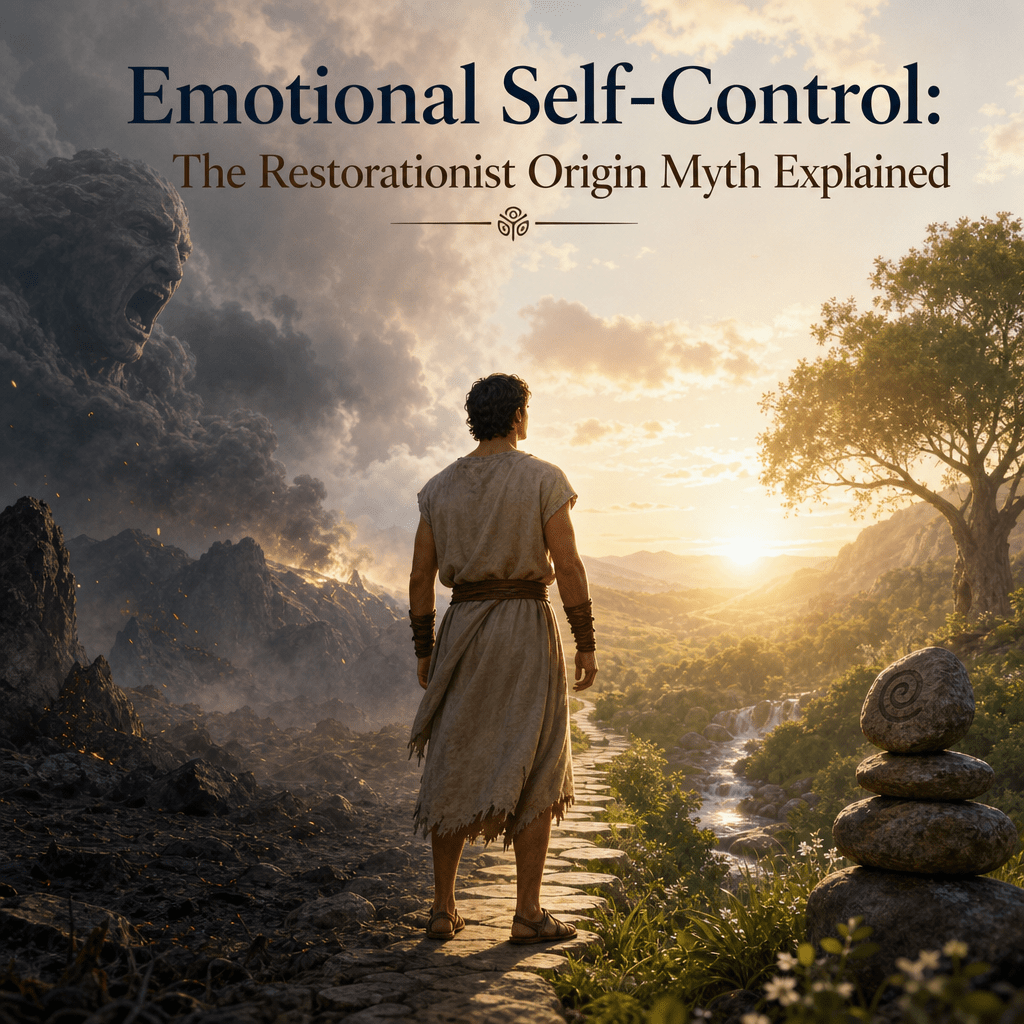
The storm was not just emotional. It became physical.
His nerves stayed raw. His sleep broke apart. His reactions were no longer chosen; they were automatic. He was no longer responding to life so much as being dragged by it. In that state, emotions were not visitors. They were rulers.
Like many people trying to survive unbearable inner pressure, he looked for relief wherever he could find it:
- alcohol to blunt the edges
- cigarettes to steady the nerves
- Xanax to quiet the panic
Each brought temporary relief. Each promised a small escape. But each also deepened the trap.
What began as coping slowly became dependency. The storm did not disappear. It simply changed its shape.
For anyone interested in the deeper civic meaning of this story, the larger argument aligns with Moral Grammar: Stunning Best Guide to Civic Character, where inner order is treated as the foundation of public life.
For a broader historical and practical frame on discipline, readers may also find the National Institute on Drug Abuse overview of benzodiazepines helpful: NIDA’s benzodiazepines research summary.
The Moment Everything Turned
The turning point was not dramatic in the way people like to imagine. There was no cinematic rescue. No sudden miracle. No one arrived to fix him.
Instead, he arrived at a harder truth: no one was coming to save him.
That realization can feel brutal, but it is also the beginning of freedom. If healing is going to happen, it has to be built. If peace is going to exist, it has to be practiced. If a life is going to be restored, the work must begin from within.
This is where Emotional Self-Control enters the story—not as a luxury, but as a necessity.
And it is also where the Restorationist vision begins to take shape: the conviction that a person must learn to rule the inner life before they can hope to contribute to a stable common life. The same principle appears in Citizen Sovereignty: Stunning Path to Self-Governance, where self-command is tied to moral agency.
The Long Climb Back
He began the climb in stages.
First came alcohol. Then cigarettes. Then the hardest mountain of all: Xanax. The taper lasted a year and a half. That is not a minor inconvenience. It is a prolonged confrontation with fear, weakness, and the body’s dependence on relief.
For a year and a half, he lived with:
- shaking hands
- sleepless nights
- panic waves
- emotional collapse
- the temptation to quit
There was nothing glamorous about it. No instant transformation. No easy breakthrough. Just a daily refusal to surrender.
And that daily refusal mattered.
Every day he made one small act of self-command. Every day he held the line a little longer. Every day he chose not to let the emotion dictate the reaction. That is how a person rebuilds an inner life: not all at once, but brick by brick.
In practical terms, Emotional Self-Control grew through repetition. He did not wait to feel strong before acting strongly. He acted, and strength followed. The same pattern appears throughout recovery, whether someone is changing habits, managing stress, or learning to stay present when the mind begins to spiral.
Emotional Self-Control is never merely about stopping a bad habit. It is about learning how to bear discomfort without immediately reaching for escape. It is about creating enough inner space to choose well.
That long season of struggle also taught an important lesson about patience. Real change often looks unimpressive while it is happening. It is quiet, repetitive, and uncertain. There are no headlines for the morning after a sober night, no applause for the decision to endure one more anxious hour, no public ceremony for resisting the impulse to numb out. Yet those hidden decisions accumulate into character.
In that sense, the story is not only about addiction or withdrawal. It is about the construction of will. Each setback clarified the cost of surrender. Each small victory proved that the self could be trained. And each hard day reinforced the central truth that Emotional Self-Control is built through practice, not preference.
He had to learn how to breathe through panic without obeying it. He had to let the wave pass without calling it destiny. He had to discover that the body can be distressed while the person remains steady. That distinction is one of the most important parts of recovery, because it separates temporary sensation from final authority.
Many people assume that strength means the absence of fear. In truth, strength often means continuing while fear remains present. That is what made the year-and-a-half taper so significant: it was not simply a medical process, but a moral one. It demanded honesty, humility, endurance, and a willingness to be uncomfortable for as long as necessary.
What He Rebuilt Was Grammar
The phrase “moral grammar” sounds abstract until you understand what it means in practice. Grammar is the structure that makes language intelligible. Without it, words scatter into noise.
A person’s inner life works the same way.
If impulses rule everything, the self becomes chaotic. If reactions happen without reflection, meaning disappears. If emotion always gets the final word, then the soul has no structure.
He came to see that discipline was not punishment. It was architecture.
He was rebuilding:
- the ability to pause
- the ability to choose
- the ability to endure discomfort without collapse
- the ability to act from principle rather than impulse
That is Emotional Self-Control at its deepest level. Not suppression. Not numbness. Governance.
This is also why the story is not just psychological. It is civilizational. The same habits that make an individual stable also make a community durable. When people can govern themselves, they can live with greater trust, restraint, and responsibility.
Emotional Self-Control does not erase feeling. It orders feeling. It gives emotion its proper place instead of allowing it to seize the throne. That ordering matters because human beings are not machines. We feel deeply, we react quickly, and we often explain ourselves after the fact. The work of restoration is to slow that process down long enough for wisdom to enter.
He learned that a person can be wounded without becoming ruled by the wound. He learned that pain can teach, but only if it is met with discipline. He learned that the self is not healed by denial, but by structure, consistency, and truth. Those are grammar-like qualities: they make meaning possible where there was once only noise.
That is why the Restorationist origin myth insists on more than survival. Survival alone is not the end. The end is restored order. The end is a person who can stand in the middle of uncertainty and still answer to principle. The end is a life that no longer confuses impulse with identity.
From Personal Recovery to a Larger Idea
As the storm lost its power, something else became visible. His suffering was not merely private. It revealed a broader truth.
A person is only truly free when they can govern themselves.
That insight expanded outward. A society filled with people who cannot govern their emotions becomes fragile. A republic built on undisciplined citizens cannot remain strong for long. Institutions matter, but they rest on character. Laws matter, but they depend on conscience. Civilization itself needs internal order.
This was the seed of Restorationism.
Not ideology. Not theory. Not a slogan. A lived conclusion born from pain, discipline, and recovery.
It is also why the Restorationist tradition keeps returning to the formation of character. The question is never only, “What did the man survive?” The deeper question is, “What did survival teach him about human nature?” The answer was simple and severe: without self-government, there can be no lasting freedom.
That idea connects directly to broader work on public character, including Civil Formation: Stunning Calm Strength for Best Living and The Restorationist Project • Education Series, both of which explore how habits, discipline, and formation shape a society over time.
Once this broader frame becomes clear, the private story takes on public weight. The recovery was not just about getting through the night or making it to the next morning without falling apart. It became a witness to something larger: the truth that a republic depends on people who can tell the difference between feeling and command, between impulse and duty, between the moment and the long term.
That is why the story refuses to remain merely therapeutic. It reaches into ethics, politics, and culture because the same inner habits shape all three. A person who cannot govern frustration may become unreliable in family life, unstable in work, and reckless in civic life. A person who learns restraint can become steadier in every sphere.
The Core Lesson of Restorationism
The Restorationist origin myth is not about perfection. It is about restoration. It says that a broken inner world can be rebuilt. It says that peace is earned. It says that freedom is not the absence of struggle, but the capacity to rule oneself within it.
Its central lesson is simple:
- discipline creates freedom
- self-command creates stability
- moral grammar creates strength
The man walked through the storm and found his grammar there. Not because the storm was good, but because survival forced him to learn what structure means. In the end, he did not just get clean. He got clear. And in that clarity, he discovered what he believed a life—and a republic—must have to endure.
That is why Emotional Self-Control is more than a coping skill. It is a kind of citizenship of the self. It teaches a person how to remain answerable to principle when the body demands relief and the emotions demand immediate release.
It also teaches humility. No one escapes weakness by willpower alone. No one becomes stable without struggle. But struggle can become fruitful when it is governed by purpose. In that sense, discipline is not a rejection of humanity. It is a defense of it. It protects the person from being consumed by every passing fear or appetite.
Restorationism takes that defense seriously. It treats the inner life as a place where order must be rebuilt, maintained, and honored. That is not sentimental language. It is hard language. It asks for restraint, patience, confession, and follow-through. It asks for a person to become trustworthy to themselves first, so they may become trustworthy to others.
Why Emotional Self-Control Matters
Emotional Self-Control matters because life will always contain pressure. No one escapes disappointment, fear, grief, temptation, or uncertainty. The real issue is whether those pressures will govern the person experiencing them.
Without Emotional Self-Control, a person may become reactive, exhausted, and easy to sway. With it, the same person can become stable enough to think clearly, respond wisely, and keep faith with long-term goods.
That difference matters in ordinary life:
- in a hard conversation, it keeps anger from becoming cruelty
- in a crisis, it keeps panic from erasing judgment
- in recovery, it keeps cravings from becoming commands
- in civic life, it keeps impulse from masquerading as principle
It also matters in the hidden life, where no audience is present. A person becomes stronger when they can sit with discomfort without immediately fleeing it. That is why habits, routines, and disciplined self-observation matter so much. They train the soul to remain in command.
There is also a deeper reason Emotional Self-Control matters: it protects freedom from collapse. Liberty without self-government becomes indulgence, then instability, then dependency. People often speak as if freedom means doing whatever one feels in the moment, but that is only another form of captivity. Real freedom is the capacity to choose what is right even when what is easy is tempting.
That is why the story keeps returning to the language of command, governance, and rule. Those words are not accidental. They describe the structure of a life that no longer belongs to appetite. They describe the hard-won ability to remain present, accountable, and oriented toward a future that is bigger than the next urge.
The Broader Restorationist Vision
Restorationism begins with one person’s recovery, but it does not end there. It asks what happens when self-governance is no longer treated as optional. It asks what kind of culture can be built when people understand that inner order is not a private luxury but a public necessity.
That is why the story remains compelling. It is not only about one man climbing out of a personal abyss. It is about what his climb reveals: that suffering can become instruction, that discipline can become freedom, and that a disciplined self can become the starting point for a stronger republic.
If you want the shortest version of the Restorationist origin myth, it is this: a man could not find peace until he learned to govern himself. Once he did, he saw that the same truth applied beyond his own life. Emotional Self-Control was not just the end of a breakdown. It was the beginning of a philosophy.
That philosophy is patient but demanding. It does not promise ease. It promises clarity. It does not pretend that pain is good. It insists that pain can be made meaningful. It does not deny weakness. It teaches that weakness can be met with structure. The result is not perfection but restoration: a self that can bear weight, a life that can withstand pressure, and a people more capable of sustaining liberty.
What the Storm Teaches About Human Nature
The storm teaches that human beings are vulnerable to their own inner weather. We are not neutral systems. We are creatures of memory, appetite, fear, habit, and hope. When any one of those powers goes ungoverned, the whole person can tilt.
That is why Emotional Self-Control cannot be reduced to positive thinking. It is not a slogan. It is a practice of ordered attention. It means noticing the first tremor of panic before panic becomes policy. It means recognizing the difference between an emotion and an instruction. It means refusing to let the loudest feeling define the whole reality.
The Restorationist story is powerful because it refuses sentimental shortcuts. It does not say that the man simply believed harder. It says he endured. He endured withdrawal, fear, and exhaustion while learning that endurance itself can become a teacher. That truth is difficult, but it is also liberating. It tells us that character is not inherited whole. It is built under pressure.
Discipline as a Form of Mercy
Many people hear the word discipline and think only of severity. But in this story, discipline is a mercy. It is the mercy of boundaries, the mercy of structure, and the mercy of not allowing every impulse to become law.
Without discipline, the man remained at the mercy of every wave. With discipline, he gained a place to stand. That place was not comfort. It was steadiness. And steadiness, over time, became peace.
This is one reason Emotional Self-Control deserves attention beyond self-help language. It is deeply humane. It protects the person from collapse by giving them a way to carry pain without becoming pain. It allows grief without despair, fear without surrender, and desire without servitude.
In ordinary life, this looks small. A pause before speaking. A walk instead of a rage. A night of restraint. A choice to endure instead of escape. But these small acts are how a life changes shape. They are the practical grammar of a restored soul.
Inner Order and Public Life
The Restorationist origin myth insists that the boundary between private character and public life is thinner than people think. A nation does not become ordered by accident. It reflects the habits of the people within it.
If citizens can govern themselves, then laws can function more lightly because conscience does some of the work. If citizens cannot govern themselves, then institutions must strain to hold what character should have carried. That is a costly and unstable arrangement.
This is why Emotional Self-Control matters politically as well as personally. It makes a person harder to manipulate, less likely to panic, and more capable of long-term judgment. It encourages civil speech, patient listening, and moral endurance. Those are not just personal virtues. They are civic ones.
The same recovery that helps a person step away from addiction can also help a republic step away from chaos. The same discipline that steadies one mind can help steady a family, a neighborhood, or a nation. Restorationism takes that continuity seriously.
The Restorationist Inheritance
The man walked through the storm, and the storm became instruction. What he found there was not comfort but meaning. He learned that peace is built, that freedom must be guarded, and that the self requires structure if it is to remain free.
That is the inheritance of the Restorationist origin myth. It is an account of suffering transformed into wisdom, and wisdom transformed into a way of life.
Emotional Self-Control stands at the center of that inheritance because it names the practice that made restoration possible. It is the discipline of not surrendering the self to every passing force. It is the quiet art of remaining governed when life presses hard. It is the beginning of maturity, the basis of trust, and the hidden architecture of any durable republic.
In the end, the story is both personal and public. One man learned to survive his own storm. In doing so, he discovered a principle that reaches far beyond his life: people who cannot govern themselves cannot easily remain free, and people who learn self-government can begin to build something worthy of the name civilization.
That is why the myth endures. It does not flatter us. It instructs us. It says that the hard road matters, that discipline can redeem pain, and that the deepest kind of strength is the kind that can quietly hold the line.