
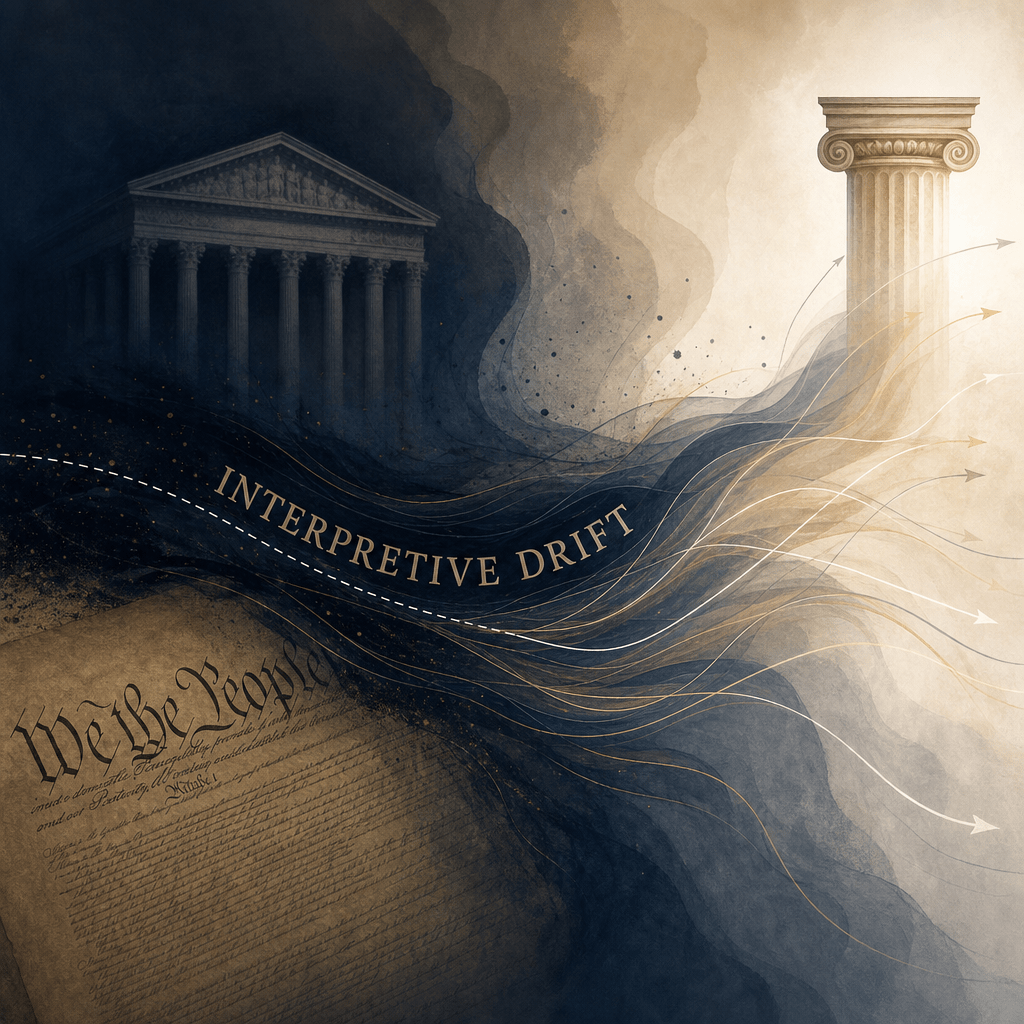
Interpretive drift is one of the most important and most misunderstood forces in constitutional law. It happens when the meaning of a text changes over time without formal amendment, so that the words remain the same while their legal force quietly expands, contracts, or shifts in a new direction. The Constitution may still be printed in the same language, but if judges and lawyers no longer read its phrases as the ratifying public understood them, then the document is no longer governing in the same way. That is the central warning of this chapter: the Marshall Court did not simply interpret the Constitution. It helped rewrite it through interpretive drift.
The Constitution as a Grammar of Power
A written constitution functions much like grammar does in language. Grammar establishes boundaries, relationships, and rules that make meaning possible. If those rules are changed without notice, the sentence still looks familiar, but what it means is no longer the same. The same is true of constitutional interpretation. The words ratified by the people were not intended as vague suggestions. They were the legal structure of the republic.
This is why original public meaning matters so much. A constitution is not a living draft to be revised by each new generation of judges. It is the highest law because it fixes the terms on which government operates. When courts treat those terms as flexible material, they do more than interpret. They alter the conditions under which power is exercised.
Interpretive drift is therefore not a harmless side effect of constitutional development. It is a mechanism by which power changes hands without the visible consent of the governed. The result may appear orderly, even respectable, because it arrives clothed in precedent and legal language. But familiarity is not legitimacy.
This problem is not limited to one clause or one era. Once a court normalizes a new reading of a word like “necessary” or “commerce,” the rest of the legal system begins to build around that interpretation. Lawyers cite the case, judges rely on the citation, and institutions arrange their conduct around the precedent. What begins as a judicial gloss hardens into constitutional assumption. That is interpretive drift in motion: the text stays put, but the meaning moves.
Marshall’s Foundational Cases
Three Marshall Court decisions sit at the center of this discussion.
Marbury v. Madison established judicial review and elevated the Supreme Court as the final authority on constitutional meaning.
McCulloch v. Maryland broadened the Necessary and Proper Clause by interpreting “necessary” to mean something closer to “convenient” or “useful” than strictly essential.
Gibbons v. Ogden expanded the Commerce Clause in a way that opened the door to federal regulation far beyond the narrow founding-era understanding of trade.
Together, these decisions helped create a new constitutional order. From a Restorationist perspective, the problem is not that the Court offered interpretations. The problem is that these interpretations became foundational even though they were not plainly demanded by the text itself. Once that happened, later courts could extend the same logic further, and each extension would seem natural because it rested on an earlier judicial premise.
That is the subtle power of interpretive drift. Courts rarely announce that they are departing from the Constitution. Instead, they present their move as a faithful elaboration. But if the elaboration changes the legal force of the words, the drift has already begun.
Why Interpretive Drift Matters
Interpretive drift matters because it usually happens gradually. A court shifts one definition here, broadens one clause there, and before long an entirely different constitutional system has emerged without any amendment being passed.
That creates serious consequences:
– Democratic bypass: the people lose their role in constitutional change.
– Doctrinal stacking: later rulings build on earlier distortions, compounding the original error.
– Institutional supremacy: the judiciary begins to function as the true source of constitutional authority.
This is not just a matter of legal style. It changes who governs. A constitution that can be reshaped case by case, without amendment, gradually ceases to be a fixed charter and becomes a record of accumulated interpretation. That is why interpretive drift is such a serious constitutional concern: it marks the point where interpretation stops serving the text and begins replacing it.
It also explains why disputes over constitutional meaning are never merely academic. Once one generation accepts a revised reading, the next generation inherits that revision as settled law. A doctrine born of convenience becomes a doctrine defended as tradition. By then, the original question is often forgotten, and the drift is no longer recognized as drift at all.
Marbury and the Rise of Judicial Supremacy
Marbury v. Madison is usually praised as the case that clarified judicial review. But the deeper issue is not whether courts may compare statutes to the Constitution. The real question is whether the Supreme Court becomes the final and binding interpreter for all branches.
The Constitution does not plainly say that it does. Yet Marbury helped establish exactly that assumption. Once the Court became the ultimate arbiter of meaning, constitutional limits grew increasingly dependent on judicial discretion. That development did more than resolve one dispute. It made later expansions of power much easier to defend.
When the Court is treated as the last word, constitutional argument becomes less democratic and more self-referential. In that environment, interpretive drift is not merely possible. It becomes the operating system.
Marshall’s opinion also helped define the role of the judiciary as more than a dispute resolver. It encouraged the idea that judges do not simply apply the law, but authoritatively define the scope of everyone else’s authority. That is a profound institutional shift, and it is another example of interpretive drift: the drift does not only affect the meaning of a clause. It can also attach to the role of the institution that reads the clause.
McCulloch and the Redefinition of “Necessary”
If Marbury changed who interprets, McCulloch changed how power expands. Marshall’s reading of the Necessary and Proper Clause turned a bounded grant of implementation authority into a broad source of implied federal power.
This is the heart of interpretive drift in constitutional law. A term that once helped limit power became a justification for enlarging it. Once “necessary” could mean “convenient” or “useful,” the door opened for national authority to grow in ways the text itself never enumerated.
That change mattered in practice, not just in theory. The new interpretation gave future courts a ready-made rationale for finding implied authority where the text listed none. It allowed the federal government to expand without the amendment process ever being invoked. The word did not change on the page. Its legal effect changed in the hands of interpreters.
Marshall’s famous line—“we must never forget that it is a constitution we are expounding”—is often treated as a warrant for flexibility. The Restorationist reading sees it differently. Because it is a constitution, its language deserves stricter fidelity, not looser control. The whole point of a constitution is that it is not supposed to be updated by judicial convenience.
If “necessary” can mean merely “helpful,” then virtually any implied power can be defended, and enumeration stops doing real limiting work. That is not a minor adjustment. It is a structural revision. And once structural revision arrives through interpretation rather than amendment, the republic has crossed from textual governance into judicial governance.
Gibbons and the Endless Commerce Clause
Gibbons v. Ogden widened the federal sphere further by giving “commerce” a broad reading. The case itself involved interstate navigation, which was a reasonable subject for federal regulation. But the framework Marshall used made later expansion almost inevitable.
What began as regulation of trade among states eventually supported federal control over nearly any economic activity that might affect commerce in the aggregate. That trajectory is the practical cost of interpretive drift. Once the line moves, later courts rarely move it back.
The danger is not limited to the Commerce Clause. The same habit can spread throughout the constitutional system. If one clause can be redefined to fit changing institutional needs, then every clause becomes vulnerable. The written Constitution remains in place, but its controlling meaning migrates elsewhere.
This is why commerce cases matter so much. A plausible interpretation can become the foothold for an implausibly large system. Interstate navigation plainly involved commerce among the states. But once the term was stretched beyond exchange and trade to cover broader economic life, the limiting principle weakened. Later courts could move from shipping to manufacturing, from manufacturing to labor, from labor to production, and from production to nearly anything with downstream effects on the national market.
That chain is a classic illustration of interpretive drift. Each step looks modest in isolation. Taken together, the steps create a new constitutional geography.
Doctrinal Stacking and Modern Expansion
The real danger is not one controversial case. It is the habit of treating judicial constructions as if they were the Constitution itself. When that happens, the written text becomes secondary to the interpretive tradition built on top of it.
That tradition may be powerful, familiar, and widely accepted. But if it departs from the ratified meaning of the words, it is still a departure. Over time, these departures accumulate. One generation of judges relies on the previous one, and the next generation relies on both. The result is doctrinal stacking: a tower of precedent resting on an original interpretive move that may never have been textually justified in the first place.
This is why the Marshall Court matters so much in any serious account of interpretive drift. Once the foundational layer changes, everything built above it inherits the same distortion. Federal power expands, judicial authority hardens, and the constitutional text becomes harder to recover in practice even if it remains easy to quote.
Modern constitutional law reflects this process in many areas. New Deal expansion, administrative deference, and broad federal regulatory power all depend on a legal atmosphere in which Marshall’s expansive constructions were treated as settled starting points. Without those starting points, much of the later structure would have needed a more direct textual justification—or a formal amendment.
How the Drift Becomes Normal
One reason interpretive drift is so powerful is that courts tend to treat precedent as self-validating. A decision that is old, cited often, and woven into institutional life begins to seem right simply because it is established. But established is not the same as original, and convenient is not the same as constitutional.
The longer a doctrine persists, the more difficult it becomes to separate settled law from settled error. That is why interpretive drift should be understood not as a single event but as an accumulation of habits. Courts do not usually announce that they are replacing the Constitution. They say they are refining it, harmonizing it, or applying it sensibly to modern conditions. Yet the cumulative result can still be a different constitutional order from the one the ratifiers adopted.
That is the deeper problem. Once judicial glosses become taken-for-granted assumptions, the public often forgets that a choice was ever made. The doctrine is inherited as if it were part of the original design, and interpretive drift disappears into the background of ordinary legal life.
Restorationist Corrective and Legal Limits
The chapter’s message is direct: constitutional restoration requires returning to the text before adding new layers of doctrine. If the people wish to expand federal power, they can do so through amendment. If courts do it by reinterpretation, the republic loses the distinction between law made by the people and law made by judges.
The Restorationist answer is not reckless overruling for its own sake. It is a disciplined return to original public meaning, coupled with respect for legitimate democratic processes. That means identifying where a doctrine first departed from the text, explaining the departure clearly, and resisting the temptation to treat later accretions as if they were original meaning.
There are also practical limits to what courts can do. They operate inside an inherited legal system shaped by reliance interests, institutional expectations, and public habits of interpretation. A serious corrective must therefore be careful and sequenced. But caution does not mean surrender. It means correction with discipline rather than correction with spectacle.
The core principle remains the same: if the text means something, it must be possible to state that meaning without constantly deferring to whatever result later courts found useful. That is the antidote to interpretive drift.
Conclusion
The lesson of Chapter Three is not that John Marshall was foolish. He was brilliant. But brilliance can still produce distortion. In constitutional law, even small acts of interpretive drift can reshape the entire structure of power.
That is why original meaning matters. Not because history is sacred, but because law cannot remain law if its terms are endlessly rewritten. The Constitution is not whatever the Court says at any given moment. It is a ratified text with fixed language, and the republic depends on that language meaning what it says.
Marshall’s legacy is therefore double-edged. He helped strengthen the Union, but he also helped establish interpretive habits that made constitutional expansion easier than constitutional amendment. Once that habit took root, later generations inherited a legal culture in which the Court’s constructions often mattered more than the Constitution’s words. That is the problem named by interpretive drift, and it remains one of the central constitutional challenges of the modern era.
The next chapter turns to the Reconstruction Amendments and the doctrinal choices that followed them. But before moving on, one lesson should remain clear: if the Constitution is to govern, its grammar must remain its own. Once judges are free to revise that grammar in the name of interpretation, the republic risks losing the very thing the Constitution was written to secure—a government of limited, knowable, and accountable powers.
In the end, interpretive drift is a warning against constitutional amnesia. A people cannot preserve self-government if it forgets which words were ratified, what those words meant, and who was authorized to change them. The Marshall Court did not erase the Constitution. It changed the terms on which the Constitution was read. That difference is subtle in appearance and profound in consequence.
If the republic is to recover its grammar, it must begin by recovering the discipline of reading. Not reading for preferred outcomes, and not reading for inherited assumptions, but reading for meaning. That is the Restorationist task, and it begins where the drift began: with the words themselves.