
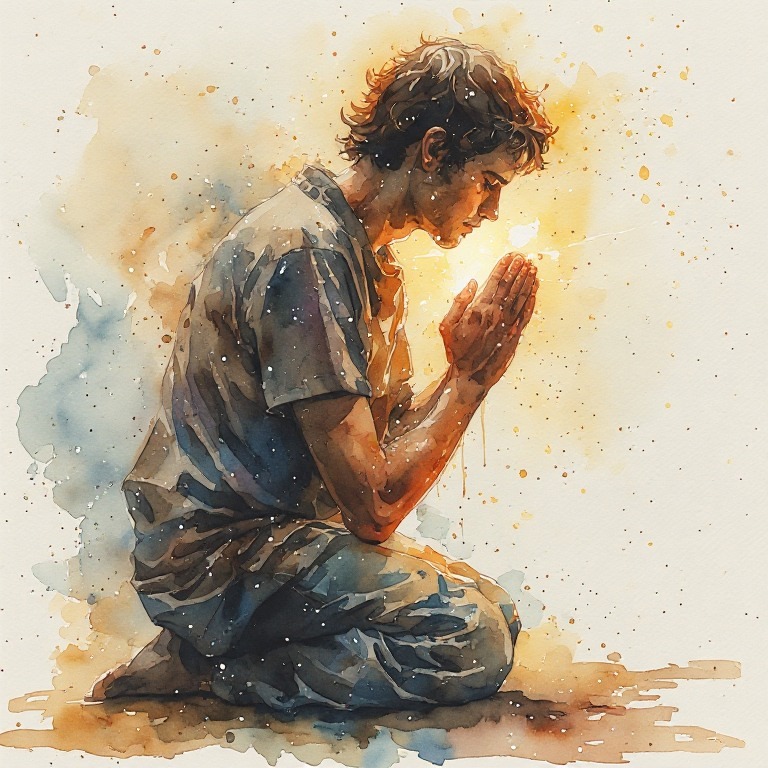
Have you ever wondered what is actually happening when we pray? For centuries, believers have treated prayer as a spiritual lifeline, a way of reaching toward God in moments of need, gratitude, or confusion. Yet modern neuroscience and even the fringes of quantum physics are beginning to reveal that prayer is not only a spiritual act but also a biological technology woven directly into the human design. When we pray with intention, something measurable happens inside the brain and body — something structural, chemical, and deeply transformative.
The essay Rewired by the Sacred explores this idea by showing how prayer reshapes the mind from the inside out. For generations, scientists assumed the adult brain was fixed, its pathways locked in place. We now know this was never true. The brain is constantly rewiring itself through a process called neuroplasticity, forming new connections and weakening old ones based on what we repeatedly think, feel, and do. The old saying “neurons that fire together wire together” is not poetry — it is biology. And the inverse is equally true: pathways we stop using begin to fade. When Paul urged believers to “be transformed by the renewal of your mind,” he was describing a literal biological process long before science had the language to explain it.
Prayer engages this process with remarkable precision. Brain imaging shows that intentional prayer functions like a full‑brain workout. It strengthens the prefrontal cortex — the region responsible for judgment, self‑control, and moral reasoning — giving us greater capacity to act in alignment with the character we aspire to. It quiets the amygdala, the brain’s alarm system, which modern life keeps in a constant state of agitation. Prayer calms this region, offering a neurological exit ramp from anxiety. It also softens the Default Mode Network, the part of the brain that loops us into rumination, self‑pity, and old grudges. In prayer, that loop is interrupted, allowing us to “take every thought captive” not just spiritually, but neurologically.
But the effects of prayer go deeper than structure. Prayer triggers a cascade of neurochemicals that shift the body into a state of peace, clarity, and connection. Serotonin and GABA settle the nervous system. Dopamine heightens motivation and purpose. Oxytocin, often released in communal or corporate prayer, deepens trust and strengthens bonds. These are not abstract spiritual metaphors — they are measurable biological responses that shape how we think, feel, and relate to others.
This internal rewiring also plays a role in dismantling the habits we struggle to break. What theology calls sin, neuroscience often describes as deeply grooved neural pathways — patterns carved by repetition. Addictions, resentments, and reflexive anger are simply circuits that have been reinforced over time. Prayer creates the conditions for synaptic pruning, the brain’s natural process of weakening and dismantling pathways we no longer use. Confession forces us to bring these patterns into conscious awareness. Repentance interrupts the old circuit and begins forming a new one. Gratitude lays down entirely fresh pathways that orient the mind toward peace.
At the edges of science, even quantum physics offers a surprising resonance. A 2025 study suggests that consciousness may arise from the brain’s interaction with the zero‑point field — a universal sea of quantum energy. For believers, this echoes the idea that Christ “fills all in all,” that our minds are not isolated engines but participants in a larger, sustaining reality. Prayer also influences the Reticular Activating System, the brain’s internal filter that determines what we notice and what we ignore. When we pray with clarity and expectation, we tune this filter to recognize opportunities, answers, and moments of grace that we might otherwise overlook.
Building a prayer habit that takes advantage of this divine architecture does not require complexity. What matters most is consistency. A daily practice, even twenty minutes, reshapes the brain far more effectively than occasional marathon sessions. Specificity matters as well; vague prayers create vague pathways, while precise prayers carve precise circuits. Morning prayer is especially potent because the waking brain is uniquely receptive before the day’s noise begins. And varying the form — spoken prayer, silent meditation, Scripture reading, journaling — engages different regions of the brain, strengthening the practice as a whole.
Every time you kneel, speak, or sit in silence before God, you are not merely performing a ritual. You are participating in the rewiring of the three‑pound universe inside your skull. You are shaping the pathways that determine your reactions, your habits, your peace, and your character. Prayer is not only communion with God; it is cooperation with the way He designed the human mind to grow, heal, and transform.