
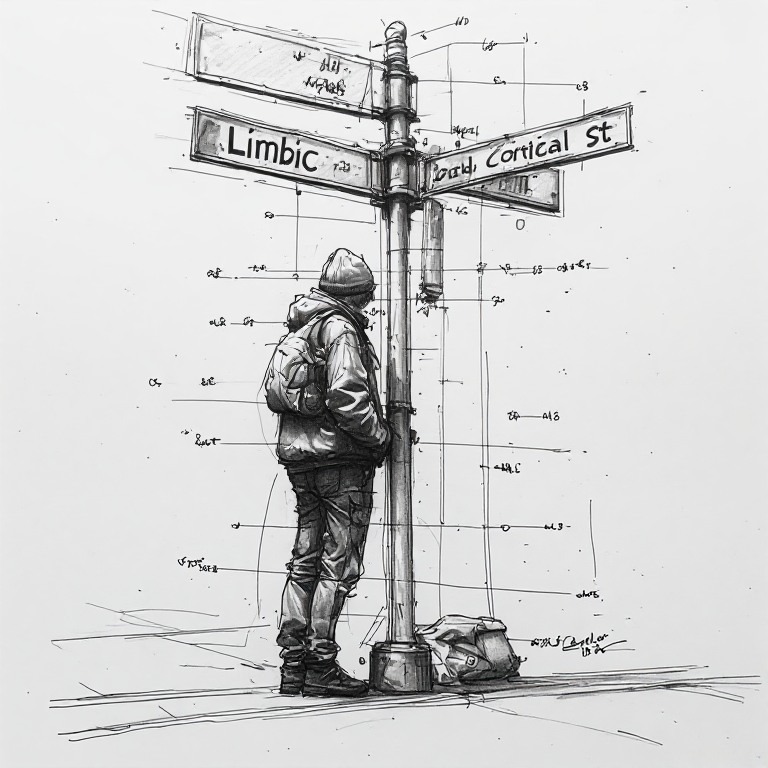
When The Mechanism Falters But The Pattern Remains
A Restorationist Reassessment of Political Cognition After the Replication Crisis
The first page of this series argued that political cognition is limbic-first — that the emotional systems fire before the reasoning systems even begin their work. That claim stands. It is one of the most consistently replicated findings in cognitive science. But intellectual honesty requires a second admission: the specific neuroscientific studies that attempted to map those limbic differences onto discrete brain regions may not survive the replication crisis. The early claims about amygdala dominance on one side and insula dominance on the other were built on small samples, noisy fMRI data, and statistical models that may have been more confident than the evidence justified. A Restorationist analysis begins by acknowledging that fragility.
Yet fragility of mechanism is not the same as fragility of phenomenon. Even if the neural mapping is revised or overturned, the behavioral asymmetry those studies attempted to explain refuses to disappear. It shows up everywhere political behavior is measured: in physiology labs, in crowd‑behavior research, in political mobilization patterns, in cross‑cultural anthropology, in threat‑sensitivity experiments, in harm‑perception studies, and in the lived reality of political conflict itself. Conservatives and progressives do not merely disagree on issues. They animate differently under political activation. This is not metaphor, not rhetoric, not cultural habit. It is an observable, measurable, and remarkably stable pattern.
When conservatives perceive threat, their behavior moves inward. They reinforce boundaries, seek structure, rely on institutions, and gravitate toward known-group trust networks. When progressives perceive harm, their behavior moves outward. They approach the source, gather collectively, escalate through visible presence, and express solidarity with those they believe are affected. These are not ideological choices. They are behavioral consequences of different activation pathways. The mechanism may be debated; the divergence is not.
This is why the pattern persists even when the neuroscience wobbles. The early fMRI studies tried to explain the asymmetry by pointing to specific neural regions. Perhaps they were right. Perhaps they were partly right in a way that will be refined over time. But the behavioral divergence does not depend on the amygdala–insula split. It appears in startle reflex amplitude, in skin conductance, in heart‑rate variability, in comfort with crowds, in the channels through which each side organizes, and in the emotional direction each side moves when activated. Different methods, different populations, different decades — and the same architecture emerges. Threat pulls one side inward. Harm pulls the other outward.
This reframes the divide. Political disagreement is not primarily about facts or values. It is about which limbic system activates first, and what that activation compels the body to do. The conservative nervous system interprets disorder as danger and responds by tightening the perimeter. The progressive nervous system interprets visible harm as moral urgency and responds by moving toward the scene. Each side believes it is responding to reality. Each side is, within its own frame.
The tragedy is that each side’s normal behavior is the other side’s primary escalation trigger. The progressive crowd that feels like moral solidarity to one nervous system feels like disorder and contamination to the other. The conservative institutional response that feels like necessary containment to one nervous system feels like suppression and indifference to the other. Neither side intends escalation. Both sides produce it automatically. They are not escalating each other because they are malicious. They are escalating each other because their nervous systems are calibrated to opposite signals.
A Restorationist must therefore conclude that the collapse of a study does not collapse the architecture. The early neuroscience may be revised, corrected, or replaced, but the behavioral asymmetry remains exactly where it has always been: in the open, observable world. Political conflict is not a disagreement between two reasoning systems. It is a collision between two limbic architectures that respond to different triggers and produce opposite behavioral outputs. If the neuroscience changes, the theory adapts. If the behavioral pattern remains — and it does — the theory stands.
Page One established the emotional foundation. Page Two establishes the behavioral divergence. The next step, when we turn to it, is the design question: if the divide is structural rather than moral, what kind of political architecture could reduce escalation rather than amplify it? That is the Restorationist challenge that follows from everything laid out here.