
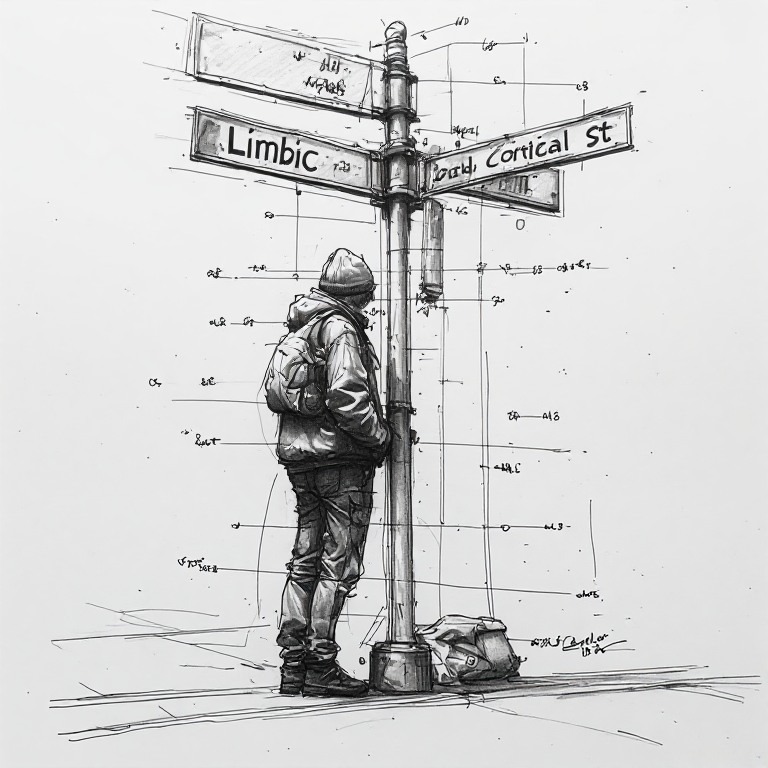
Designing for Stability in a Limbic Age
A political architecture that reduces escalation rather than amplifying it must begin from the one truth the data refuses to let us escape: the divide is structural, not moral. If the nervous systems on each side are activated by different signals and produce opposite behavioral outputs, then any political design that assumes symmetry, sameness, or interchangeable cognition will fail by design. The system will keep generating conflict because the system is built on the wrong model of the human beings inside it.
A Restorationist architecture begins by accepting the asymmetry rather than trying to wish it away. It treats political cognition the way an engineer treats load distribution: not as a matter of preference, but as a matter of physics. If one side’s nervous system interprets disorder as threat and the other interprets suppression as harm, then the architecture must be built to prevent each side’s normal behavior from triggering the other’s escalation reflex. That is the central design constraint.
The first requirement is separation of activation environments. A system that forces both sides into the same arena at the same moment — the same nationalized fight, the same televised spectacle, the same zero‑sum referendum — guarantees limbic collision. A healthier architecture distributes political conflict downward, into smaller, local, lower‑temperature environments where the amygdala’s threat signal is weaker, and the insula’s harm signal is less amplified by mass visibility. Localism is not nostalgia; it is de‑escalation by design.
The second requirement is differentiated channels of political expression. If one nervous system expresses activation through institutions and the other through collective mobilization, then a system that privileges only one channel will always feel illegitimate to the other. A Restorationist architecture would formalize both channels: institutional pathways that conservatives trust, and participatory, deliberative, community‑based mechanisms that progressives trust. The goal is not to merge them but to give each side a legitimate outlet that does not automatically trigger the other’s alarm system.
The third requirement is temporal buffering. Limbic activation is fast; deliberation is slow. A system that allows immediate translation of limbic energy into policy — whether through mass protest forcing rapid action or through rapid institutional crackdowns — guarantees escalation. A healthier architecture inserts structured delay: cooling periods, multi‑stage decision processes, and staggered veto points that force the nervous system to hand the problem back to the cortex before action becomes irreversible. This is not obstruction; it is neurological hygiene.
The fourth requirement is cross‑cutting identities that dilute limbic sorting. When all political conflict is nationalized, identities collapse into two camps, and the nervous system begins to treat politics as existential. But when people belong to overlapping, non‑aligned communities — local boards, professional associations, religious groups, civic organizations — the limbic system loses its clean enemy map. The architecture must therefore encourage multiplicity rather than funneling everyone into a single binary conflict.
The fifth requirement is institutional opacity to limbic triggers. A system that broadcasts every conflict in high‑definition, real‑time emotional intensity is a system designed to keep the insula and amygdala in a state of permanent activation. A healthier architecture reduces the visibility of conflict, not to hide it, but to prevent the nervous system from interpreting every disagreement as a crisis. Deliberation behind closed doors is not undemocratic; it is a recognition that the human nervous system cannot metabolize constant political spectacle without escalating.
The sixth requirement is a structural brake on national emotional synchronization. When millions of nervous systems are activated simultaneously by the same stimulus — a viral video, a national protest, a televised confrontation — the system becomes ungovernable. A Restorationist architecture would decentralize authority, reduce the number of issues decided at the national level, and limit the capacity of any single event to activate the entire polity at once. The goal is not fragmentation; it is preventing limbic resonance from becoming a national contagion.
The final requirement is a design for political stability that assumes the nervous system will always win the first round. The architecture must not rely on rationality to restrain emotion; it must rely on structure to restrain emotion. It must be built the way a dam is built: not to eliminate the force of the water, but to channel it safely. A system that expects citizens to be calmer, wiser, or more rational than their biology allows is a system that will fail. A system that expects citizens to be human — and designs around that fact — is a system that can endure.
In short, a political architecture that reduces escalation is one that stops trying to make the two nervous systems behave the same way and instead builds a structure that prevents their differences from becoming mutually triggering. It is not a moral solution. It is not a cultural solution. It is a structural solution to a structural problem.