
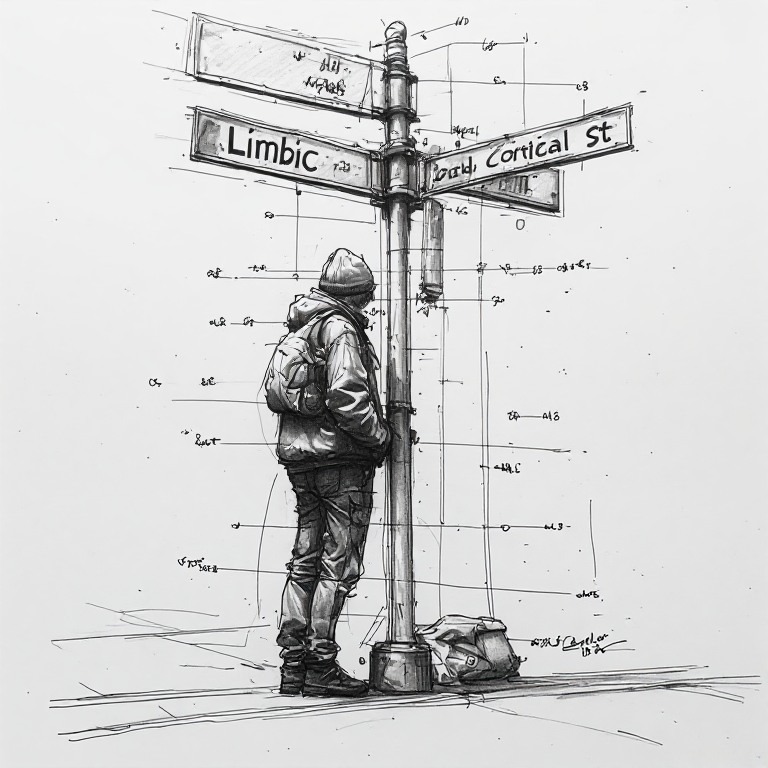
Free Will In A Limbic Species
Any political architecture designed for human beings must begin with an uncomfortable truth: the nervous system fires before the mind does. The limbic system interprets the world in milliseconds, long before the cortex has the opportunity to weigh, reflect, or choose. This raises a question that political theorists rarely confront directly but that any honest framework must address: if humans act from limbic reasoning first, do they possess free will at all?
The answer is yes — but not in the way people imagine. Humans do not possess first‑round free will. The initial reaction, the first emotional interpretation, the first surge of fear or outrage or moral alarm, is not chosen. It is automatic, pre‑conscious, and physiologically determined. It is the product of inherited neural architecture, developmental conditioning, and the emotional learning that shaped the nervous system long before any political argument was ever heard. The first round belongs to biology.
But free will does not disappear simply because the first round is automatic. Free will begins in the second round — in the moment after the limbic system fires, when the cortex finally enters the scene and decides what to do with the reaction it has been handed. The freedom humans possess is not the freedom to choose their impulses. It is the freedom to choose their response to their impulses. That distinction is the hinge on which any realistic political theory must turn.
The problem is that modern political life rarely gives the cortex a chance. A system that demands immediate judgment, immediate outrage, immediate mobilization, or immediate retaliation is a system that collapses the entire behavioral sequence into the limbic round. When the environment is structured for speed, the nervous system governs the whole process. The human being becomes a passenger inside their own biology, carried forward by reactions they did not choose and barely had time to notice.
This is why political rhetoric matters so profoundly. It is why escalation loops matter. It is why governing architecture matters. A political system that constantly activates the limbic system — through existential framing, nationalized conflict, perpetual crisis language, and instantaneous public visibility — is a system that systematically suppresses free will. It forces citizens to act from the first round and never reach the second.
A healthier architecture would do the opposite. It would create the structural conditions under which the cortex can reclaim the wheel. It would slow the pace of political decision-making, distribute conflict downward into smaller and less emotionally charged environments, reduce the visibility of every disagreement, and prevent millions of nervous systems from being activated simultaneously by the same stimulus. It would not expect citizens to be calmer, wiser, or more rational than their biology allows. It would simply give them the time and space required for free will to operate.
In this sense, free will is not merely a philosophical question. It is a design question. It is a matter of political engineering. Humans possess free will, but only after the limbic system fires — and only if the architecture gives the cortex enough room to act. A system that ignores this reality will always produce escalation. A system that respects it can produce stability.
This is the Restorationist premise: if the divide is structural, then the solution must be structural as well. And if the nervous system always wins the first round, then the political architecture must be built for the second.