
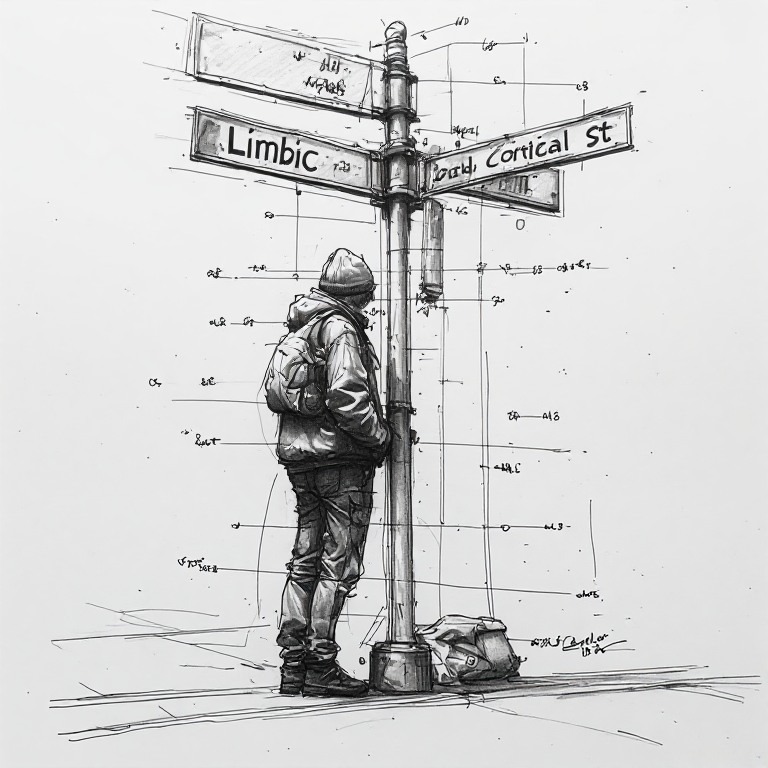
How Leaders Activate Their Bases: The Rhetorical Assymetry
If the nervous systems of conservatives and progressives are calibrated to different signals, then it follows that the rhetoric of their political leaders will not activate their bases in the same way. The divide is not simply in what each side believes, but in what each side feels first, and therefore in what kinds of messages their nervous systems interpret as meaningful, urgent, or mobilizing. This is where the asymmetry in political rhetoric becomes visible — not as a moral failing, but as a structural consequence of two different limbic architectures responding to two different kinds of cues.
Progressive leaders tend to speak in the language of harm, injustice, and existential urgency because their base is animated primarily through the insula, the organ that responds to perceived suffering. When the insula fires, the emotional experience is not mild concern; it is moral alarm. It interprets visible harm as a crisis requiring immediate collective action. Rhetoric that emphasizes emergency, catastrophe, or moral stakes is therefore not an exaggeration within that frame — it is the natural vocabulary of a nervous system that experiences harm as existential. What sounds apocalyptic from the outside often feels proportionate from the inside.
Conservative leaders, by contrast, tend to speak in the language of threat, disorder, and boundary protection because their base is animated primarily through the amygdala, the organ that responds to danger and instability. When the amygdala fires, the emotional experience is not outward urgency; it is inward tightening. It interprets disorder as something to be contained, not something to be marched toward. Rhetoric that emphasizes caution, protection, and the preservation of structure is therefore not avoidance — it is the natural vocabulary of a nervous system that experiences threat as a signal to reinforce the perimeter.
This asymmetry produces a predictable difference in visible emotional intensity. The insula externalizes activation; the amygdala internalizes it. One side expresses urgency through collective mobilization, public demonstration, and moral escalation. The other expresses urgency through withdrawal, institutional reinforcement, and defensive posture. Both sides feel intensely. Both sides are sincere. But the outward expression of that intensity is not symmetrical, because the underlying limbic systems are not symmetrical.
This is why progressive rhetoric often appears, to conservative observers, as over-the-top or catastrophizing. It is not necessarily manipulative; it is simply calibrated to a nervous system that experiences harm as an emergency. And it is why conservative rhetoric often appears, to progressive observers, as emotionally muted or insufficiently responsive. It is not indifference; it is simply calibrated to a nervous system that experiences disorder as something to be stabilized rather than dramatized.
The problem is not that one side’s leaders are reckless and the other’s are restrained. The problem is that each side’s leaders speak in the emotional language their base can hear, and those languages are structurally incompatible. The rhetoric that mobilizes one nervous system is the rhetoric that alarms the other. The rhetoric that feels responsible to one feels inflammatory to the other. The rhetoric that feels proportionate to one feels destabilizing to the other.
This is the structural trap: each side’s leaders, by speaking naturally to their own base, unintentionally escalate the other. Not because they are malicious, but because they are neurologically congruent with their own coalition. The insula hears harm and demands action. The amygdala hears disorder and demands containment. The two systems are not wrong; they are simply built to respond to different signals. But when those signals are amplified through political rhetoric, the result is a feedback loop in which each side’s attempt to mobilize its own supporters becomes the other side’s activation trigger.
A political architecture that hopes to reduce escalation must begin by acknowledging this asymmetry. It must recognize that the problem is not the rhetoric itself, but the nervous systems it activates. And it must design structures that prevent the emotional vocabulary of one coalition from becoming the existential alarm bell of the other. Only then can the republic escape the cycle in which every message meant to energize one half of the country is interpreted as a threat by the other.