America’s Formative Tradition: A Clear Introduction
America did not emerge by accident. It was formed — deliberately, structurally, and with a clarity of purpose unmatched in world history. The Founders built a Republic on principles that were meant to endure, adapt, and guide future generations.
But over time, those principles faded from public memory. The grammar of the Republic — its logic, its architecture, its design — became obscured by noise, bureaucracy, and political theater.
America’s Formative Tradition is the effort to recover that original clarity.
It is not nostalgia. It is not ideology. It is not religion. It is the study and restoration of the ideas that formed the American mind.
This worldview rests on three pillars.
I. The Pillar of Understanding
Most citizens today encounter politics as chaos. Events appear random. Institutions feel opaque. Media amplifies fear instead of clarity.
America’s Formative Tradition begins by restoring understanding — the ability to see the Republic as a coherent structure rather than a confusing spectacle.
This means:
- learning the constitutional architecture
- understanding the design of self-government
- recognizing historical patterns
- seeing institutions as systems
- interpreting events through cause and effect
Understanding is not academic. It is the foundation of citizenship.
A citizen who understands the Republic cannot be manipulated by fear.
II. The Pillar of Sovereignty
Sovereignty is the ability to govern oneself — individually and nationally.
National Sovereignty
A nation must control:
- its borders
- its energy
- its economy
- its alliances
- its institutions
Without sovereignty, a nation becomes reactive — shaped by external forces rather than internal purpose.
Personal Sovereignty
A citizen must control:
- their speech
- their conscience
- their labor
- their family decisions
- their local community
Without personal sovereignty, the citizen becomes dependent — shaped by bureaucracy rather than self-governance.
America’s Formative Tradition insists that sovereignty must be rebuilt from both directions: the nation upward and the citizen downward.
III. The Pillar of Constitutional Design
The American Republic was built with:
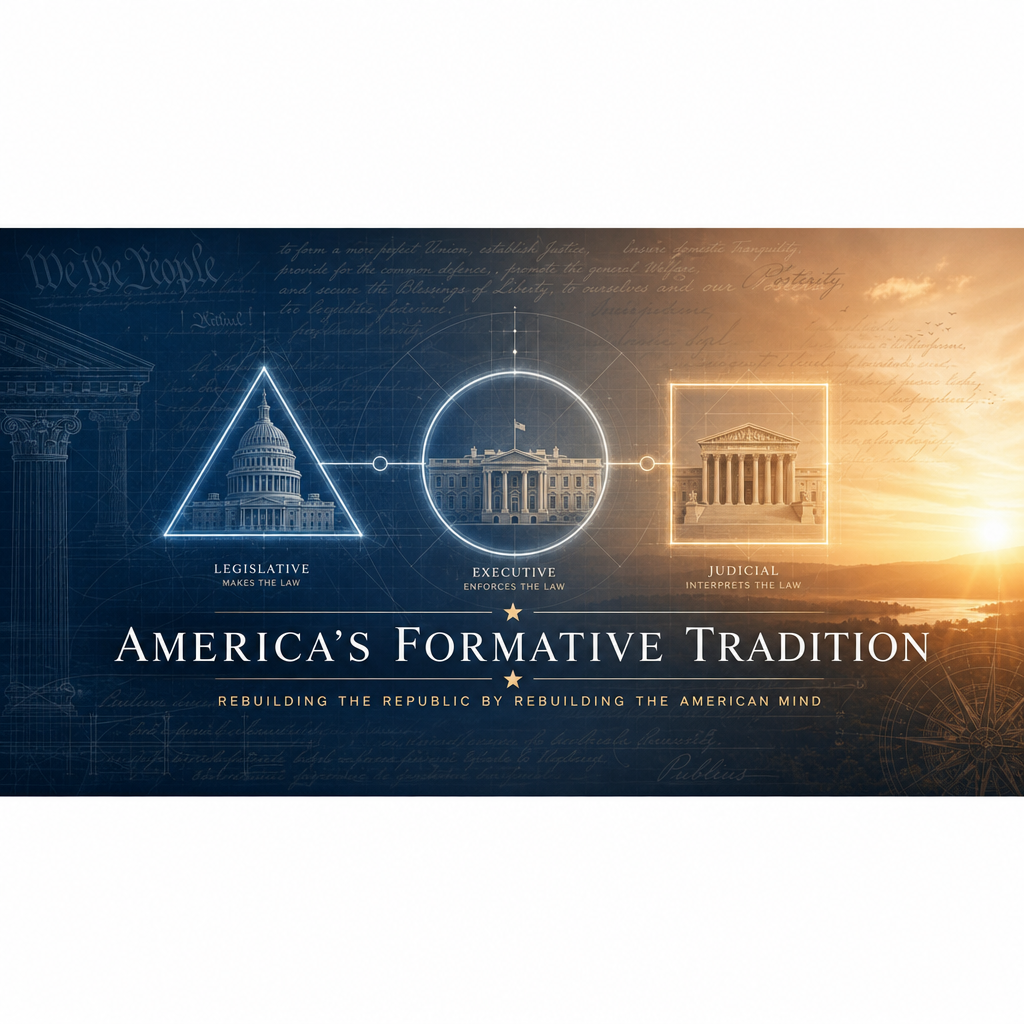
- separation of powers
- checks and balances
- federalism
- civic virtue
- constitutional limits
- citizen participation
These principles have eroded under:
- administrative sprawl
- judicial overreach
- legislative stagnation
- cultural fragmentation
- media manipulation
America’s Formative Tradition seeks to restore the Republic by returning to its original grammar — the structural logic that made it resilient.
This is not a return to the past. It is a return to the principles that allow a free people to govern themselves.
IV. How This Worldview Interacts With Modern Models
America’s Formative Tradition is not Promethean Action. It is not Project 2025. But it uses both as tools.
Promethean / LaRouche Model
Explains the global system — the geopolitical architecture America must navigate.
Project 2025
Explains the domestic system — the administrative machinery America must rebuild.
America’s Formative Tradition
Explains the purpose — why rebuilding matters and what it must achieve.
Promethean = the world Project 2025 = the government Formative Tradition = the mission
V. The Formative Citizen
A citizen shaped by America’s Formative Tradition:
- seeks understanding over fear
- seeks sovereignty over dependency
- seeks structure over chaos
- seeks clarity over confusion
- seeks the Republic over the empire
This worldview is not about anger. It is about rebuilding.
It is the work of citizens who refuse to surrender the Republic to confusion, bureaucracy, or global drift.
America’s Formative Tradition is the project of our time. And every citizen who chooses clarity becomes part of it.
Leave a Reply