
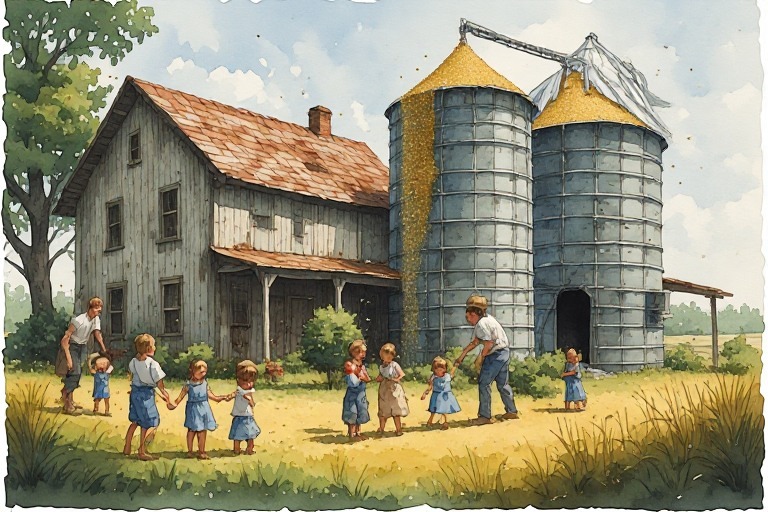
A Restorationist Essay Segment
The ascent of man did not begin in the laboratory or the observatory. It began in the household — the smallest functional economy — where sunup‑to‑sundown labor carved the first human rhythms into the world. Before cities, before writing, before the first stone temple rose from the earth, the human day was defined by light. Dawn opened the work‑window; dusk closed it. Every hour between was consumed by the raw mechanics of survival.
In this early world, the family was not a sentimental construct but a load‑bearing system. Men contended with the resisting ground — plowing, herding, building, defending. Women sustained the continuity of life — bearing children, preparing food, maintaining the fire, preserving knowledge through memory and repetition. The household was the first division of labor, the first specialization, the first economy. It was here that humanity learned the foundational truth of civilization: no one survives alone, and no one advances without others carrying part of the load.
But specialization does more than distribute labor. It produces surplus. And surplus is stored time.
When a household produced more grain than it consumed, more cloth than it wore, more stability than it needed to merely survive, something unprecedented occurred: time opened. For the first time in human history, not every waking hour was consumed by the struggle against entropy. A margin appeared — a cognitive buffer — and within that buffer, a new kind of human emerged.
The first cognitive specialists were not scientists in the modern sense. They were priests.
In every early civilization, the priestly class became the first humans with socially protected leisure. They alone possessed a legitimate reason not to labor in the fields: the gods required their attention. This exemption was not arbitrary. A society with surplus needed someone to track the seasons, interpret anomalies, maintain ritual calendars, preserve genealogies, arbitrate disputes, and guard the stories that held the community together. These tasks required time, memory, and pattern recognition — the earliest forms of scientific thinking.
Thus the priest became the first astronomer, because someone had to watch the sky. The priest became the first mathematician, because someone had to measure the year. The priest became the first physician, because someone had to understand the body. The priest became the first historian, because someone had to remember. The priest became the first philosopher, because someone finally had the hours to ask why.
Surplus created leisure. Leisure created inquiry. Inquiry created the priesthood. And the priesthood created the first architecture of knowledge.
This is not an accident of culture but a structural inevitability of Genesis itself. Ability awakened the mind; resistance shaped it; surplus freed it; and the priesthood focused it. The earliest clergy were not merely religious figures — they were the first cognitive warriors, the first humans to step beyond the sunup‑to‑sundown cycle and devote their days to understanding the world rather than merely surviving it.
From their watchtowers of time, humanity’s long ascent began.