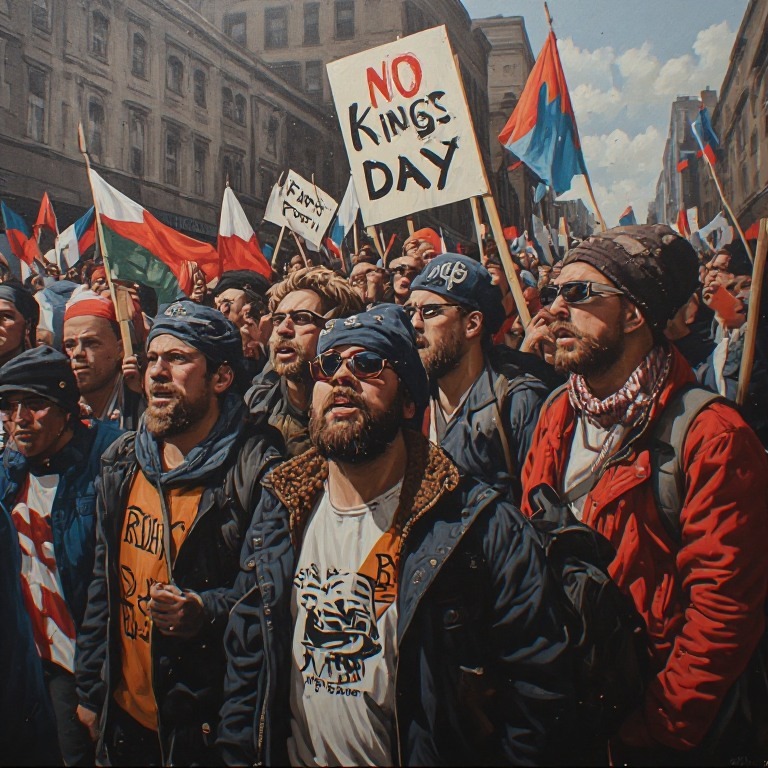
As I watch the preparations for the “No Kings Day” protests, I’m struck by the feeling that multitudes are missing an important meaning.
I contend that most protestors will have no idea that what they’re protesting is the real power of an energetic, “Unitary Executive” with complete Article II powers granted by our US Constitution. What feels like an abuse of Presidential authority is, in fact, the shock of seeing a real President in action. In fact, protestors invoke constitutional ideals while misreading constitutional design.
“All legislative Powers herein granted shall be vested in a Congress of the United States…” Legislative powers are specific, enumerated, and limited.
Executive Power is vested, broad, inherent, and unified.
Broad: The President doesn’t just execute laws—he commands the military, negotiates treaties, appoints officials, and responds to emergencies. These powers aren’t scattered across departments; they’re centralized.
Inherent: Some powers aren’t spelled out but are implied by the nature of executive responsibility—like recognizing foreign governments or protecting national security.
Unified: There’s no executive committee. Agencies, secretaries, and departments all operate under the President’s authority. That unity ensures accountability and decisiveness.
Before we condemn a President’s actions as authoritarian, we must ask: are we reacting to constitutional authority, or to political discomfort?
The Constitution vests executive power in a single individual—not to crown a king, but to ensure clarity, accountability, and lawful execution. When the President enforces laws, directs agencies, or invokes powers granted by Congress, he is not breaching the Constitution—he is fulfilling it.
Discomfort arises when those actions challenge our preferences, our party loyalties, or our media-fed expectations. But discomfort is not a constitutional argument. It is a feeling, a valid one, perhaps—but not a legal refutation.
To restore civic clarity, we must distinguish between:
- Lawful authority rooted in Article II, and
- Narrative-driven outrage that confuses power with tyranny.
I realize that no one wants to be on the losing side of an argument, but it’s important to understand how you got there. At some point, you must have decided that following the constitution is authoritarian. Or, you might have decided that enforcing laws passed by Congress or other authorities is dictatorial, unconstitutional, or illegal when enforced by federal agencies, the National Guard, or our military service members. You’d be wrong.
It is for just those reasons I voted for Donald Trump. Going all the way back to the 1980s, he has been saying out loud what he was going to do. Throughout his 2016 campaign, he explained what he would do, and again, in 2024, he laid out his plans before the American people, and we bought into all of it.
He is probably one of the few Presidents in history who has kept his word. I guess that most protestors will be emotional tomorrow, after all, it’s how they make decisions every day. To see with clarity, one must suppress their emotions and use their head.
Watch how the courts react, and how the Supreme Court reacts. Watch how MAGA crowds react. Watch how their progressive leaders jump up and down, scream and yell, tell stories of the Big Bad Orange Boogieman. The threats they make stir up emotions in a crowd, and they say they’re not responsible when bad things happen. What you can learn is fascinating.