
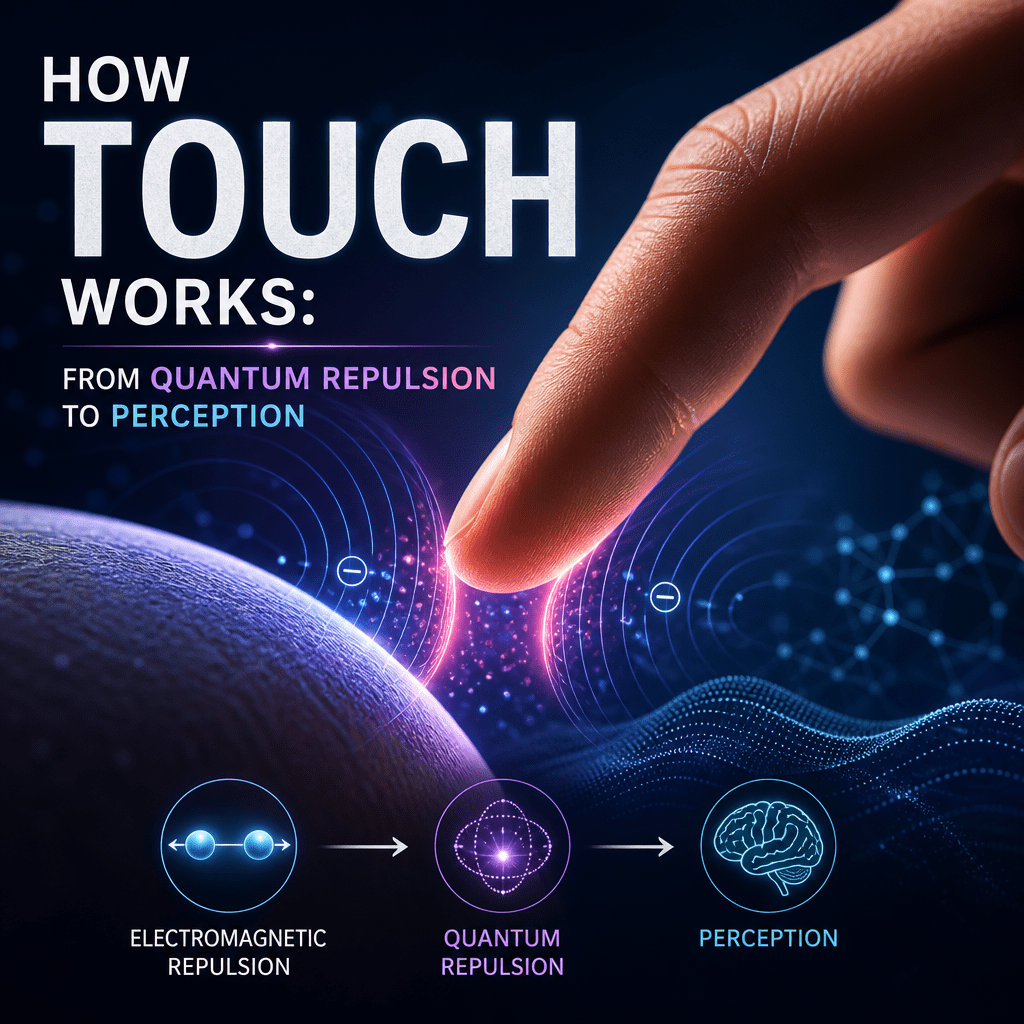
Touch feels simple. You press your hand on a table, and the table feels solid. You tap a wall, and it pushes back. It seems like two objects are meeting directly.
But the truth is more surprising.
What we call “touch” is not direct contact in the everyday sense. It is the result of quantum forces, electromagnetic repulsion, biology, and brain processing. In a very real way, touch is how your nervous system builds a model of the world.
So how does touch create reality?
It does not create the universe itself. But it does create your lived experience of reality. And that experience is shaped by physics from the smallest scales upward.
Table of Contents
- The surprising truth: nothing really “touches” at the smallest scale
- Quantum physics: the foundation of touch
- Why solid objects feel solid
- From atoms to skin: how biology turns force into sensation
- Different kinds of touch use different sensors
- The brain does not merely receive touch. It creates the experience
- Social touch: the emotional side of physical contact
- The deepest answer: touch does not reveal reality directly, but it reveals how reality acts on you
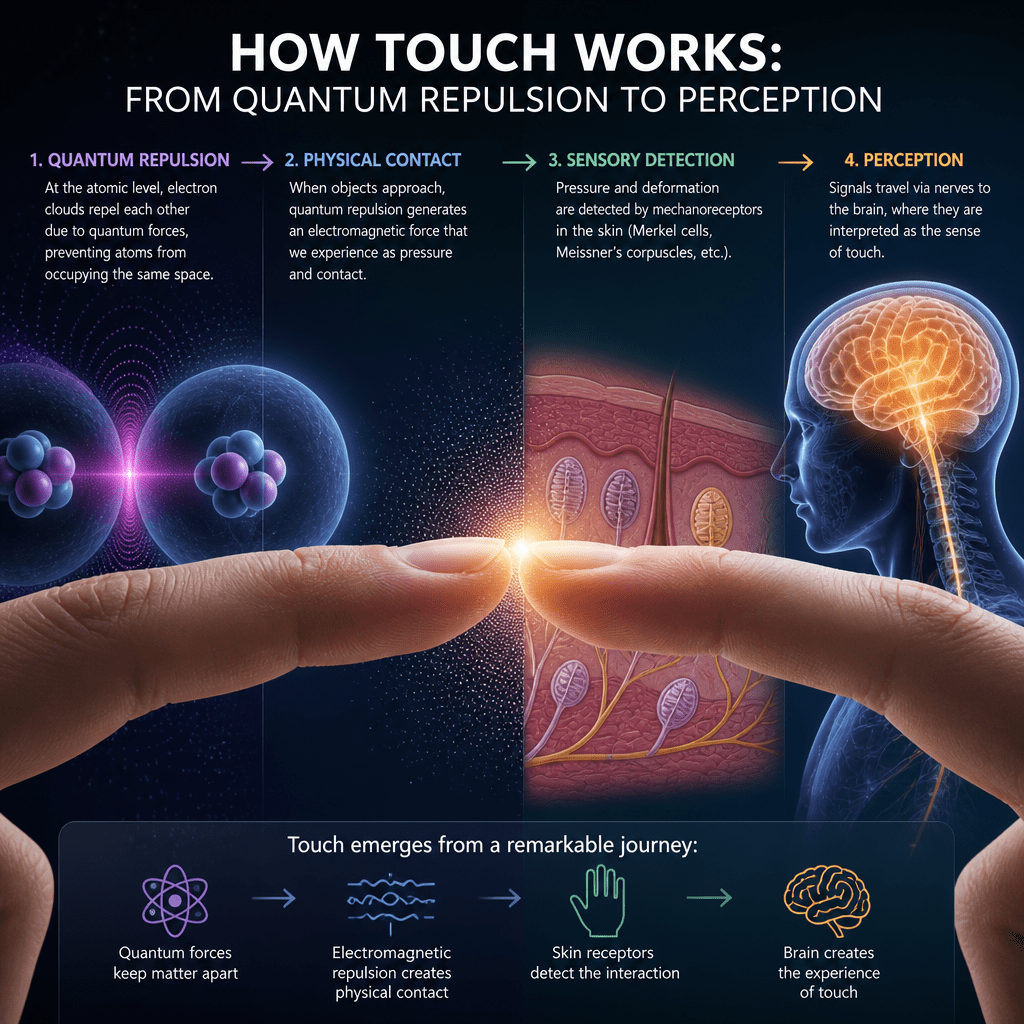
The surprising truth: nothing really “touches” at the smallest scale
At the level of atoms, objects are mostly empty space.
That sounds strange, but it is true. The nucleus of an atom is tiny compared to the space around it. Electrons occupy regions of probability, not little hard shells.
So when your finger touches a table, the atoms in your skin are not physically merging with the atoms in the wood.
Instead, something else happens:
- The electron clouds around the atoms come very close
- Their charges begin to interact
- Electromagnetic Repulsion pushes the atoms apart
- Your brain interprets that force as pressure, texture, and contact
In other words, touch is really a force interaction.
What feels like solid contact is the result of invisible repulsion. That is why electromagnetic repulsion is so central to everyday life: it is the reason your hand can meet a surface without passing through it.
That also means the everyday experience of touch can be deeply convincing even when the microscopic story is very different. The sensation is real, but the mechanism is deeper than appearances suggest.
Once you notice that, it becomes easier to see why a simple act like resting your hand on a desk is actually the end result of many layers of physical organization.
Quantum physics: the foundation of touch
To understand touch, we need to start with quantum mechanics.
At this level, particles do not behave like tiny billiard balls. They behave more like probabilities. Electrons do not sit in fixed orbits. They occupy quantum states.
This matters because atoms are built around rules that prevent matter from collapsing into itself.
1. Electromagnetic force
Electrons are negatively charged. When electron clouds of two objects get close, they push against each other.
This is electromagnetic repulsion. It is one of the strongest everyday forces we experience, even though we usually notice it only as pressure, resistance, or hardness.
When people talk about a surface “fighting back,” they are describing the macroscopic effect of electromagnetic repulsion between the charged parts of matter.
2. The Pauli exclusion principle
Electrons cannot all occupy the same quantum state. This creates an additional form of resistance when matter is squeezed together.
That resistance is part of why solid objects feel solid.
So the feeling of touch comes from a combination of:
- charge interactions
- quantum restrictions on electrons
- the way atoms resist overlapping
This is why the word repulsion is central to touch. Without it, there would be no stable objects, no surfaces, and no familiar world to feel.
And this is also why the phrase electromagnetic repulsion matters so much in any explanation of touch: it connects the invisible world of particles to the everyday world of pressure and solidity.
Why solid objects feel solid
A table does not feel solid because it is a smooth block of matter.
It feels solid because your hand cannot pass through it.
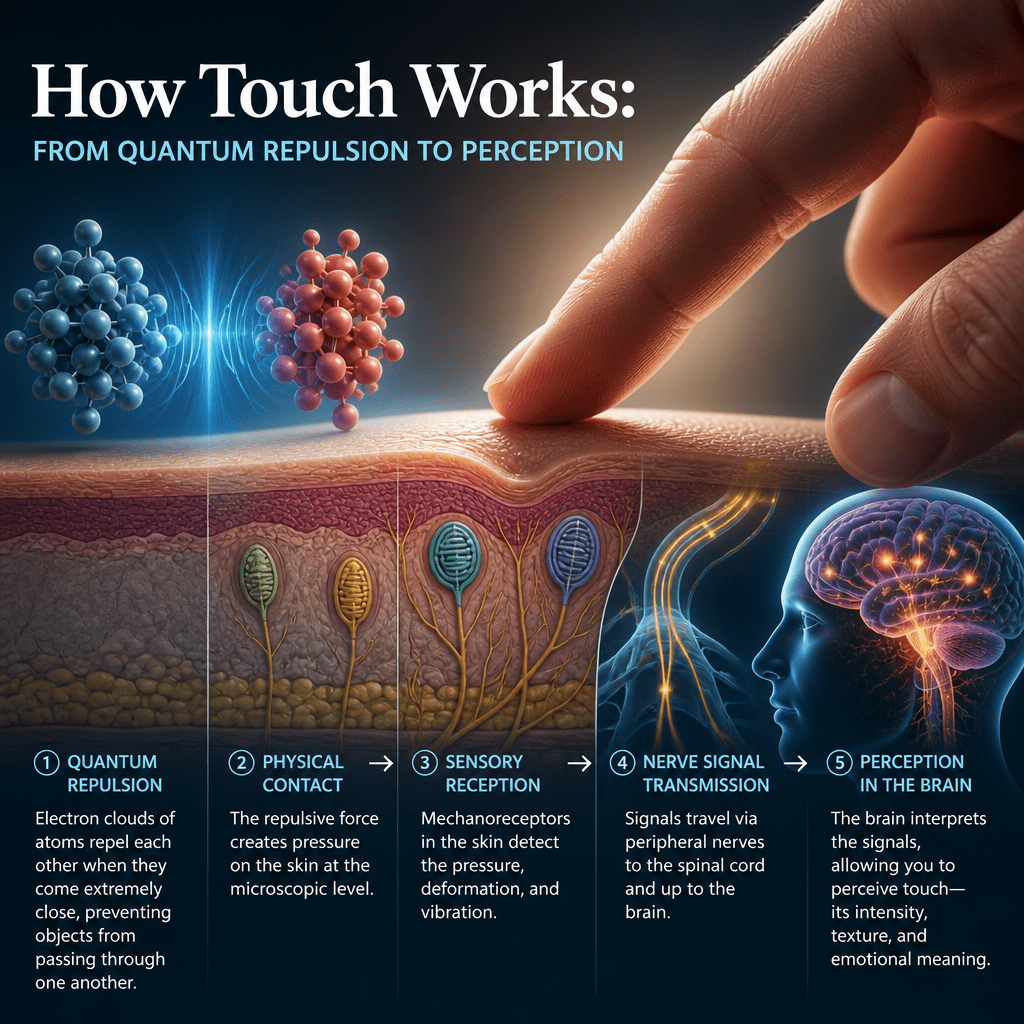
When your hand moves toward the table, the atoms in your skin and the atoms in the table resist closer overlap. That resistance grows very quickly.
Your nervous system detects that resistance as:
- pressure
- hardness
- vibration
- resistance to movement
So “solidness” is not a thing you directly see or feel. It is a pattern of force.
This is a good example of how the world we experience is a construction based on physical interaction, not a direct view of microscopic reality.
In practical terms, the body is reading a constant stream of force feedback. That is why a surface can seem smooth, rough, warm, cold, heavy, or light even before you consciously think about it.
The same principle helps explain why a wall feels immovable while a cushion gives way under your hand: the amount of deformation changes, but the underlying interaction still comes down to electromagnetic repulsion and the way matter resists being compressed.
If you want a second angle on this idea, the structure of matter is closely tied to the way forces hold atoms together and keep surfaces distinct. A helpful companion discussion is this post on electromagnetic forces and touch.
Seen this way, the experience of solidity is not a mystery at all. It is the brain’s interpretation of resistance, and that resistance begins in the physics of atoms.
From atoms to skin: how biology turns force into sensation
Physics creates the force. Biology translates it.
Your skin is packed with specialized nerve endings called mechanoreceptors. These sensors respond to pressure, stretch, vibration, and texture.
When you touch something, the process looks like this:
- Your skin compresses or stretches
- Mechanoreceptors detect the change
- They convert that change into electrical signals
- Nerves send signals to the spinal cord
- The brain processes the signals into sensation
This is called transduction.
It means physical force becomes neural activity.
Your body does not pass along “table-ness” or “softness” directly. It sends coded signals. Then the brain interprets them.
That interpretation is what you experience as touch.
In the case of electromagnetic repulsion, the same underlying interaction can feel different depending on how much your skin is compressed, how fast the object moves, and where the contact occurs. Biology adds context to the physics.
Touch also changes as the body adapts. A constant pressure on the skin may fade from awareness, while a sudden tap stands out sharply. The nervous system is not merely recording force; it is prioritizing useful information.
That is one reason touch feels so immediate and so personal. The signal is filtered through living tissue before it becomes a conscious event.
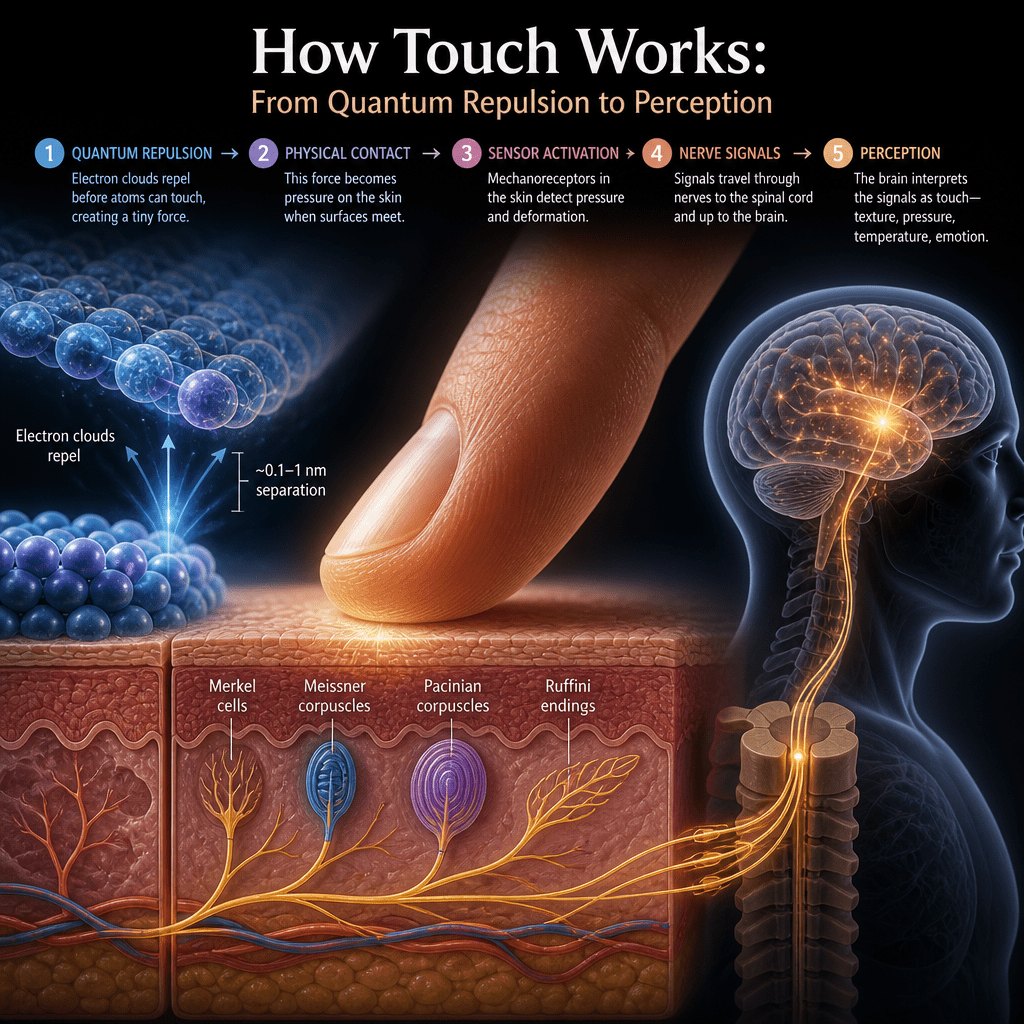
Different kinds of touch use different sensors
Touch is not one sense. It is several senses working together.
Your skin can detect:
- pressure
- vibration
- temperature
- pain
- stretch
- fine texture
Different receptors specialize in different tasks.
For example:
- Meissner’s corpuscles help detect light touch and motion across the skin
- Merkel cells help with shape and texture
- Pacinian corpuscles detect deep pressure and vibration
- Ruffini endings respond to stretch
That is why a feather, a handshake, and a hot mug all feel completely different.
Your nervous system does not just register contact. It identifies the kind of force involved.
For a broader look at how physical forces behave at the smallest scales, see this post on electromagnetic forces and touch.
When you think about the mechanics of touch, it helps to remember that the skin is not passively waiting for the world to impress itself on it. It is actively sampling pressure, movement, and temperature, then sending that information onward in real time.
That active sampling is one reason the phrase electromagnetic repulsion belongs in a discussion of human sensation. The force is physical, but the experience is shaped by a biological system designed to read change, not just contact.
Texture, shape, and motion
Texture is especially revealing. A smooth surface produces a different pattern of tiny vibrations than a rough one. Shape creates different pressure distributions across your fingers. Motion across the skin produces shifting signals that help your brain identify what is happening before you consciously name it.
That means your sense of touch is never just about “being touched.” It is about the pattern, direction, and timing of force.
Once again, the world begins with atomic interactions, but the meaning of those interactions is added by the body.
The brain does not merely receive touch. It creates the experience
This is where perception becomes important.
The brain does not act like a passive receiver. It actively constructs the experience of touch.
It combines:
- pressure signals from the skin
- temperature signals
- position information from muscles and joints
- past experience
- expectations
- context
That is why the same touch can feel different depending on the situation.
A gentle brush in the dark may feel alarming. The same brush from a loved one may feel comforting.
The physical input may be similar. The brain’s interpretation changes everything.
So touch is not just a mechanical event. It is also a perceptual event.
The brain uses touch to estimate where the body ends and the world begins. In that sense, perception helps create the boundary between self and environment.
What you call “reality” in daily life is partly the result of this continuous mapping process. The body gathers signals, and the brain turns them into a usable world.
That is why two people can experience the same physical event differently. The force may be identical, but the meaning is not.
Why touch feels immediate even though the brain is interpreting it
Touch seems instant because the nervous system is fast and tightly integrated. By the time you consciously notice the contact, a lot of processing has already happened. The body has measured force, the brain has organized the signal, and the experience arrives as a single moment.
This is one of the most fascinating parts of touch: it feels direct, yet it is built through layers of translation. At the base are atomic interactions governed by electromagnetic repulsion. Above that is skin sensing. Above that is neural signaling. Above that is perception.
The final result is a seamless experience of contact.
That seamlessness is useful. If the brain had to consciously reconstruct every stage, touch would feel slow, confusing, and fragmented. Instead, it arrives as a stable and coherent sensation.
That stability makes the world feel reliable. A desk stays a desk. A stone stays hard. A hand feels like a hand. Behind those certainties, though, is a dynamic physical system constantly negotiating force.
Social touch: the emotional side of physical contact
Touch is also social.
A hug, a handshake, or a pat on the back is not just mechanical stimulation. It carries meaning.
Humans use touch to signal:
- safety
- affection
- reassurance
- status
- trust
This is where biology and psychology overlap.
The same basic sensory system that detects pressure also helps create emotional bonding. Touch can lower stress, support connection, and make people feel more present.
In this sense, touch helps build shared reality between people.
It says, without words: I am here with you.
That social meaning does not cancel the physics. It rests on top of it. The body first receives force, and then the mind gives that force emotional weight.
So even the warmest or most comforting touch is still grounded in the same underlying structure: matter resists matter, and that resistance becomes meaning through the nervous system.
For another perspective on how biological systems shape experience, you may also find this discussion of how prayer physically rewires the brain interesting, especially if you are curious about how repeated experience can shape neural processing over time.
The deepest answer: touch does not reveal reality directly, but it reveals how reality acts on you
So how does touch create reality?
It creates your reality by turning physical forces into lived experience.
At the smallest scale, quantum behavior and electromagnetic repulsion prevent atoms from passing through each other. That resistance is what makes contact possible in the first place.
At the biological scale, nerve endings translate force into signals.
At the mental scale, the brain builds a world of surfaces, textures, pressure, and presence.
What you call touch is the final result of all three layers.
That means touch is not a simple sensation. It is a bridge.
- From invisible forces to body signals
- From body signals to perception
- From perception to the reality you experience
The physics of touch is rooted in evidence from modern science. The National Institute of General Medical Sciences offers a useful overview of cell communication and signaling, which helps explain how biological systems convert physical input into usable information.
If you want to understand the full chain from atoms to awareness, this is the key idea: the world does not enter consciousness unchanged. It is filtered, translated, and organized before it ever becomes a felt experience.
That filtering does not make touch less real. It makes touch possible. Without electromagnetic repulsion, without nerves, and without perception, there would be no stable experience of a world you can hold, feel, or trust.
The bottom line
Touch feels like contact, but it is really the experience of resistance.
Matter stays separate because of repulsion at the atomic level, driven by electromagnetic repulsion and quantum rules. Your skin detects that resistance. Your brain turns it into a world of solid objects, textures, and closeness.
So touch does not create the universe.
But it does create your felt reality of the universe.
And that makes touch one of the most powerful senses we have.
When you press a finger to a surface, you are not just contacting matter. You are experiencing a highly organized chain of physics, biology, and perception that turns invisible forces into the reality you live inside.