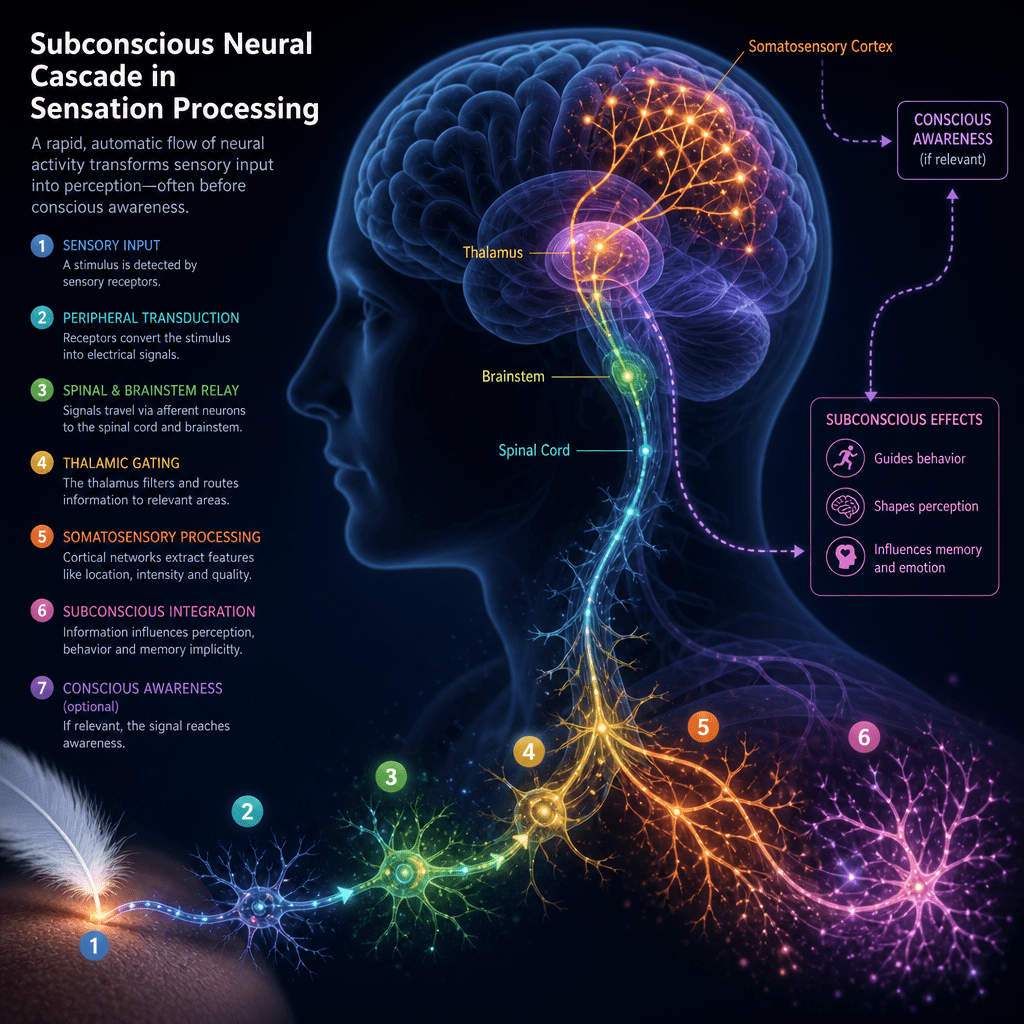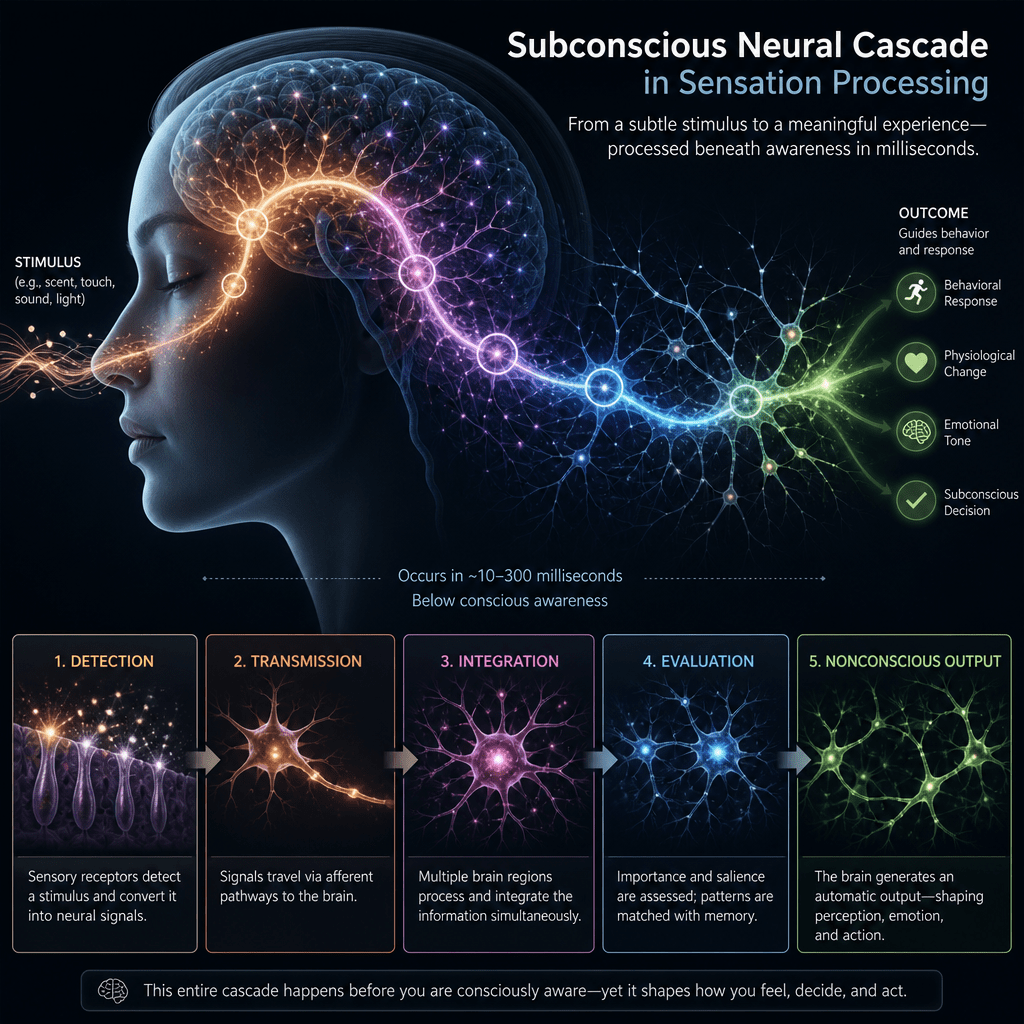
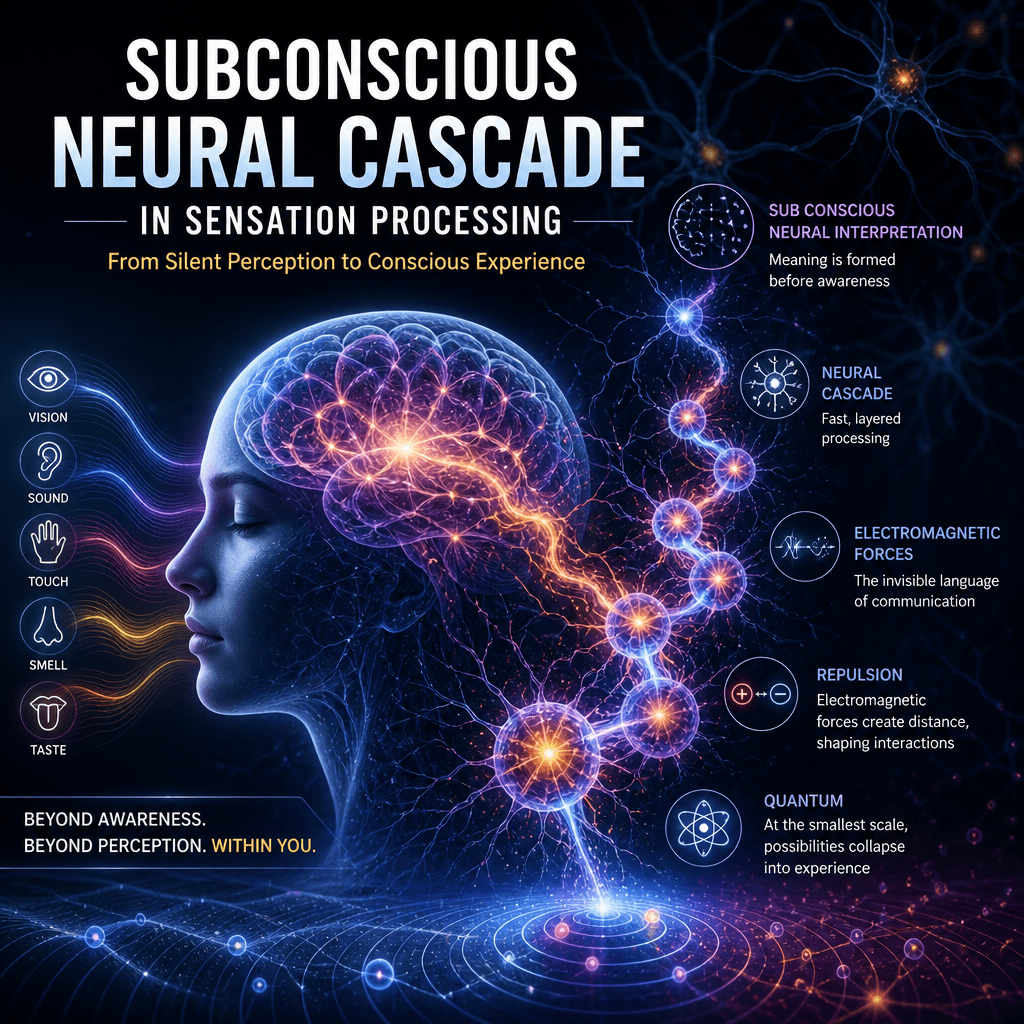
When we touch, see, hear, smell, or taste something, the body does not go straight from stimulus to awareness. It first converts that input into nerve signals. This process is called transduction.
Those signals then move through a neural cascade. The brain receives, filters, compares, and interprets them before you become fully aware of the sensation. This happens very fast.
So, does this cascade happen in the sub conscious mind?
The short answer is: yes, much of it happens outside conscious awareness. But it is more accurate to say that it happens through automatic neural processing in the nervous system and brain, not in a separate “subconscious” place.
What Is Transduction?
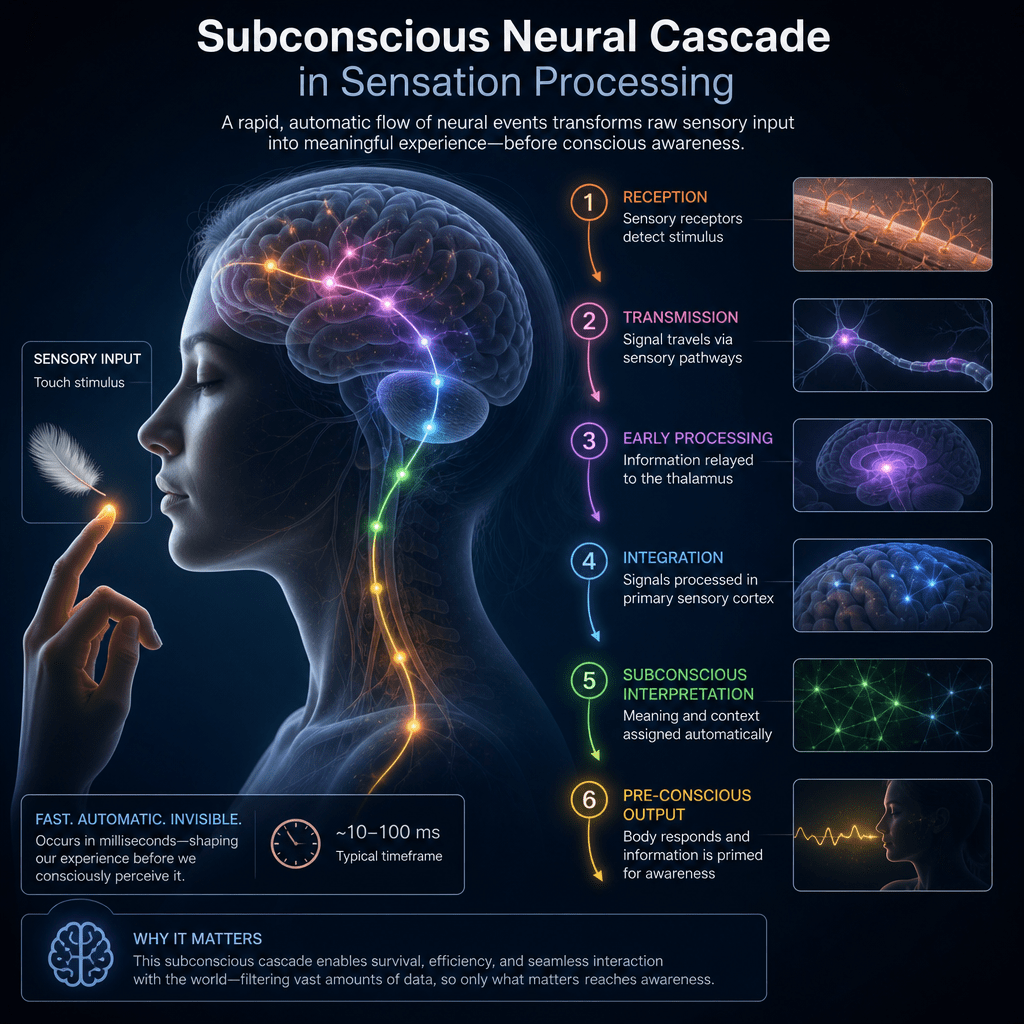
Transduction is the process of turning physical energy into neural signals.
Examples include:
- Light entering the eyes
- Sound waves reaching the ears
- Pressure on the skin
- Chemicals on the tongue or in the nose
Specialized sensory receptors detect these inputs and convert them into electrical signals. Those signals then travel along nerve pathways toward the brain.
This is the starting point of the sensory experience.
For a broader discussion of early processing and automatic response, see The Reflexive Mind: How Evolution Misleads Us in the 21st Century.
What Is the Neural Cascade?
The term neural cascade refers to the chain of activity that follows transduction.
Once a stimulus is detected, the signal moves through multiple steps:
- Sensory receptors detect the stimulus
- Nerve cells generate electrical impulses
- Signals travel through sensory pathways
- The brain processes the incoming data
- Meaning is assigned through neural interpretation
- Conscious perception may finally occur
This chain is rapid, but it is not simple. The brain is not just recording raw input. It is constantly organizing, filtering, and predicting.
That is why two people can experience the same event differently.
In the language of everyday explanation, the neural cascade is the bridge between sensation and awareness.
Is This Process Subconscious?
In everyday language, many people call this early processing subconscious.
That makes sense, because:
- You do not consciously control the first steps
- Your brain processes sensory data automatically
- Your awareness comes later
For example, you may pull your hand away from a hot surface before you fully think about it. The body reacts first. Conscious thought comes after.
So yes, a large part of the neural cascade is sub conscious in the sense that it happens below conscious awareness.
However, in neuroscience, the term “subconscious” is not always used as a technical term. Scientists usually describe these events as:
- Automatic processing
- Preconscious processing
- Unconscious sensory processing
That distinction matters because it keeps the discussion of subconscious processing grounded in biology rather than in vague theory.
How the Brain Turns Sensation Into Perception
Sensation and perception are not the same thing.
Sensation
This is the detection of physical input.
Perception
This is the brain’s interpretation of that input.
The difference matters.
Your nerves can detect light, sound, or touch, but perception only happens after the brain gives the signal meaning. This is where neural interpretation becomes important.
The brain asks questions like:
- What is this?
- Is it dangerous?
- Have I experienced this before?
- Does it matter right now?
Perception is not passive. It is an active construction.
In other words, the brain does not merely receive sensation; it evaluates sensation and turns it into experience. That process is a core part of sub conscious processing, even when we are not aware of it happening.
Why the Brain Filters Sensory Input
The brain receives far more sensory information than you consciously notice.
To avoid overload, it filters most of it automatically.
This is why:
- You can ignore background noise
- You may not feel your clothes after a few minutes
- You notice your name in a noisy room
- Certain smells disappear after you become used to them
These are examples of unconscious neural filtering.
This filtering is part of the neural cascade, and it happens before full awareness. In fact, the sub conscious mind often seems quiet only because the brain is doing this work so efficiently.
For a related discussion of how the brain can react before reflective thought, see The Reflexive Mind: How Evolution Misleads Us in the 21st Century.
The Role of Electromagnetic Forces in Neural Signaling
Nerve activity depends on electrical signals. Because of that, electromagnetic forces are part of how neurons communicate.
Neurons use:
- Electrical charges
- Ion movement
- Chemical neurotransmitters
- Membrane voltage changes
These processes are physical and measurable.
But it is important not to overstate the role of electromagnetic forces. They help explain how neurons send signals, but they do not by themselves explain consciousness or perception in a complete way.
The brain is a biological system, not just an electrical device.
For a basic reference on electrical signaling in the nervous system, the NCBI Bookshelf offers accessible scientific background from medical and neuroscience texts.
What About Repulsion and Quantum Ideas?
Some theories try to connect perception or consciousness to quantum effects. Others use terms like repulsion in attempts to describe interaction between particles, neurons, or energy fields.
At this time, mainstream neuroscience does not support the idea that normal sensory perception depends primarily on quantum processes.
Here is the key point:
- Quantum physics describes behavior at very small scales
- Neural interpretation and perception are studied mainly through biology and neuroscience
- Electromagnetic activity in the brain is real, but that is not the same as a quantum explanation
Terms like repulsion and quantum may sound interesting, but they should be used carefully. They are not currently accepted as the main explanation for how the brain turns sensation into perception.
If you want to explore related ideas about how the mind can misread reality, you can also read Why People Stop Thinking: A Physiological Explanation for Modern Argument Failure.
A Simple Way to Think About It
You can think of the process like this:
- A stimulus enters the body
- Receptors transduce it into nerve signals
- The nervous system sends those signals upward
- The brain filters and interprets them
- Conscious awareness may follow
This means there is a gap between raw input and awareness.
That gap is where much of the sub conscious processing occurs.
The same pattern appears in many everyday moments, which is why the neural cascade is such a useful idea for understanding the transition from sensation to perception.
Real-World Examples
1. Touching a hot pan
Your skin senses heat immediately. Your nerves fire. Your spinal cord and brain coordinate a fast reflex. You pull away before fully thinking about it.
2. Hearing your name in a crowd
Most sounds are ignored. But your brain notices important patterns and shifts attention. That happens through automatic processing.
3. Seeing a face
Your eyes detect light, but your brain quickly identifies the shape, expression, and meaning. That is neural interpretation at work.
4. Smelling smoke
You may react before you consciously analyze the smell. The brain treats some signals as urgent.
In all these cases, a neural cascade begins before conscious perception.
That is why the question of sub conscious processing remains so useful: it describes the speed and invisibility of early brain activity in a simple way.
So Is the Cascade in the Subconscious Mind?
The best answer is:
Much of it happens outside conscious awareness, so it can be described as subconscious or sub conscious processing.
But scientifically, it is better understood as:
- Automatic sensory processing
- Neural transmission
- Preconscious brain activity
- Neural interpretation before awareness
This process is not mystical. It is part of how the nervous system works.
For a broader philosophical perspective on how thinking begins before deliberate reflection, see What Ancient Philosophers Knew of Limbic First Thinking.
Key Takeaways
- Transduction converts stimulus energy into nerve signals
- Those signals trigger a neural cascade
- The brain performs neural interpretation before full awareness
- Much of this happens automatically, outside conscious control
- This can be called sub conscious processing in simple terms
- Electromagnetic forces are involved in neural signaling
- Claims about quantum explanations for normal perception are not supported as the main scientific model
Final Answer
Yes, the neural cascade that begins with transduction is processed largely outside conscious awareness. In that sense, it happens in the subconscious or sub conscious mind. But scientifically, it is better described as automatic neural processing in the brain and nervous system before sensation becomes perception.
The brain does not wait passively for awareness. It interprets, filters, and organizes sensory input first. Only then does the experience reach conscious perception.
Understanding this process can make the mind feel less mysterious and more elegant: transduction starts the signal, the neural cascade shapes it, and perception arrives only after the brain has already done most of the work.
In that sense, the sub conscious mind is not a separate place at all. It is the quiet, rapid work of the brain before awareness becomes clear.