
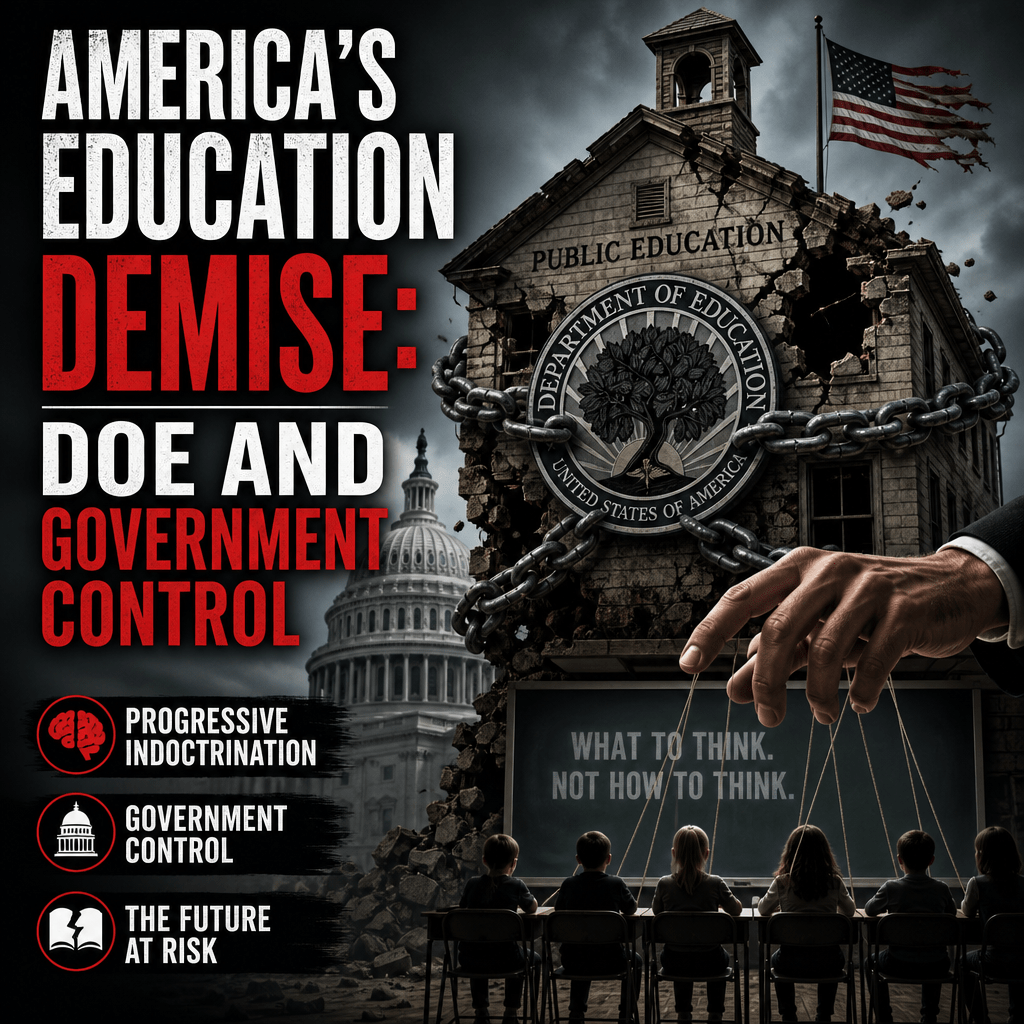
American education did not collapse overnight. Educations demise in America developed over decades as policy after policy moved authority away from parents, teachers, and local communities and toward federal agencies, standardized systems, and political institutions. From Woodrow Wilson to Joe Biden, presidents of both parties expanded the national role in schooling, often promising improvement while adding layers of administration, testing, compliance, and ideological conflict.
This article presents a critical view of that history. It argues that the Progressive belief in expert management, the expansion of the federal state, the creation of the Department of Education, and later testing and standards movements gradually changed the purpose of schooling. Education increasingly became a system managed through rules and measurements rather than a local institution centered on knowledge, character, and intellectual independence.
Table of Contents
- The Core Problem: Centralization
- Woodrow Wilson and the Progressive Shift
- Franklin D. Roosevelt and the Expansion of the Federal State
- Jimmy Carter and the Creation of the Department of Education
- Bill Clinton and the Rise of Standards, Testing, and Compliance
- George W. Bush and No Child Left Behind
- Barack Obama and the Common Core Era
- Joe Biden and the Deepening Crisis
- What Went Wrong
- The Real Cost
- How to Reverse the Damage
- Conclusion
Educations demise in America: The Core Problem of Centralization
The central issue in Educations demise in America is not that every federal education program has produced the same result or that every teacher, administrator, or reformer shares the same goals. The larger issue is the steady transfer of decision-making power. When education moves farther from parents, teachers, and local communities, national institutions gain more ability to shape what schools teach, how they measure success, and which priorities receive funding.
Federal involvement can provide resources and address genuine problems, but it also creates incentives for schools to follow distant rules. In examining Educations demise in America, funding conditions, reporting requirements, testing systems, and regulatory guidance make local independence increasingly difficult. A district may technically retain authority while still changing its practices to satisfy federal expectations.
That shift is central to any account of Educations demise in America. It brought:
- More federal influence over local schools
- Less local decision-making
- More compliance rules and reporting
- Less academic freedom for teachers
- More focus on ideology, process, and measurable outputs
- Less time for reading, writing, mathematics, history, and critical thinking
- More administrative work for educators
- Less direct accountability to parents
For many Americans, Educations demise in America means Government Control replacing genuine education. The concern is not simply that Washington makes individual decisions poorly. It is that a centralized system is less responsive when decisions are wrong because families have fewer practical ways to change the system.
Woodrow Wilson and the Progressive Shift
Woodrow Wilson helped normalize the idea that experts and federal institutions should guide society from the top down. The Progressive Era was not a single education program, and its participants disagreed about many issues. However, it encouraged confidence in professional administration, scientific management, standardized systems, and institutions led by experts rather than by local citizens. That legacy is often presented as an early stage of Educations demise in America.
That mindset mattered. In education, the Progressive Era pushed the belief that schools should not merely transmit facts and skills. Schools were also expected to shape citizens, values, behavior, and social attitudes. Some civic education is necessary in a constitutional republic, but the broader ambition created a risk: whoever controls the institution can increasingly influence the beliefs and habits of future citizens. This tension helps explain Educations demise in America.
This was not yet the modern Department of Education. Still, it laid part of the philosophical foundation for later federal involvement. In the story of Educations demise in America, the school could be viewed less as a community institution and more as an instrument for organized social improvement.
The warning signs associated with Educations demise in America were clear:
- Central planners over parents
- Experts over communities
- Social engineering over classical learning
- Standardization over local excellence
- Administrative efficiency over personal judgment
- Political objectives over intellectual independence
Once that path was established, reversing it became harder. A system that promises uniform improvement naturally creates more offices, more rules, and more measurements. Each new layer can be defended as a solution to the problems created by the previous layer, which is one reason Educations demise in America became a long-term process rather than a single event.
Franklin D. Roosevelt and the Expansion of the Federal State
Franklin D. Roosevelt expanded the federal government across nearly every part of American life. The New Deal established a stronger expectation that Washington could respond to social and economic problems through national programs, funding, and administrative agencies. That expectation influenced the later development of Educations demise in America.
Education was not transformed into a fully federal system during the New Deal. Schools remained largely local, and states continued to exercise substantial authority. Even so, the period helped normalize the idea that Washington could direct local institutions indirectly through grants, programs, data collection, and administrative pressure. This indirect influence became a recurring feature of Educations demise in America.
That created a new model. Instead of education being understood primarily as a local responsibility, it became a field increasingly connected to federal priorities. The connection was often presented as cooperation, but cooperation backed by funding conditions can gradually become dependence. Critics regard that dependence as another step in Educations demise in America.
The long-term result was a system in which schools learned to look to Washington for resources and legitimacy. Once schools begin to rely on federal programs, they may feel compelled to follow federal rules even when local educators or parents disagree. The question changes from “What does this community need?” to “What does this program require us to report, adopt, or measure?” That question captures a central complaint about Educations demise in America.
This expansion also changed public expectations. If national officials claimed responsibility for improving education, families could reasonably ask them to explain disappointing results. Yet federal officials had limited control over daily instruction, staffing, discipline, and curriculum. The result was a recurring mismatch between national promises and local responsibility, a pattern frequently cited in discussions of Educations demise in America.
Jimmy Carter and the Creation of the Department of Education
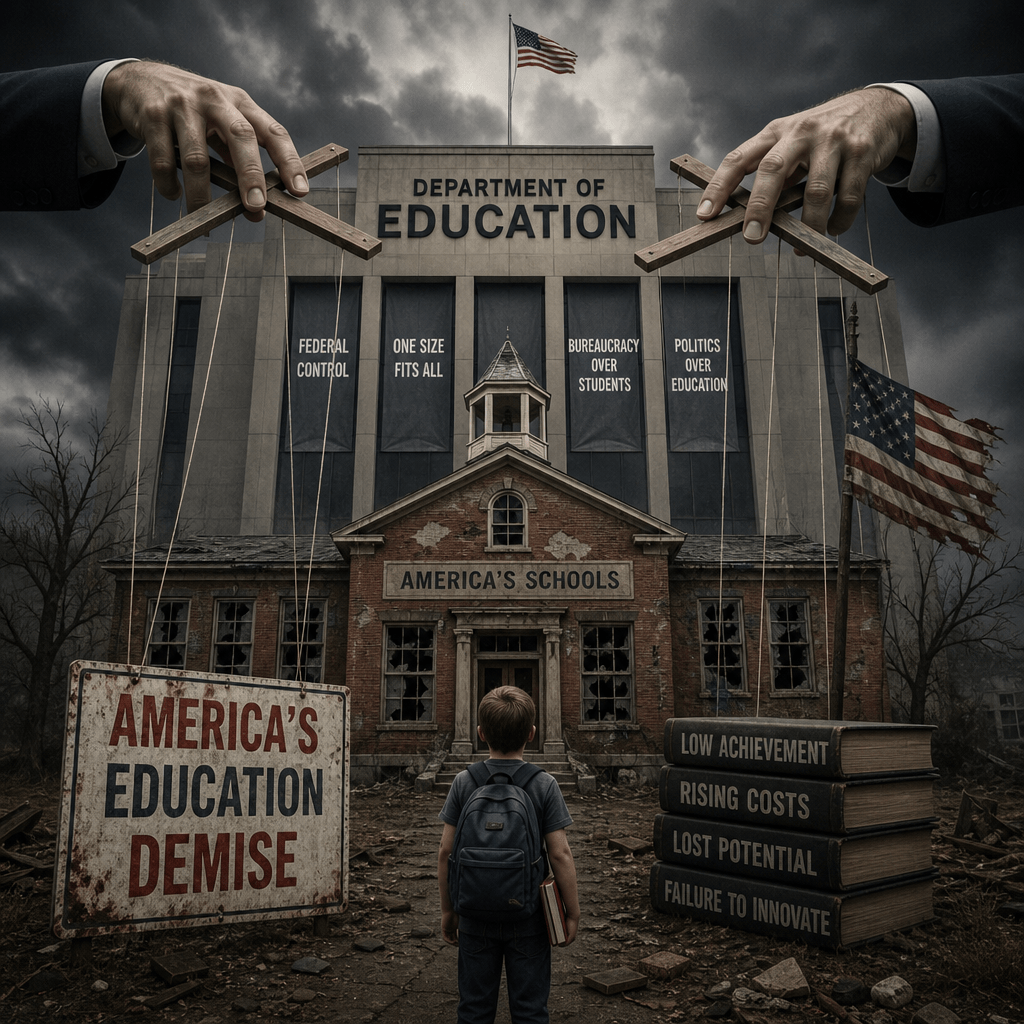
Jimmy Carter signed the Department of Education into existence in 1979. Supporters argued that a cabinet-level department would give education a stronger voice in the federal government and coordinate national efforts. Critics argued that it would create another layer of bureaucracy and move education farther away from parents and states. For critics, this institutional change marked a decisive moment in Educations demise in America.
The creation of the Department marked an important institutional change. Federal education policy now had a dedicated department with its own leadership, personnel, programs, regulations, and public identity. Even if the department did not directly run local classrooms, its existence made federal involvement more permanent and visible. That permanence is why the DOE remains closely associated with Educations demise in America.
Over time, critics argued that the department expanded oversight without producing a broad, lasting improvement in academic performance. Its supporters pointed to civil rights enforcement, research, financial aid, and targeted assistance. Those functions can be important, but they do not automatically justify expanding federal direction over ordinary classroom decisions. The debate over those competing claims remains part of Educations demise in America.
The DOE helped expand:
- Federal oversight
- Compliance mandates
- National policy pressure
- Data collection and reporting
- Administrative growth
- Uniform expectations for diverse communities
This is where many people say the decline accelerated. The Department was supposed to support schools, protect rights, and improve opportunity. Instead, many believe it became a vehicle for Government Control. The broader concern is that a department created to assist local education can slowly become an authority that defines what acceptable education looks like.
The debate remains relevant because the federal role is not limited to one administration. As discussed in the analysis of the DOE and the collapse of regular order, institutional expansion can make temporary policies feel permanent. New programs are rarely removed once agencies, contractors, and reporting systems depend on them.
Bill Clinton and the Rise of Standards, Testing, and Compliance
Under Bill Clinton, the federal government pushed harder into education reform. The language centered on accountability, standards, measurable outcomes, and improvement. Those goals can sound reasonable, since schools should teach effectively and taxpayers should know whether public money is being used responsibly. Within the longer history of Educations demise in America, however, these reforms also strengthened federal influence over how schools defined and reported success.
The problem was the growing assumption that what is easiest to measure is what matters most. Test scores, performance metrics, attendance figures, and federal benchmarks became increasingly important. As measurement expanded, schools had stronger incentives to direct time and resources toward the items appearing in reports.
The Clinton-era approach added another dimension to Educations demise in America. It led to predictable problems:
- Teachers taught to the test
- Creativity declined
- History and civics were narrowed
- Reading became formulaic
- Schools focused on scores instead of substance
- Students received less room for curiosity and exploration
- Administrators spent more time documenting compliance
Standards can clarify expectations, but national standards can also reduce educational diversity. A strong local school might use a different sequence, reading list, or instructional method from a neighboring district. A compliance-centered system may treat that difference as a problem rather than as evidence of local judgment, reinforcing the concerns behind Educations demise in America.
Clinton-era reform sold itself as modernization. In practice, it helped turn education into a management system. The teacher became responsible for producing measurable results under conditions the teacher did not control. Family circumstances, attendance, discipline, language, and community conditions could all affect outcomes, yet the system often responded by adding more tests and forms. This is another reason critics describe Educations demise in America as bureaucratic rather than accidental.
The official National Assessment of Educational Progress provides useful long-term information about student achievement. Such data can help the public understand trends, but national averages cannot explain every local cause or serve as a complete definition of educational success.
George W. Bush and No Child Left Behind
No Child Left Behind was one of the most influential federal education policies in modern American history. It promised that every child would succeed and sought to close achievement gaps through testing, public reporting, and consequences for schools that failed to meet targets. The law intensified debates about Educations demise in America.
The goal sounded noble. The method was flawed. Schools were pressured to meet ambitious targets that did not always reflect the complexity of student learning. Teachers were burdened with tests, data, and penalties. Administrators were encouraged to chase numbers rather than improve the quality of instruction. For many critics, this was Educations demise in America expressed through accountability mechanisms.
The consequences were serious:
- Test preparation replaced real learning
- Schools narrowed the curriculum
- Art, music, and vocational training were pushed aside
- Teachers lost flexibility
- Students were treated like data points
- Schools faced pressure to reclassify or prioritize students in ways that improved reported results
Accountability is necessary, but accountability should identify problems rather than create incentives to hide them. When a school’s reputation and funding depend heavily on a narrow set of scores, leaders may rationally focus on the scores even when doing so weakens the broader education of students. That distinction is essential when evaluating Educations demise in America.
No Child Left Behind exposed a hard truth: Washington cannot bureaucratize its way to excellence. A federal law can require testing, but it cannot create a knowledgeable teacher, a disciplined classroom, an engaged family, or a culture that respects learning.
Barack Obama and the Common Core Era
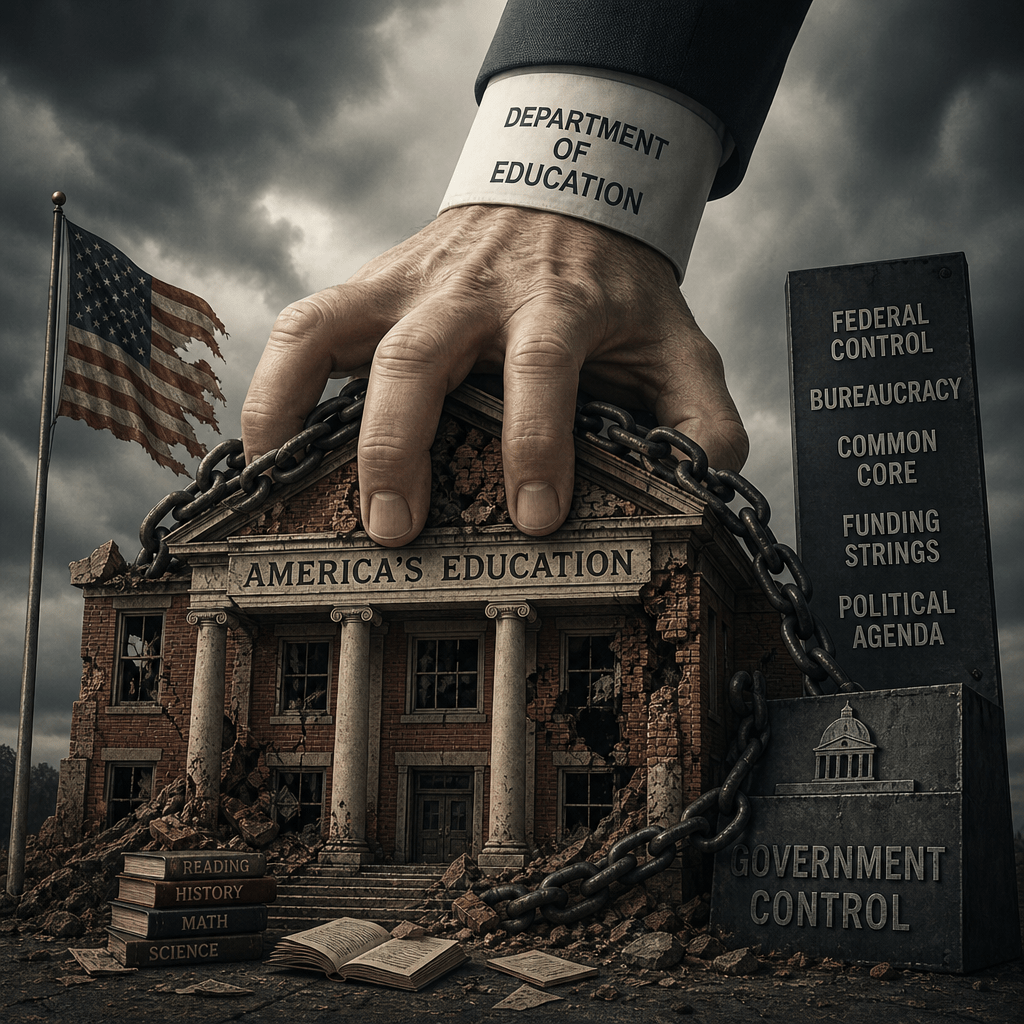
The Obama years expanded the federal role again, even when policy was presented as state-led. The Common Core movement promised consistency and rigor. Supporters believed common expectations could improve preparation and make achievement easier to compare. Critics saw one-size-fits-all standards, confusing instructional methods, and reduced local authority.
For critics tracing Educations demise in America, many parents and teachers saw the same old pattern:
- Centralized direction
- Reduced local authority
- More bureaucracy
- Less transparency
- More ideological framing of school reform
- Greater pressure to align teaching with outside benchmarks
Even when states formally adopted the standards, federal incentives influenced the environment in which adoption occurred. This contributed to public suspicion that “state-led” reform could still be national policy by another name.
At the same time, schools and universities became more open to political activism. Education has never been entirely separate from civic values, but the line between teaching and messaging grew thinner. Families increasingly questioned whether their children were being taught how to evaluate competing claims or being encouraged to accept one approved political interpretation.
This is where the idea of Progressive indoctrination became impossible for many families to ignore. The phrase is contested, and not every lesson involving social issues is indoctrination. The legitimate concern is whether students are allowed to ask questions, examine evidence, and disagree without being punished socially or academically.
The classroom was no longer just about learning facts and methods. It was increasingly about shaping attitudes. When a school system treats disagreement as misconduct, it weakens the intellectual habits that education is supposed to develop.
Joe Biden and the Deepening Crisis
Under Joe Biden, Educations demise in America became more visible to many parents. School closures and disputes over reopening decisions brought renewed attention to the power of public institutions. Families who had rarely examined school policy began asking what their children were learning, who made those decisions, and why parental concerns were sometimes dismissed.
Parents across the country have objected to what they see in their children’s schools:
- Radical ideology
- Lowered standards
- Gender and identity politics
- Weak discipline
- Reduced academic rigor
- Open hostility toward dissenting parents
- Insufficient transparency about curriculum and school policies
These concerns do not mean that every school or teacher follows the same approach. They do show how deeply trust has deteriorated. Parents are more likely to accept difficult policies when schools explain them clearly and invite meaningful participation. They are less likely to accept them when decisions appear to be made by distant officials or defended with labels rather than evidence.
At the same time, federal education policy continued to favor centralized control over local trust. National guidance, grants, civil rights rules, and administrative expectations shaped local decisions even when classrooms remained under state and district control.
The Biden era reinforced a painful reality for critics: the Department of Education has not solved the crisis. It has become part of it. The deeper problem is not one president alone. It is a system that repeatedly responds to failure by expanding authority, adding programs, and demanding more compliance.
What Went Wrong
Any account of Educations demise in America must acknowledge that the decline of American education has many causes and that federal policy is only one of them. Family instability, poverty, technology, teacher shortages, discipline problems, economic changes, and local leadership all affect student outcomes. Still, the political pattern is clear: federal power grew, local control shrank, ideology entered more classrooms, and accountability became increasingly performative.
Bureaucracy replaced common sense when schools became more concerned with documenting approved processes than with asking whether students could actually read, write, calculate, reason, and understand history. A long policy document can create the appearance of seriousness without improving a single lesson.
The system also confused equality of inputs with equality of results. Providing every school with similar standards or procedures does not guarantee that every student receives the same quality of instruction. Students differ in ability, interest, background, and needs. Effective education requires both high expectations and enough flexibility to respond to those differences.
The result is a system where too many students graduate without:
- Strong reading skills
- Basic math fluency
- Historical knowledge
- Civic literacy
- Clear writing ability
- Critical thinking habits
- Confidence in independent study
- The discipline required to complete difficult work
That is why so many people now speak of Educations demise in America with anger and frustration. They see institutions that claim to value learning while permitting students to advance without mastering essential skills.
The Real Cost
The human cost of Educations demise in America is not abstract. It affects real families and real children. A student who leaves school unable to read complex material or explain an argument faces disadvantages in college, employment, and civic life. A family that loses confidence in a school must spend more time monitoring instruction, seeking alternatives, or paying for supplemental help.
A broken education system leads to:
- Lower job readiness
- Weaker civic life
- Greater dependence on institutions
- Less upward mobility
- More social division
- Less confidence in the future
- Higher costs for remedial education and training
- Fewer opportunities for students without wealthy or highly educated parents
The damage is also cultural. Schools are among the few institutions that can bring citizens together around shared knowledge. When history becomes political propaganda, civics becomes slogan-driven, or academic standards are quietly lowered, students lose a common foundation. They may know how to express outrage but not how to evaluate evidence or understand the constitutional limits on power.
When schools stop teaching truth, discipline, and knowledge, the whole country suffers. Democracy depends on citizens who can read primary sources, recognize weak arguments, understand basic institutions, and disagree without treating every opponent as an enemy.
How to Reverse the Damage
Reversing Educations demise in America requires the country to address the trends that caused the damage. Reform should begin with humility. No national office can know the needs of every classroom, and no single assessment can capture every form of learning. The most effective changes will restore responsibility to the people closest to students while preserving basic protections and honest public reporting.
That means:
- Returning meaningful control to parents and local communities
- Reducing federal overreach and unnecessary compliance requirements
- Restoring demanding academic standards
- Removing ideological content from core instruction while teaching controversial subjects fairly
- Rewarding excellent teachers and supporting strong classroom leadership
- Bringing back phonics, civics, history, literature, and real mathematics
- Ending the culture of test obsession and bureaucratic compliance
- Giving schools flexibility to use different methods when they can demonstrate strong results
- Publishing curricula and instructional materials in clear, accessible language
- Giving parents timely ways to review concerns and appeal decisions
- Expanding legitimate educational choices for families trapped in failing schools
Local control does not mean abandoning standards or civil rights. It means allowing communities to pursue high standards through approaches suited to their students. Federal policy should protect basic rights, provide transparent information, and assist disadvantaged children without attempting to manage every classroom from Washington.
Parents also have responsibilities. They must read with their children, encourage serious study, attend school meetings, ask direct questions, and distinguish genuine evidence from political exaggeration. Teachers deserve support when they maintain order and teach difficult material honestly. School boards deserve scrutiny when they hide decisions behind bureaucratic language.
Education should not be a federal project of social management. It should be a local mission to teach children how to think, read, calculate, understand their history, and live as responsible citizens. A healthy system can acknowledge national problems without assuming that national control is the answer.
Conclusion
From Wilson to Biden, the march toward centralization has changed American education for the worse in the view of many families, teachers, and local leaders. This pattern defines Educations demise in America: each administration added another layer of control, each era promised progress, and each era moved schools farther from local accountability and closer to political management.
The history is not a story of one party or one president. It is a story of institutional expansion. Progressive administration established the philosophy, the New Deal strengthened the federal state, Carter created the Department of Education, and later administrations built increasingly elaborate systems of standards, testing, funding, and oversight.
That is why so many Americans now view the Department of Education not as a solution, but as a symbol of decline. The lesson is stark: if education remains under the grip of bureaucracy, ideology, and Government Control, then Educations demise in America will continue.
Preventing Educations demise in America requires rejecting Progressive indoctrination and returning to education that serves students, families, and communities. The goal should not be political conformity. It should be knowledge, intellectual honesty, discipline, opportunity, and the freedom to think.