

Whole-brain integration is a rare and valuable state. It is the point where the brain’s analytical side and its holistic side work in harmony, producing clearer judgment, deeper perception, and more grounded action. In modern life, this kind of integration is uncommon, but it is not unreachable.
For a useful framework on how truth can be approached through disciplined reflection, see The Examined Goal.
Table of Contents
- What Is Whole-Brain Integration?
- The Left Hemisphere and the Right Hemisphere
- Tom: A Natural Integrator
- Steve: Integration Through Practice
- The Role of the Thalamus
- Why Stillness Changes Perception
- Non-Verbal Knowing
- “Be Still and Know”
- The Restorationist View of Mastery
- What Tom and Steve Teach Us
- Why Whole-Brain Integration Matters Today
- Final Thoughts
What Is Whole-Brain Integration?
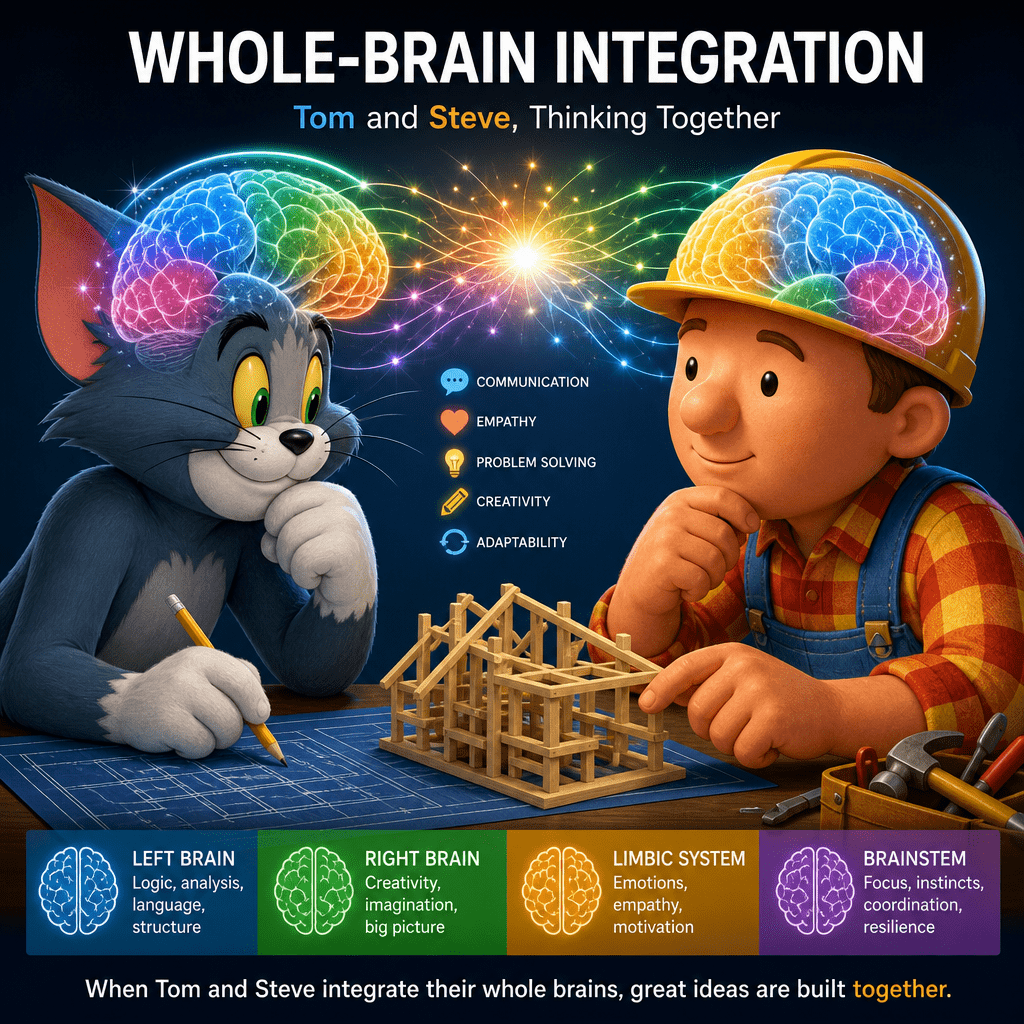
Whole-brain integration is not about using “both sides” of the brain in a simplistic way. It is about coordination.
It means analytical thinking and intuitive perception work together, language supports understanding without dominating it, facts remain connected to context, and the mind can hold both detail and the bigger picture.
This matters because many people live in a fragmented way. They analyze well, but they do not always perceive whole patterns. Or they feel deeply, but struggle to organize that insight into action. Whole-brain integration brings those capacities together.
For a broader philosophical treatment of integrated perception and truth-seeing, What Ancient Philosophers Knew of Limbic First Thinking offers another angle on how human understanding can move beyond purely linear analysis.
In practical terms, whole-brain integration can improve the way people read a room, evaluate risk, write, speak, lead, and respond under pressure. It is not an abstract ideal detached from daily life. It is a lived form of coherence.
When the mind is integrated, it does not need to choose between precision and depth. It can move between them fluidly. That flexibility is one reason integrated people often seem both calm and quick, both reflective and decisive.
The Left Hemisphere and the Right Hemisphere
Modern neuroscience often describes the hemispheres as having different strengths. The left hemisphere tends to specialize in language, categorization, sequential reasoning, linear analysis, and detail-focused attention. It narrows. It names. It breaks things apart.
The right hemisphere tends to specialize in pattern recognition, relational awareness, context, emotional tone, and holistic perception. It widens. It connects. It sees the whole.
Neither side is “better.” Both are necessary. But in Western culture, the left-hemisphere style often gets more attention. Schools reward verbal fluency. Workplaces reward efficiency. Digital life fragments attention into small units. Over time, this can make whole-brain integration harder to sustain.
Researchers and educators continue to explore attention, cognition, and brain function in more nuanced ways, and a reliable starting point is the NCBI Bookshelf, which offers accessible overviews of neuroscience and related medical topics.
That cultural imbalance does not eliminate the value of analysis. It only means analysis often becomes overused while other capacities atrophy. A healthy mind needs distinction, but it also needs synthesis. It must be able to divide in order to understand, and then reunite in order to know.
In that sense, the hemispheres are not rivals. They are partners in a larger act of perception. The left hemisphere helps articulate what is known. The right hemisphere helps ensure that what is known remains connected to reality.
Tom: A Natural Integrator
Tom represents a person whose mind seems naturally oriented toward right-hemisphere integration. He does not need to force himself into wholeness. He appears to perceive in a global way first, and only later put insight into words.
That is important. Some people understand a situation before they can explain it. They sense emotional shifts, social dynamics, hidden patterns, and likely outcomes. This kind of knowing is often immediate. It arrives whole.
Tom’s mind seems to work this way by nature. He is not less analytical. He is simply more naturally integrated.
In that sense, Tom illustrates an important principle: natural cognitive gifts can already contain the balance that others must learn through practice. He shows what it looks like when perception, judgment, and language stay closely aligned without becoming rigid or mechanical.
He also shows why some people are unusually good at noticing what is not said directly. A subtle pause, a change in tone, an inconsistency in behavior, or a shift in atmosphere may register to him before a full explanation forms. That is not mystical in the exaggerated sense; it is a form of heightened integration.
The value of such a mind is obvious in difficult conversations, leadership, caregiving, and discernment. Where others may become trapped in isolated details, Tom seems able to keep the wider meaning in view.
Steve: Integration Through Practice
Steve represents another path. He did not begin with an especially integrated cognitive style. Instead, he spent years in deliberate prayer, contemplative stillness, and silence.
That matters because stillness changes the mind. When verbal noise quiets down, deeper forms of perception can emerge.
Through long practice, Steve cultivated greater inner silence, less mental reactivity, stronger pattern awareness, more balanced perception, and more integrated decision-making. His wholeness was not automatic. It was formed.
That makes his story especially important because it shows that whole-brain integration can be developed.
His example also helps correct a common misconception: contemplative discipline is not a retreat from reality. It can be a training ground for reality, because it teaches a person to receive experience without immediately flattening it into labels, arguments, or reflexive conclusions.
There is a difference between passivity and receptivity. Steve’s practice is not about disengaging from life. It is about becoming less dominated by mental noise so that life can be perceived more clearly. That shift can change not only spiritual experience but also practical judgment, emotional steadiness, and relational wisdom.
Over time, this kind of formation can make a person less impulsive and more anchored. It can reduce the need to react quickly to every impression. It can also create the patience required to wait for a fuller understanding before acting.
The Role of the Thalamus
One of the most interesting structures in this conversation is the thalamus. The thalamus acts like a traffic controller for the brain. It helps decide what information gets through to conscious awareness.
In simple terms, it filters. When a person is stressed or mentally overloaded, the brain may favor fast, narrow, highly verbal processing. That can reduce access to broader, more relational awareness.
When a person is calm and still, the filter changes. More subtle information can come through. This helps explain why contemplation matters.
The point is not that the thalamus “creates” wisdom by itself. Rather, it helps shape the conditions under which perception becomes more inclusive or more restricted. That is why the same external situation can feel opaque in one state and transparent in another.
For readers interested in the neuroscience behind sensory relay and filtering, the NCBI Bookshelf provides a dependable overview of the thalamus and its broader role in brain function.
This matters for ordinary human experience as much as for theory. A person under pressure may overinterpret small details, miss the larger pattern, or become locked into a single explanatory frame. A calmer mind can hold more at once. That wider holding capacity is one of the practical signs of integration.
In other words, the thalamus does not simply permit sensation. It helps organize attention. And attention, in turn, shapes the quality of thought. A more open gate can support a more integrated mind.
Why Stillness Changes Perception
Stillness is not inactivity. It is receptive attention. When someone enters sustained silence, several things may happen: internal verbal chatter decreases, rumination slows, attention becomes steadier, sensory awareness sharpens, and deeper pattern recognition increases.
This creates better conditions for whole-brain integration. In other words, stillness helps the mind stop over-privileging analysis. It allows the wider field of experience to be felt.
That is why many spiritual traditions value silence so highly. They understand, even if in different language, that quiet can make room for clearer seeing.
Stillness also changes the pace of interpretation. Instead of reacting immediately to every impression, the mind can wait. In that waiting, many details become visible that would otherwise be lost. The person becomes less captive to urgency and more capable of discernment.
Stillness can also reveal how much unnecessary mental commentary a person carries. Much of daily thought is not insight but repetition. It rehearses concerns, predicts outcomes, and narrates identity. When that stream slows, awareness becomes less crowded and more truthful.
That is one reason contemplative practice is so transformative over time. It does not merely produce a pleasant mood. It restructures the conditions of attention. And when attention changes, the quality of understanding changes with it.
Non-Verbal Knowing
One of the clearest signs of integration is non-verbal knowing. This is the ability to understand something before putting it into words. It is not vague intuition. It is often remarkably accurate.
People with strong non-verbal awareness may sense the mood of a room instantly, recognize a problem before they can explain it, perceive relational tension without direct evidence, and make grounded decisions quickly.
Tom appears to operate in this mode naturally. Steve developed it through prayer and discipline. Both show that knowing does not always begin with language. Sometimes perception comes first. Words come later.
This is important because modern culture often treats verbal explanation as if it were the only legitimate form of understanding. But many of the deepest human insights begin as felt recognition, spatial awareness, or a sense of coherence that has not yet been translated into speech.
When that recognition is healthy, it does not oppose reason. It precedes reason, supports reason, and gives reason something real to work with.
There is also a moral dimension here. A person who can sense what is happening before forcing it into a theory may be less likely to harden into false certainty. That humility matters. Integrated knowing is rarely loud about itself. It tends to be quiet, exact, and willing to wait.
“Be Still and Know”
The phrase “be still and know” is often read devotionally. But it also has a practical dimension. Stillness reduces noise. Less noise creates more space for perception.
From a neuroscience perspective, this makes sense. Less verbal traffic and less mental agitation can allow more integrated processing. That is why contemplative traditions have long emphasized silence, prayer, breath, attention, and surrender of control.
These practices do not destroy reason. They deepen it. They create the conditions for whole-brain integration.
The practical lesson is simple: if a mind is always filling itself with language, stimulation, and reaction, it may never become quiet enough to notice what is actually there. Stillness interrupts that habit. It gives awareness room to become spacious rather than crowded.
That spaciousness is not empty in a negative sense. It is available. It makes room for nuance, patience, and the kind of perception that can only emerge when the mind stops defending itself long enough to receive reality.
The Restorationist View of Mastery
The Restorationist model gives a powerful framework for understanding this process. In that view, stillness is the foundation of knowing. And knowing is the foundation of mastery.
This is a progression:
- Stillness
- Knowing
- Mastery
That sequence matters. Many people try to master life through effort alone. They push harder. They think faster. They speak more.
But real mastery often begins in quiet. It begins when the mind becomes still enough to receive what it could not manufacture.
For another reflection on disciplined meaning-making and restorationist thinking, see Sumer as the Root Archive: A Restorationist Case for the Earliest Human Record.
In this framework, mastery is not merely technical competence. It is a settled capacity to respond from integrated awareness. That is why the Restorationist vision treats silence as formation rather than absence. Silence is where a person becomes receptive to truth, and truth is what makes stable action possible.
Seen this way, mastery is not domination. It is alignment. The person becomes less divided within and therefore more capable of acting without inner distortion. That is a far deeper kind of strength than mere performance.
What Tom and Steve Teach Us
Tom and Steve are different in origin, but similar in destination. Tom suggests that some people are naturally suited to whole-brain integration. Steve shows that it can also be cultivated over time.
Together, they offer a balanced lesson: integration can be a gift, integration can also be a practice, stillness is central to both, and wholeness is possible in more than one way.
This is encouraging. It means people are not trapped by their starting point. A naturally analytical person can learn greater wholeness. A naturally intuitive person can learn better structure. And a spiritually disciplined person can develop a mind that is both clear and open.
Tom and Steve also remind us that growth does not always look dramatic. Often the deepest change is quiet, gradual, and difficult to measure from the outside. Yet over time, such change can produce a mind that sees more accurately, listens more carefully, and acts with greater wisdom.
They also point to a larger anthropological truth: human beings are not meant to live as fragments. Our best life is not one in which one faculty triumphs over another, but one in which each faculty is ordered toward the good of the whole.
Why Whole-Brain Integration Matters Today
Whole-brain integration is not just a spiritual ideal. It is practical.
In daily life, it supports better decisions, deeper relationships, calmer responses to stress, stronger discernment, and more creative problem-solving. It also helps people resist the fragmentation of modern culture.
In a noisy world, the integrated mind becomes a form of strength. It can slow down. It can listen. It can perceive more than the immediate surface. That is a rare ability, and it is increasingly needed.
It is also relevant in ordinary settings: family conversations, workplaces, classrooms, and moments of conflict all benefit when a person can keep detail and context together instead of collapsing into either pure reaction or pure abstraction.
So the relevance of whole-brain integration is not abstract. It touches the basic quality of human life. A more integrated mind tends to make better use of attention, and better use of attention tends to improve nearly everything else.
It also helps people avoid false certainty. A fragmented mind can become trapped in binary conclusions, while an integrated mind is able to hold tension without panic. That capacity alone can transform the tone of a conversation or the direction of a decision.
In a culture saturated with speed, integration becomes a form of resistance. It refuses to confuse immediacy with truth. It prefers clarity over haste and wholeness over fragmentation.
Final Thoughts
Whole-brain integration is one of the clearest signs of mature intelligence. It combines analysis with perception, language with silence, and knowledge with humility.
Tom shows what this can look like when it is given naturally. Steve shows what it can look like when it is formed through discipline. Both point to the same truth: stillness precedes knowing, and knowing precedes mastery.
In that sense, whole-brain integration is not merely a cognitive achievement. It is a way of being. It is the mind learning, at last, to become whole.
That wholeness does not eliminate thought, emotion, or analysis. It orders them. It gives each its proper place. And when a person lives from that order, perception becomes clearer, action becomes steadier, and life itself becomes more coherent.