
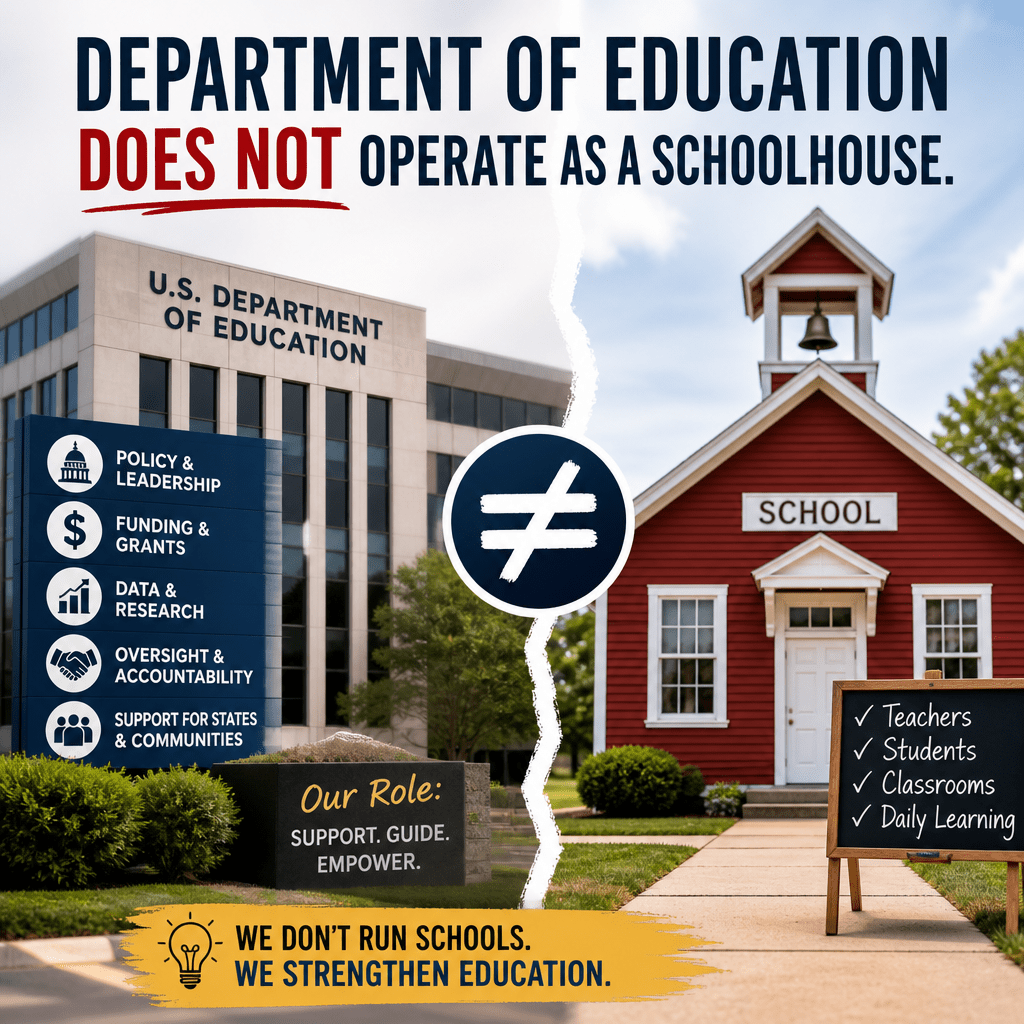
The Department Education does not operate like a schoolhouse. It does not sit with children, teach lessons, or shape judgment in any direct way. It functions more like a federal apparatus.
It moves paper. It moves money. It moves mandates.
And in doing so, it often gives the appearance of progress while education itself becomes harder to recognize.
Table of Contents
- A Machine Built for Compliance
- How the Federal Role Expanded
- The Rise of Educational Bureaucracy
- Teachers’ Unions and the Political Schoolhouse
- Families Changed Too
- What the Department Actually Produces
- The Cost to Students
- Accountability Has Changed Meaning
- The Arithmetic of Collapse
- What a Better Vision Would Require
- Final Thought
A Machine Built for Compliance
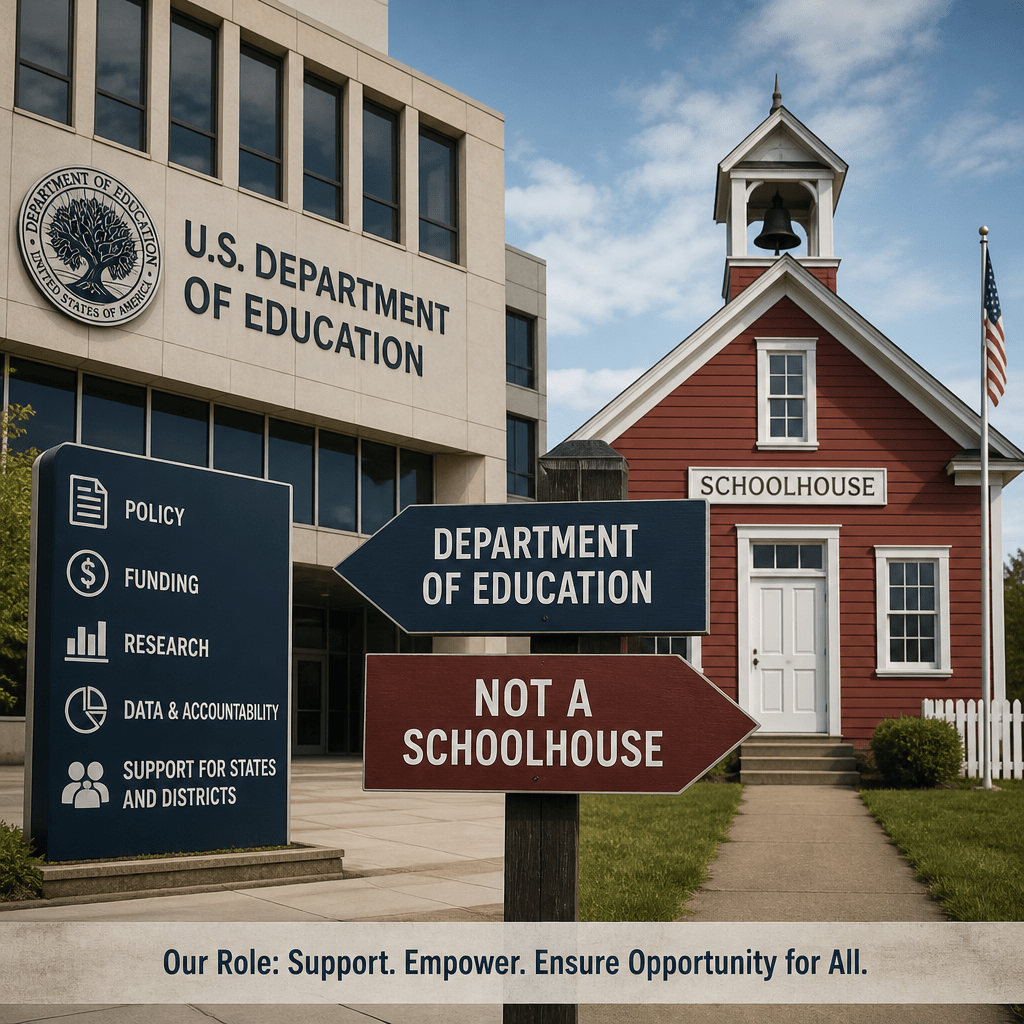
The modern education system is filled with rules, reports, audits, and standards. That is not an accident. It is the result of decades of expansion in federal involvement. The Department Education does not operate as a schoolhouse because its central logic is administrative rather than formative.
What began as an effort to correct injustice slowly grew into a structure of administration. In practice, that structure now rewards compliance over creativity, reporting over teaching, funding over stewardship, and metrics over judgment. That shift is one reason the Department Education does not operate in the same way a schoolhouse does.
A schoolhouse exists to educate children. A federal department exists to manage systems. Those are not the same thing, and the difference matters more as the system becomes more elaborate.
Even the appearance of success can be misleading. Paper can be filed on time while real learning stagnates. Standards can be published while attention, memory, and reasoning weaken. The machinery may look orderly, but order is not the same as formation.
How the Federal Role Expanded
The story did not begin with the Department itself. It began much earlier, especially after 1964, when the nation took serious steps to confront segregation and expand opportunity. The Department Education does not operate outside that history; it grew out of it.
That era brought major reforms, including desegregation efforts, busing policies, and the Elementary and Secondary Education Act. These changes opened doors that had long been closed. They were morally serious and historically important.
For a concise reference on the law that shaped much of this federal expansion, see the National Archives overview of the Elementary and Secondary Education Act.
But those reforms also created pipelines of money, regulation, oversight, and administration. Every reform came with paperwork. Every new program needed reviewers. Every federal dollar needed tracking. And with each layer of good intention, the bureaucracy grew stronger. The Department Education does not operate as a neutral bystander to this process; it is one of its clearest expressions.
We built machinery to repair injustice, and then forgot how to stop it.
The Rise of Educational Bureaucracy
As federal involvement increased, schools became more dependent on external systems of control. Teachers and administrators were asked to navigate a growing world of forms, requirements, and compliance rules. The Department Education does not operate like a local school board or a classroom because it is designed for scale, not intimacy.
That had consequences. Instead of spending time on instruction, reading, discussion, character formation, and deeper thinking, schools increasingly spent time on grant writing, reporting, audits, evaluations, and performance tracking.
The result was not merely inconvenience. It was a quiet reordering of priorities. When the institutional conversation is dominated by compliance, the classroom inevitably loses some of its freedom. The Department Education does not operate like a teacher because it cannot. Its tools are broad and procedural, not personal and formative.
Teachers still teach, of course, but they do so within a system that often asks them to prove what they already know. Administrators still lead, but they do so under growing obligations to document every decision. The more the system expands, the more energy it consumes before a child ever opens a book.
For readers interested in the broader policy context, the Department Education does not operate in isolation from the larger federal framework that shaped modern schooling. Its procedures reflect that history in almost every layer.
Teachers’ Unions and the Political Schoolhouse
Another major shift came with the rise of teachers’ unions. At their best, unions were formed to protect dignity, fairness, and professional respect. Those were real needs. Earlier generations of teachers often faced low pay and poor working conditions.
But success changed the landscape. Through collective bargaining, local elections, and national lobbying, unions became powerful political actors. Education was no longer just about students and teachers. It became part of a broader political contest. In that world, the Department Education does not operate as a simple steward of learning; it becomes one node in a larger field of influence.
As a result, classrooms began to feel like negotiating tables. Education became a constituency. That shift matters because the purpose of schooling changed in practice. The moral and intellectual formation of the young had to compete with budgets, benefits, contracts, and ballots.
Formation was no longer a covenant. It became an agenda item.
This is one of the deepest reasons the Department Education does not operate like a schoolhouse. A schoolhouse is grounded in daily encounter: teacher, student, text, lesson, correction, repetition, and growth. Political systems are grounded in leverage, bargaining, and distribution. They are not evil by definition, but they are not the same thing as formation.
Families Changed Too
This transformation was not only political. It was cultural.
Families changed. Work changed. Neighborhood life changed. In earlier generations, schools were supported by a dense web of family, church, and community life. Children were shaped by many institutions at once.
Over time, more of that responsibility drifted toward the schoolhouse. Teachers were asked to be educators, counselors, guardians, social workers, and behavior managers. Schools became holding centers for children while adults worked longer hours and expected the system to “take care” of everything else.
This helped create what many call the babysitting mentality. It is a quiet problem. Expectations slowly fall. Schools are asked to supervise more than they are asked to teach. Child development becomes a broad slogan, but the real work of formation gets thinner.
The Department Education does not operate as a family, either. It cannot provide presence, continuity, or love. Yet many of the burdens once carried by family and local community are now assumed to be handled by institutions that were never built for that purpose.
That is part of the tragedy. As the moral weight shifts away from the home and toward bureaucracy, the classroom is asked to do more than it can. The Department Education does not operate like a schoolhouse because it is, in many respects, helping manage the transfer of responsibility from persons to systems.
What the Department Actually Produces
By the time the Department of Education was created in 1979, the machinery was already running. The Department did not invent the system. It perfected it.
Its work is procedural, not Socratic. It does not exist to cultivate wisdom. It exists to administer programs, standards, and funding streams. The Department Education does not operate like a schoolhouse because its success is measured in administrative terms, not in the quiet and difficult terms of human growth.
That produces predictable outcomes:
- teachers spend more time on forms than on instruction
- administrators learn survival rather than stewardship
- compliance teams expand
- local judgment weakens
- federal money arrives with hidden costs in time and attention
Each new rule creates another layer. Each grant creates another reporting requirement. Each mandate increases the distance between the classroom and the child. The more efficiently the system operates on paper, the more difficult it becomes to preserve the human scale of education.
The Department Education does not operate as a schoolhouse because it is not built for human formation. It is built for system maintenance.
For a related reflection on this same institutional drift, read The Department of Education and the Collapse of Formation.
The problem is not that administration is unnecessary. Some administration is always necessary. The problem is proportion. When administration becomes the dominant reality, education loses its center. The classroom then serves the system instead of the student, even if everyone involved insists otherwise.
The Cost to Students
The tragedy is not only financial. The deeper tragedy is educational.
When schools become compliance engines, they lose the very conditions that make learning meaningful: time for reading, space for reflection, serious engagement with history, exposure to classic texts, and patient development of judgment.
Instead, students are often trained to meet benchmarks. But benchmarks are not wisdom. Standards are not character. And test scores are not citizenship.
The Department Education does not operate like a schoolhouse in part because a schoolhouse should cultivate the interior life of the student. A bureaucratic system can count outcomes, but it cannot produce the habits that make those outcomes worthwhile.
A republic needs more than students who can fill in bubbles. It needs people who can think clearly, remember deeply, and judge well. It needs citizens who can distinguish truth from slogan, principle from preference, and duty from convenience. That kind of formation cannot be reduced to a spreadsheet.
As curriculum narrows and instruction becomes more procedural, many young people inherit a thin education: fragmented history, shallow reading, and only partial contact with the moral language of their civilization. The Department Education does not operate like a schoolhouse because it cannot carry the whole burden of meaning that real education requires.
Accountability Has Changed Meaning
In theory, accountability should serve the public good. In practice, it often means reporting, measurement, and procedural verification. That is a thin version of accountability.
Real accountability is moral. It asks whether institutions are serving children well. It asks whether schools are forming citizens. It asks whether liberty is being strengthened.
But the modern system often measures success by dollars moved, forms completed, programs launched, and metrics met. That is not the same thing as educating a people. The Department Education does not operate like a schoolhouse when accountability becomes a technical language detached from human ends.
Congress itself often reflects this shift. School policy gets buried inside huge omnibus bills. Debate becomes distant. Vision becomes technical. The moral center of education is lost inside administrative language.
That does not mean all measurement is bad. It means measurement has limits. A school can only be understood fully when numbers are placed in the service of judgment, not when judgment is replaced by numbers. The Department Education does not operate like a schoolhouse because it prizes what can be counted more easily than what must be discerned patiently.
The Arithmetic of Collapse
The collapse of formation is not accidental. It is arithmetic.
We rewarded spending over stewardship, expansion over excellence, compliance over conscience, administration over instruction, and supervision over formation.
That is why the system looks busy but produces weak results. It is not failing at its own purpose. It is succeeding at the purpose it quietly adopted. The Department Education does not operate like a schoolhouse because the surrounding culture gradually accepted a different standard of success.
It was designed to manage. Not to form.
And once that distinction is admitted, many other failures begin to make sense. Why do teachers feel buried? Why do parents feel distant from the process? Why do students often feel processed rather than known? Why does a system that spends so much still struggle to cultivate serious learners? The answer is not mysterious. A machine made for administration will produce administrative outcomes.
In that sense, the Department Education does not operate like a schoolhouse is not merely a criticism. It is a diagnosis of institutional design.
We should be honest about the cost of that design. Time is lost. Trust is thinned. Local authority is displaced. Initiative is discouraged. And the imagination of what education could be shrinks to fit the available forms.
What a Better Vision Would Require
If education is to recover its purpose, it must be understood differently.
It should not be treated as a marketplace of programs or a federal machine for distributing mandates. It should be treated as a workshop of the soul.
That means restoring focus to what actually matters: teaching truth, reading hard books, learning history in full, practicing reason, building character, and strengthening civic responsibility.
Teachers should be able to teach because truth is worth knowing. Students should be formed because liberty is worth keeping. And schools should remember that their first duty is not bureaucratic success, but human development.
The Department Education does not operate like a schoolhouse, and that is precisely why a healthier vision must begin by restoring the distinction between administration and formation. We need institutions that trust local judgment where appropriate, protect serious instruction, and stop assuming that every problem can be solved by another layer of management.
That does not require nostalgia. It requires realism. Real education has always depended on habits, relationships, memory, discipline, and shared moral purpose. A bureau can support those things, but it cannot substitute for them.
What would recovery look like?
- more direct instruction and less paperwork
- more classical reading and less curricular fragmentation
- more local responsibility and less distant control
- more teaching and less institutional theater
- more trust in human judgment and less dependence on sterile metrics
These are not radical ideas. They are simply the conditions under which a schoolhouse can be a schoolhouse again.
The Department Education does not operate like a schoolhouse because its scale is impersonal
At a deeper level, the reason the Department Education does not operate like a schoolhouse is simple: it is organized around scale, not intimacy.
A schoolhouse depends on presence. It depends on a teacher who knows a child, a lesson that reaches a mind, and a shared moral life that can be passed on through daily practice. A federal department cannot do that work, no matter how carefully it writes regulations or distributes grants.
Its instruments are necessarily impersonal. It can set guidelines, but it cannot sit beside a struggling reader. It can fund a program, but it cannot replace judgment. It can ask for outcomes, but it cannot manufacture the habits of mind that make outcomes meaningful.
That gap matters because the modern educational crisis is not only one of resources. It is one of form. The structure has been built for administration, and administration is a poor substitute for formation.
When people say the Department Education does not operate like a schoolhouse, they are not merely criticizing an agency. They are naming a category mistake: we asked a bureaucratic machine to do the work of a human institution.
It was never likely to succeed.
And yet the fix is not impossible. It begins with clearer expectations, smaller ambitions for bureaucratic control, and a renewed willingness to let real teachers do the work of teaching. It also begins with a public that understands why the Department Education does not operate like a schoolhouse and stops pretending that it should.
Final Thought
The Department of Education does not operate like a schoolhouse because it was never meant to.
It is a great federal apparatus. A machine of paper, money, and mandates. It can move resources. It can enforce rules. It can standardize procedures.
But it cannot, by itself, form citizens.
That work belongs elsewhere.
It belongs to teachers, families, communities, and institutions that still believe education is more than supervision.
If a republic wants formed citizens, it cannot rely on audit reports and test schedules alone. It needs schools that teach, adults who guide, and a culture that remembers why learning matters.
Until that happens, the system will keep producing the same result: efficient machines, crowded classrooms, and unformed citizens in need of the very education they have been promised.
The Department Education does not operate like a schoolhouse, and the sooner we admit that, the sooner we can begin recovering what education was supposed to be.