
Most people experience reality from the inside.
We see solid objects. We feel continuous space. We assume the world exists in full detail, whether we are paying attention or not.
But that assumption may be too simple.
My path to understanding did not begin with philosophy. It began with physics, biology, and the mechanics of perception. I kept running into the same pattern across different fields.
- Quantum experiments suggested reality is not fully fixed until it is measured.
- Neuroscience showed that the brain renders only a narrow slice of the world in high detail.
- Biology showed that consciousness requires computation.
- Physics suggested the universe behaves like a rule system, not a warehouse of stored objects.
When you connect those ideas, a simple model emerges.
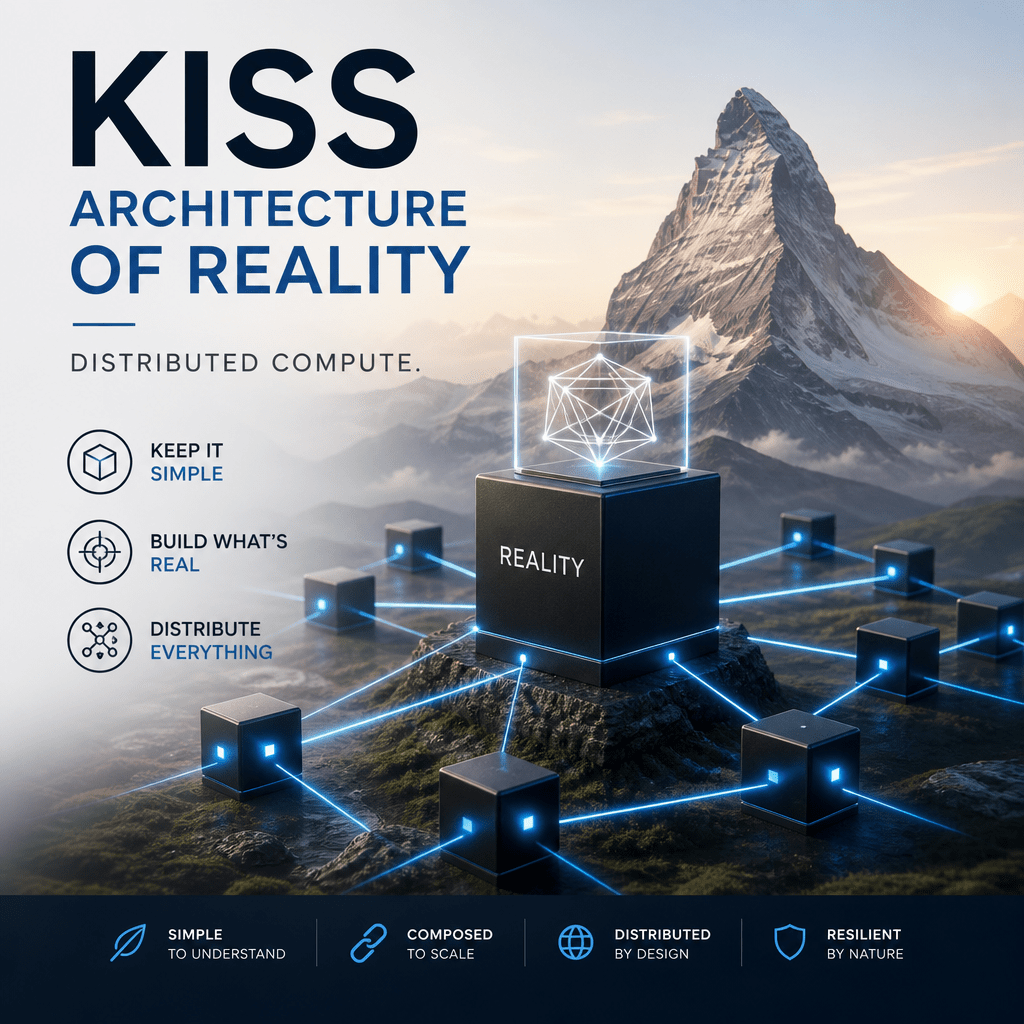
This is the KISS Architecture of Reality: Keep It Simple, Stupid.
Not as an insult, but as an engineering principle.
If reality were built with simplicity and efficiency in mind, it might look exactly like the world we experience.
Table of Contents
- Reality Feels Alive Because We Render It That Way
- The Universe Stores Rules, Not Objects
- The Brain Is a Distributed Compute Node
- Human Perception Is Narrow and Partial
- The Double Slit Experiment and the Role of Measurement
- Why Matter Seems Conscious
- Node Failure and Replacement
- The Human Rule Set Is Fragile
- Why This Model Matters
- A Simple Summary
Human beings have spent thousands of years trying to explain why the world feels aware.
Ancient traditions imagined spirits in rivers, intention in storms, and consciousness in mountains. These ideas were not always irrational. They were early attempts to explain a real experience:
The world seems to respond to us.
But that does not mean the world itself is conscious.
A more likely explanation is simpler.
We are conscious.
We interpret the world through biological compute.
That interpretation gives the world the feeling of awareness.
So when the forest feels watchful or the ocean feels deep and alive, that is not proof that matter is conscious.
It is proof that consciousness projects meaning.
Reality Feels Alive Because We Render It That Way
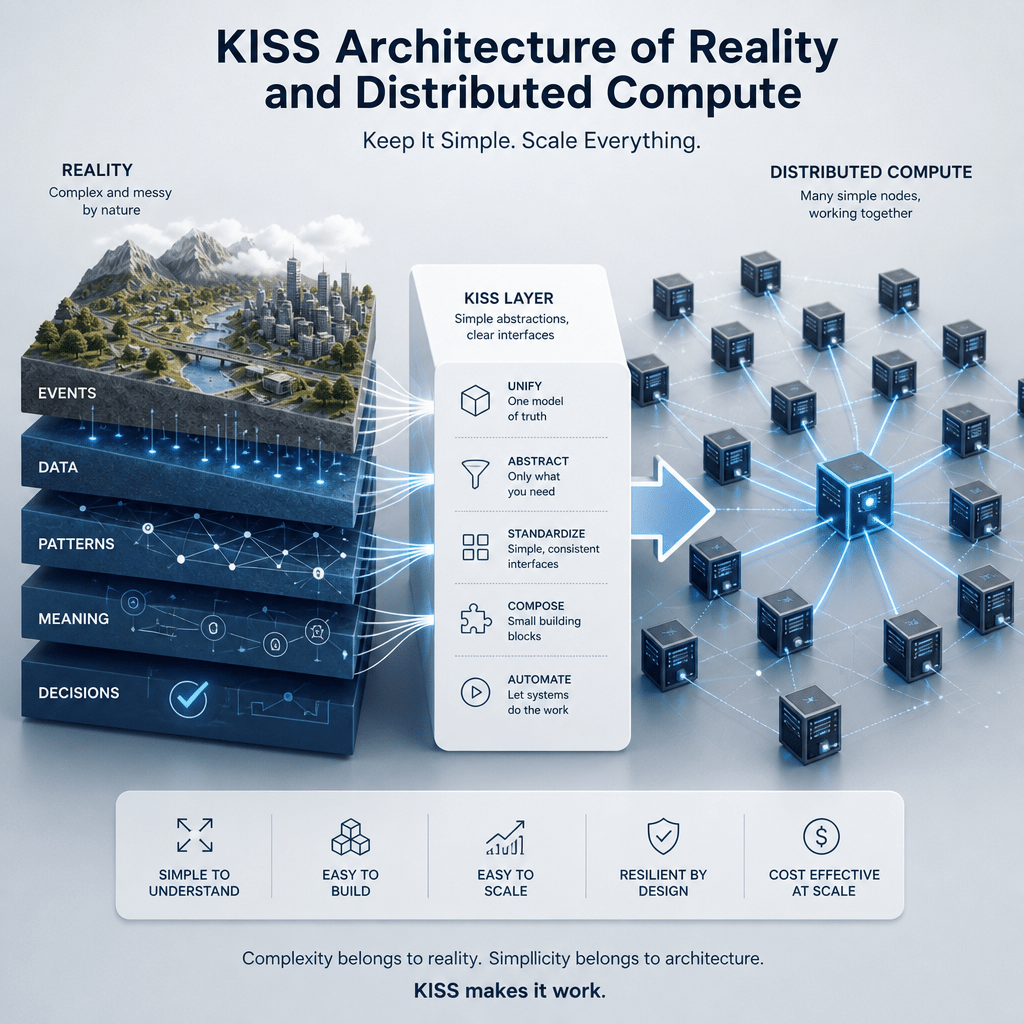
The world can feel alive because the mind is always constructing a model of it. That model is not a mystical overlay; it is a practical survival tool. We do not passively receive reality in full. We compress it, sort it, predict it, and fill in the gaps.
That is one reason the KISS Architecture of Reality makes sense as a framework. If the system were unnecessarily complex, every moment of awareness would be expensive. Instead, the system appears to use the simplest workable method: limited input, local rendering, and continuous correction.
Ancient people did not have modern neuroscience, but they were noticing the same effect. The environment seemed animated because the observer was animated. The felt sense of presence came from within the observer, not from the matter itself.
The Universe Stores Rules, Not Objects
If you were designing a simulation for billions of users, you would not store every object in full detail.
You would not save:
- every chair
- every rock
- every cloud
- every blade of grass
That would be wasteful and unscalable.
Instead, you would store rules:
- physics
- mathematics
- chemistry
- quantum behavior
- conservation laws
Objects would be generated when needed.
A chair is not stored somewhere in cosmic memory. It is what happens when atoms follow the rules.
This is the first principle of the KISS Architecture of Reality:
The universe stores code, not furniture.
That idea is not identical to a simulation claim, but it rhymes with the logic of efficient computation. For a clear reference point on how physics models fundamental behavior through rules and measurements, see Britannica’s overview of quantum mechanics.
The Brain Is a Distributed Compute Node
A centralized system would collapse under its own weight.
If one processor had to render a complete world for billions of observers, the cost would be impossible.
The scalable solution is distributed rendering.
Each human brain acts like a biological compute node. It receives sparse sensory input and builds a coherent world from it.
The brain:
- receives limited data
- fills gaps with prediction
- uses memory to stabilize experience
- creates continuity
- generates meaning and narrative
In other words:
The universe does not render reality. The brain renders reality.
This is the second principle:
Push computation to the edge.
The Warm Peak of Earth: Preparing Civilization for Extreme Heat offers a related example of how systems only remain usable when limits, adaptation, and local conditions are taken seriously.
Human Perception Is Narrow and Partial
People often assume they see the world directly.
They do not.
Biologically, human vision is highly restricted. Only a tiny cone of vision is rendered in sharp detail. The rest is lower resolution, more like a rough background.
The brain then fills in what is missing.
This is similar to modern virtual reality systems using foveated rendering.
- High detail is shown only where the user is looking.
- Lower detail is used everywhere else.
- The experience feels complete, even though it is not fully rendered.
Human perception works the same way.
We do not experience the whole world in full resolution. We experience a stable model built from selective attention.
This supports the third principle of the KISS Architecture of Reality:
Render only what the observer attends to.
That is why moments of attention can feel so powerful. Once the mind locks onto a detail, the rest of the environment recedes into a background model. The experience is not false; it is filtered. And filtering is not a bug. It is what makes experience possible at all.
The same logic explains why a scene can change depending on context, expectation, or emotional state. The brain is not a passive camera. It is an active constructor. It predicts before it confirms, and it confirms only what matters enough to survive as experience.
Seen this way, the KISS Architecture of Reality is not about reducing wonder. It is about explaining wonder with a model that can actually be tested against ordinary life. Every day, your senses give you a partial sample, and your mind turns that sample into a livable world.
The Double Slit Experiment and the Role of Measurement
The double slit experiment is often misunderstood.
A photon does not “choose” to behave like a wave or a particle. It has no intent, no awareness, and no decision-making ability.
Its behavior depends on the measurement setup.
When no measurement is made, the system remains probabilistic. When measurement occurs, the outcome becomes definite.
That collapse is not evidence that the photon is conscious.
It is evidence that measurement changes the system.
This matters because it separates mind from matter.
- Matter follows physical law.
- Minds observe, compare, and model.
- Measurement extracts information.
The observer does not give the photon a mind.
The observer determines the mode of appearance.
For readers who want a formal baseline on the experiment itself, the double-slit experiment explained by Britannica is a useful starting point.
In the language of the KISS Architecture of Reality, this is exactly what one would expect from a system that only resolves detail when interaction makes resolution necessary. The world does not need to be precomputed in its entirety for experience to feel consistent. It only needs to remain rule-bound, repeatable, and responsive to measurement.
That does not prove that the universe is a simulation. It does, however, show that reality behaves more like an information process than a static object. The distinction matters. A static object simply exists. An information process responds, updates, and stabilizes under constraints.
If the universe is built for efficiency, then measurement is one of its simplest tools. It turns potential into outcome without requiring the system to store everything all at once.
Why Matter Seems Conscious
Many traditions treated matter as alive.
Storms were angry.
Rivers were wise.
Mountains were ancient beings.
But matter has no:
- brain
- sensory input
- memory
- internal model
- compute
A single cell has chemistry. It does not have consciousness in the human sense.
So why does the world feel animated?
Because the brain assigns meaning to it.
We are pattern-making systems. We detect agency everywhere. We turn motion into intention and structure into significance.
This is why the world can feel alive even if it is not alive in itself.
The illusion comes from the observer.
This is the fourth principle of the KISS Architecture of Reality:
Let observers generate meaning locally.
That same tendency to project significance is one reason the architecture of phobias and attention matters in lived experience; once the mind tags a pattern as important, it can reshape the whole field of perception.
When we do this at scale, culture itself begins to act like a shared rendering system. Symbols, stories, rituals, and habits all become ways of agreeing on what matters. If those signals are coherent, people can coordinate. If they are distorted, the same world begins to feel hostile, random, or enchanted in ways that are really just distortions of the human model.
This is also why fear can spread faster than evidence. The brain is built to prioritize threat, and once it treats a pattern as dangerous, it reuses that pattern across many contexts. Meaning then becomes sticky. In that sense, perception is not only local; it is self-reinforcing.
Node Failure and Replacement
In any distributed system, nodes fail.
Humans die.
But the system does not stop.
New nodes arrive.
Children are born, and the process continues. The underlying rule set remains stable. Physics does not need our permission to keep working.
The laws stay in place.
Observers come and go.
This is the fifth principle of the KISS Architecture of Reality:
Make observers disposable, but keep the rule set permanent.
That is part of what makes reality coherent.
The universe does not depend on any single observer.
But observers do depend on the universe.
That permanence is what makes inheritance possible. Each new human enters a world already structured by the same rules that shaped the previous one. The child does not invent gravity, language, or causality. The child discovers them, gradually, through contact with a world that was already ordered before any individual arrived.
This is also where continuity matters psychologically. A stable rule set allows knowledge to accumulate across generations. If the underlying system changed every time a person died, learning would be impossible. Civilization depends on a reality that persists beyond the observer. The KISS Architecture of Reality explains that persistence as an efficiency feature: the rules remain, while the nodes rotate.
The Human Rule Set Is Fragile
The cosmic rule set may be stable, but the human rule set is not.
A newborn does not arrive knowing how reality works. It comes with genetic programming and raw sensory ability, but not with a full understanding of the world.
Everything else must be learned:
- how to reason
- how to interpret events
- how to distinguish fact from feeling
- how to use shared language
- how to apply common definitions
For most of human history, this transmission happened through family, apprenticeship, and education.
When that transmission is weak, people lose a common framework.
Then each person starts rendering a different version of reality.
That is where confusion begins.
If people cannot agree on the rules of interpretation, they cannot agree on what reality means.
This is where the idea of moral grammar becomes important.
Moral grammar is the shared rule set that helps people process truth, language, responsibility, and meaning in compatible ways. Without it, even basic communication breaks down.
The phrase also points to a deeper social problem: a culture can preserve institutions while losing the interpretive habits that give those institutions coherence. In that case, people still use the same words, but they no longer share the same definitions. The result is not merely disagreement; it is incompatible rendering.
That fragility helps explain why some societies become internally fragmented even while their physical infrastructure remains intact. The hardware may be present, but the software of shared judgment has degraded. The KISS Architecture of Reality is useful here because it treats interpretation as a structured process, not a vague feeling. If the process is damaged, experience itself becomes unstable.
Why This Model Matters
The KISS Architecture of Reality is not meant to be mystical.
It is meant to be practical.
It gives a simple framework for understanding why:
- the world feels stable
- perception is limited
- observation matters
- consciousness feels local
- cultural confusion can distort reality
It also reminds us that experience is not the same thing as raw reality.
We do not see everything.
We see a useful model.
That model is built by biology, constrained by physics, and shaped by attention.
The same logic applies in education, culture, and public life: if the shared framework breaks, each observer begins to render a different world from the same inputs. That is why the Moral Grammar conversation matters beyond philosophy.
It also helps explain why people can inhabit the same neighborhood, read the same headlines, and still arrive at incompatible conclusions. If the interpretive rules differ, the outputs will differ too. That is not merely a disagreement over facts. It is a disagreement over the process by which facts are made legible.
In that sense, the KISS Architecture of Reality is a bridge between hard science and lived experience. It does not collapse the world into metaphor. It shows how a rule-bound universe can still generate the subjective richness of sight, feeling, memory, and social meaning.
And because the model is simple, it can be carried forward. It gives people a way to ask better questions: What is being measured? What is being inferred? What is being filled in by the brain? What is coming from the world, and what is being added by the observer?
A Simple Summary
If this framework is correct, reality works like this:
- The universe stores rules, not objects.
- The brain renders the world locally.
- Attention determines what gets high-resolution processing.
- Measurement turns probability into experience.
- Consciousness is compute, not magic.
- Meaning is generated by observers.
- The rule set is stable, but human interpretation is fragile.
That is the architecture.
And it is simple.
Not simplistic.
Just efficient.
In that sense, the KISS Architecture of Reality is less a claim that the universe is artificial than a reminder that the simplest workable system often explains the most. The more carefully we look, the more the world resembles a distributed process: physics supplies the constraints, biology supplies the render engine, and attention supplies the frame.
When those layers stay aligned, the world feels coherent. When they do not, the result is confusion, projection, and competing stories about what is real.
That is why the KISS Architecture of Reality remains useful even if you reject the strongest metaphysical interpretation. It gives a disciplined way to talk about perception, measurement, and meaning without pretending that the observer is all-powerful or that matter is conscious. The model simply says that the experience of reality is assembled locally from partial inputs, stable rules, and biological computation.
That may not satisfy every philosophical question, but it does satisfy something equally important: explanatory economy. And in both science and life, economy is often a sign that you are close to the structure that matters.
Conclusion
The world may not be a fully rendered object waiting to be noticed.
It may be a rule-based system that becomes experienced through biological compute.
That does not make reality fake.
It makes reality elegant.
The KISS Architecture of Reality suggests that what we call “the world” is not a finished display, but an active process of rendering, interpretation, and shared rule following.
Physics gives the rules.
Biology gives the compute.
Consciousness gives the experience.
And together, they create the world we think we live in.
That is the simplest version of the argument, and it is also the most durable one: the KISS Architecture of Reality does not require the universe to be magical, only efficient. It only requires us to admit that observers are limited, models are local, and meaning is constructed as much as it is discovered.
When we understand that, we can stop mistaking the rendering for the territory. We can also begin to see why shared language, shared standards, and shared reasoning matter so much. They are not social decorations. They are the structure that lets many observers inhabit one world without losing the thread.