
Intellectual adulthood requires confrontation with difficult ideas. That is why disputation mattered so much in older systems of education. It was not a side activity. It was a mandatory subject.
People understood that real thinking requires pressure. Ideas become stronger when they are challenged. Weak ideas collapse. Strong ideas sharpen. Disputation gave students a disciplined way to meet that pressure and learn how to think without flinching.
- What Intellectual Adulthood Really Means
- Why Difficult Ideas Matter
- Why Disputation Was a Mandatory Subject
- What Modern Education Often Misses
- The Value of Being Challenged
- Disputation Builds Stronger Minds
- Why Avoiding Hard Ideas Is Risky
- How to Practice Intellectual Adulthood Today
- Signs of Intellectual Immaturity
- The Discipline of Real Thinking
What Intellectual Adulthood Really Means
 /p>
/p>
Intellectual adulthood is the ability to think beyond comfort.
A person in this stage can:
- listen to views they dislike
- separate emotion from evidence
- admit when they are wrong
- revise a belief without losing dignity
- engage disagreement without panic
This is very different from simply being informed.
A person can know many facts and still remain intellectually immature. True maturity shows up when a difficult idea appears and the mind does not shut down. That is the point at which learning becomes more than memorization and begins to shape character.
In that sense, intellectual adulthood is not a private achievement. It is a public discipline. It shows itself in how a person speaks, listens, and answers when challenged.
It also involves proportion. Mature thinkers know that not every disagreement is equally important, but they also know that some disagreements reveal whether a person has actually understood the subject. The difference between a casual opinion and a serious judgment often becomes visible only after scrutiny. That is why the habit of careful examination matters so much. It helps a person distinguish between what merely sounds plausible and what can survive sustained questioning.
To reach that level, a student has to become comfortable with uncertainty. They must be willing to sit with a problem long enough to see it clearly instead of rushing toward the first answer that protects their ego. That patience is not passive. It is active self-discipline. It trains the mind to stay steady in the presence of complexity, and that steadiness is one of the clearest signs of intellectual adulthood.
Why Difficult Ideas Matter
Difficult ideas do an important job. They expose the limits of our assumptions.
Without them, we tend to live inside mental echo chambers. We hear only what confirms what we already believe. That can feel safe. But it does not lead to growth.
Hard ideas force us to ask:
- What if I am missing something?
- What if my first reaction is too simple?
- What if the opposite view contains part of the truth?
- What if my beliefs need repair?
These are uncomfortable questions. They are also necessary ones.
A mind that avoids difficulty stays shallow. A mind that welcomes challenge becomes stronger. The habit of staying with a hard question long enough to understand it is one of the clearest marks of seriousness.
For a broader treatment of how formation and character shape understanding, see Moral Grammar: Stunning Best Guide to Civic Character.
Difficult ideas matter because they prevent intellectual laziness. They force a person to move beyond reflex and toward judgment. When a claim is easy to accept, it may not have been tested. When a claim is hard to accept, it may deserve the most attention. Many of the most important truths in life are not obvious at first glance. They require a person to slow down, compare possibilities, and think through consequences.
This is one reason disputation has endured as a serious educational practice. It trains the student not merely to repeat what is familiar, but to investigate what is true. That kind of investigation is not always comfortable, yet it is indispensable if learning is meant to produce wisdom rather than mere familiarity with information.
Why Disputation Was a Mandatory Subject
In many classical educational traditions, disputation was central to learning.
Students were required to argue both sides of an issue. They had to defend a claim, answer objections, and refine their reasoning in public. This was demanding. It could be stressful. But it trained people to think clearly.
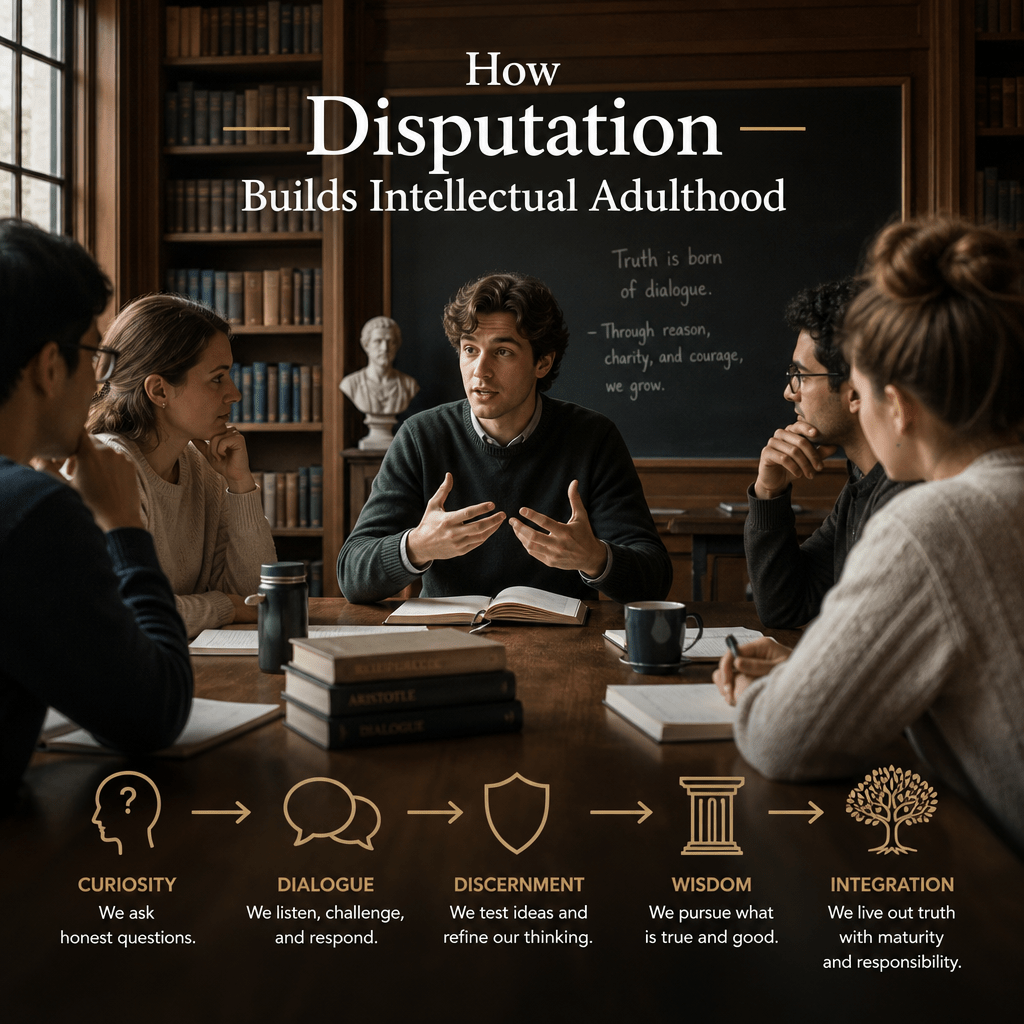
Disputation taught several essential habits:
- precision in language
- discipline in reasoning
- respect for objections
- tolerance for disagreement
- humility before truth
It was not about winning an argument.
It was about learning how truth survives scrutiny.
When disputation was mandatory, students could not avoid disagreement. They had to meet it directly. That made intellectual adulthood possible.
This was also why older educators treated debate as formation, not performance. The goal was not to produce clever talkers. The goal was to produce people capable of careful judgment.
Seen this way, disputation was a kind of intellectual apprenticeship. A student did not simply receive conclusions from a teacher and move on. They had to learn how those conclusions were defended, where they were vulnerable, and what objections needed to be answered. This process created resilience. It gave students a framework for assessing ideas rather than merely absorbing them. In a culture that values speed, disputation slows the mind down enough for discernment to happen.
That slower pace is not a weakness. It is one of the main reasons the practice was so effective. Important questions do not reward haste. They reward careful attention. A mandatory subject in disputation reminded students that the search for truth includes friction, and that friction is not an obstacle to learning but one of its primary tools.
What Modern Education Often Misses
Today, many people are encouraged to express opinions quickly. But they are not always taught how to test those opinions.
That creates a problem.
Without practice in disputation, many learners:
- confuse confidence with correctness
- treat disagreement as hostility
- repeat arguments they have never examined
- avoid topics that make them uneasy
- struggle when their views are challenged
This is not intellectual adulthood.
It is intellectual fragility.
The modern world gives us instant access to information, but not always the discipline to evaluate it. That is why the older emphasis on disputation still matters.
There is also a difference between exposure and formation. A student may encounter many views online and still never learn how to weigh evidence, spot a weak inference, or distinguish a serious objection from a rhetorical flourish. Those skills must be practiced, not merely absorbed.
In many environments, students are rewarded for responsiveness rather than reflection. They learn to answer quickly, but not necessarily well. They may accumulate opinions before they acquire the habits needed to inspect them. Disputation corrects that imbalance by requiring the learner to hold an argument in their hands, turn it over, and examine it from more than one angle. That is a very different mode of education from simply reacting to whatever appears on a screen.
Modern education often misses the moral side of thinking as well. A person who cannot handle disagreement patiently may eventually become careless with truth itself. The issue is not only whether the student can speak, but whether they can listen without defensiveness and evaluate without prejudice. Those capacities do not emerge by accident. They are formed through repeated exposure to disciplined disagreement.
The Value of Being Challenged
A difficult idea is not always a threat. Often, it is a gift.
Being challenged can reveal:
- hidden assumptions
- weak logic
- emotional bias
- incomplete evidence
- better alternatives
In this sense, disagreement is useful. It shows where thought needs work.
Many people want affirmation. Fewer want correction. But correction is often what leads to growth.
Intellectual adulthood begins when a person can say:
- “I had not considered that.”
- “That objection is strong.”
- “My view may need revision.”
- “I need to think more carefully.”
These are not signs of weakness. They are signs of maturity.
For a useful reference on structured argument and debate, the Stanford Encyclopedia of Philosophy’s overview of informal logic is a strong starting point.
Being challenged also reveals whether a person is attached to truth or merely attached to being right. That distinction is crucial. A person attached to truth can be corrected because correction serves their purpose. A person attached to pride experiences correction as humiliation. Disputation is valuable because it trains people to tolerate the discomfort of correction without collapsing into defensiveness.
This becomes especially important in communities and institutions where important decisions are made under pressure. Good decisions require people who can hear objections without treating them as personal attacks. They require minds that can weigh evidence even when the answer is inconvenient. A culture that avoids challenge may preserve temporary harmony, but it usually does so at the cost of wisdom. Challenge is not the enemy of unity; often, it is the means by which unity becomes honest and durable.
Disputation Builds Stronger Minds
Disputation does more than expose error. It builds intellectual strength.
A person trained in disputation learns how to:
- distinguish argument from insult
- identify assumptions
- evaluate evidence
- respond to criticism calmly
- revise ideas without ego
These skills matter in school, work, politics, religion, and everyday life.
A disputatious environment, when handled well, encourages seriousness. It reminds people that important questions deserve more than slogans.
It also teaches that truth is not fragile. Honest questioning does not destroy truth. It helps reveal it.
That is why disputation remains valuable even outside formal classrooms. In conversation, writing, and public life, the same discipline applies: hear objections fairly, answer them precisely, and avoid the temptation to substitute noise for reasoning.
Strong minds are not simply full minds. They are flexible minds. They can hold a position without becoming brittle. They can encounter resistance without becoming defensive. They can admit complexity without feeling defeated by it. Disputation builds this kind of strength because it repeatedly places the learner in contact with resistance that must be answered intelligently.
That process also clarifies language. Many disagreements continue only because words are used loosely. Disputation forces definitions, distinctions, and careful phrasing. It makes students ask whether they are actually arguing about the same thing or whether hidden assumptions are driving the conflict. In that way, the practice improves both thought and speech. A stronger mind is one that can speak precisely because it has learned to think precisely.
Why Avoiding Hard Ideas Is Risky
Avoidance may feel easier in the short term. But it carries a cost.
When people avoid difficult ideas, they may become:
- intellectually complacent
- emotionally reactive
- easy to manipulate
- loyal to opinions rather than truth
- unable to handle complexity
A person who cannot face challenge will also struggle to grow.
Intellectual adulthood requires courage. It requires the willingness to read what unsettles you, hear what you dislike, and examine what you would rather ignore.
That is not a threat to identity. It is the path to wisdom.
Once avoidance becomes a habit, even small disagreements can feel overwhelming. The result is a mind that reacts quickly but reasons slowly, if at all. Disputation interrupts that pattern by training patience and resilience.
There is also a civic risk in avoiding hard ideas. Communities made up of people who never practice serious disagreement become vulnerable to manipulation by slogans, tribes, and emotional pressure. When no one has learned how to evaluate competing claims, the loudest voice can begin to masquerade as the strongest argument. A culture that neglects disputation may still produce many opinions, but it will struggle to produce judgment. And without judgment, people cannot reliably tell the difference between persuasion and truth.
That is why avoiding hard ideas is not merely a personal weakness. It can become a social one. The habits of thought learned by individuals shape the intellectual health of families, schools, and institutions. If a community rewards only comfort, it will eventually lose its capacity for honest self-correction. Disputation helps resist that decline by preserving the practice of thoughtful challenge.
How to Practice Intellectual Adulthood Today
You do not need a medieval classroom to practice disputation. You can begin in everyday life.
Try these habits:
- Read views you disagree with in good faith.
- Summarize the opposing argument before answering it.
- Ask what evidence would change your mind.
- Pause before reacting to ideas that upset you.
- Separate a person’s worth from their opinion.
- Look for the strongest version of the other side.
- Welcome correction as part of learning.
These practices are simple, but they are not easy.
They require discipline.
They also require honesty.
If you want to strengthen this habit, make it concrete. Choose one contested issue, write the best version of the argument against your position, and then answer it without dismissing its strongest points. That exercise alone can reveal how much a person actually understands.
You can also practice this form of maturity by revisiting old conclusions. Ask whether a belief you have held for years is still supported by the best evidence available. Ask whether you adopted it because it is true or because it was familiar. Ask whether your strongest reasons still hold after scrutiny. These questions are not signs of instability. They are signs that the mind is alive and willing to grow.
In conversation, intellectual adulthood often looks like restraint. It means not interrupting, not exaggerating, and not turning every exchange into a performance. It means being able to say, “I need to think about that,” and actually meaning it. The person who can delay judgment until the facts are clear is already practicing a deeper form of strength than the person who reacts immediately. Disputation teaches that patience.
Signs of Intellectual Immaturity
It helps to know what to avoid.
Common signs of intellectual immaturity include:
- refusing to engage opposing views
- treating disagreement as disrespect
- relying on labels instead of arguments
- changing the subject when challenged
- needing to “win” every exchange
- protecting ego more than truth
These habits block learning.
They make conversation shallow and thought narrow. In contrast, intellectual adulthood opens the door to genuine understanding.
The more a person depends on reactions, the less room there is for reflection. That is why mature disagreement is never merely emotional; it is disciplined, patient, and interested in what is true rather than what is convenient.
Another sign of immaturity is the refusal to distinguish a difficult argument from a personal attack. A person may hear criticism and immediately feel that their identity is under threat, when in fact only a specific claim is being questioned. Disputation helps correct that confusion. It teaches students to separate the person from the proposition and the ego from the evidence. That separation is essential if a thinker wants to grow without becoming defensive at every turn.
There is also immaturity in the habit of consuming only easy material. A mind that constantly seeks confirmation soon loses the muscle needed for discernment. It becomes overconfident and under-tested. That is why a willingness to face harder arguments is not optional for those who want to mature intellectually. It is part of the work itself.
The Discipline of Real Thinking
Real thinking is often uncomfortable.
It asks you to slow down, examine assumptions, and accept complexity. It may even force you to admit that your first answer was incomplete.
That is exactly why disputation mattered as a mandatory subject. It made thinking active rather than passive. It made students wrestle with ideas instead of merely absorbing them.
This is still one of the best ways to educate the mind.
If a person never confronts difficult ideas, their beliefs may remain untested. If they never enter disputation, their reasoning may never mature.
For readers interested in how educational formation develops character over time, The Restorationist Project • Education Series offers a helpful companion perspective.
In practical terms, real thinking means allowing a question to stay open long enough for the answer to become clear. It means resisting the urge to jump to a conclusion simply because certainty feels good. That restraint is one of the clearest signs that the mind is growing up.
Real thinking also has a habit of returning to first principles. When an issue becomes tangled, a disciplined thinker asks what is actually being assumed, what is being proven, and what still needs support. This kind of inquiry can feel slow, but it is often the only way to avoid being misled by appearances. Disputation cultivates that practice by making reasoning visible. It places arguments under examination so that hidden weaknesses can be found before they harden into bad habits.
In this way, disputation is not merely about controversy. It is about formation. It trains the mind to remain steady, fair, and curious when pressure arrives. Those are exactly the traits needed for intellectual adulthood, because adulthood is not defined by age alone. It is defined by the ability to face reality as it is, rather than as we would prefer it to be.
Conclusion
Intellectual adulthood requires confrontation with difficult ideas.
It cannot be built on comfort alone. It grows through challenge, correction, and disciplined argument. That is why disputation was once a mandatory subject. It taught people how to think under pressure, how to listen to objections, and how to pursue truth with seriousness.
In the end, intellectual adulthood is not the absence of conflict.
It is the ability to meet conflict with clarity, humility, and strength.
That is what difficult ideas demand.
And that is why disputation still matters.
For anyone who wants to grow beyond mere opinion, the lesson is simple: do not avoid the hard question. Meet it, examine it, and let it test you. The mind becomes more adult not by escaping disagreement, but by learning to work through it with courage and care.