And How Project 2025 Fits Into the Long Arc of the Republican Platform from Reagan to Today
I. The Political Architecture of Denial and Alignment
In American politics, there is a long-standing distinction between authorship and alignment. A leader can deny writing or endorsing a document while still advancing policies that mirror its goals. Donald Trump’s relationship to Project 2025 fits this pattern precisely. Understanding this dynamic is crucial for a clearer political landscape.
It is crucial to understand this dynamic for a clearer political landscape.
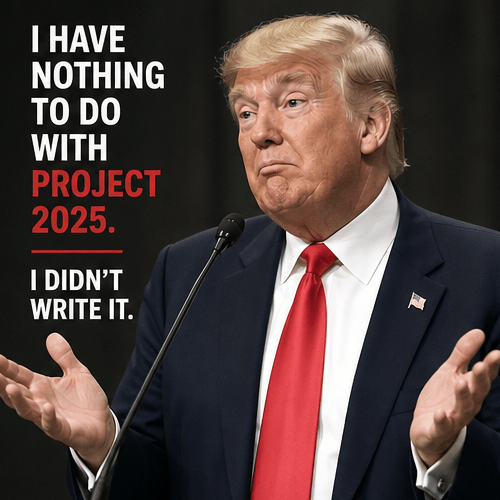
Project 2025 is a 900‑page administrative blueprint produced by the Heritage Foundation and allied conservative institutions. It is not a campaign document, not a government document, and not a Trump‑authored document. Trump can therefore say—accurately in a narrow sense—that he “has nothing to do with it.”
Table of Contents
— Link to Project 2025.PDF —
Yet the blueprint’s core themes overlap with Trump’s long‑standing political goals:
- Restructuring the federal bureaucracy
- Expanding presidential control over executive agencies
- Rolling back regulations
- Reorienting federal policy toward cultural conservatism
- Reducing the footprint of the administrative state
- Restructuring the federal bureaucracy
- Expanding presidential control over executive agencies
- Rolling back regulations
- Reorienting federal policy toward cultural conservatism
- Reducing the footprint of the administrative state
This overlap allows Trump to maintain distance from the document while embracing the agenda embedded within it. This is not deception so much as a political technique: separate the origin of the plan from the usefulness of the plan.
This is not deception so much as a political technique. It’s about separating the origin of the plan from its usefulness.
II. Why the Strategy Works
1. Most Americans do not read policy blueprints
Project 2025 is nearly 900 pages. Even politically engaged citizens rarely read documents of that scale. Voters judge by:
- speeches
- headlines
- actions
- media framing
This gives Trump room to deny involvement without widespread contradiction.
2. The “deep state” narrative makes alignment intuitive
For many supporters, the administrative state is viewed as entrenched, unaccountable, and resistant to elected authority. Project 2025 is framed as a plan to correct that imbalance. Thus, when Trump advances similar reforms, supporters see consistency, not coordination.
3. Simplicity beats complexity
Trump’s communication style is intentionally binary:
- “I didn’t write it.”
- “I’m doing what’s best for America.”
This simplicity overwhelms the complexity of administrative architecture.
III. Why Trump’s Agenda Overlaps With Project 2025 Without Formal Coordination
A. Shared intellectual lineage
Project 2025 draws from decades of conservative policy thought:
- Reagan-era deregulation
- The Federalist Society’s unitary executive theory
- Heritage Foundation’s administrative reform agenda
- Long-standing Republican skepticism of federal bureaucracy
These ideas have circulated in conservative circles for 40+ years. Trump’s agenda overlaps because:
- the personnel pool is the same
- the grievances are the same
- the constitutional philosophy is the same
You do not need coordination when the worldview is shared.
B. Personnel is policy
Many contributors to Project 2025 have served in or advised Trump-aligned institutions. This creates informal alignment even without formal adoption.
C. The administrative state is the common adversary
Both Trump and Project 2025 view the modern federal bureaucracy as too large, too independent, too ideological, and too resistant to elected authority. This shared diagnosis naturally produces similar prescriptions.
- too large
- too independent
- too ideological
- too resistant to elected authority
This shared diagnosis naturally produces similar prescriptions.
IV. How Trump Frames the Contradiction
Trump uses three rhetorical moves:
1. Denial of authorship
He did not write Project 2025, did not commission it, and did not publish it. This is technically true.
2. Adoption of aligned policies
He frames overlapping policies as:
- “common sense”
- “constitutional corrections”
- “fixing the deep state”
- “restoring presidential authority”
This reframes alignment as independent judgment.
3. Distance from controversial sections
If critics highlight unpopular proposals, he can say:
- “That’s not mine.”
- “I never supported that.”
- “I don’t know who wrote that.”
This protects him from owning the entire document.
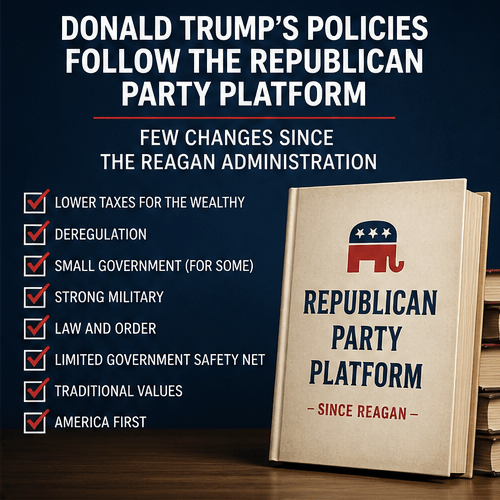
V. Project 2025 Compared to the Republican Platform (Reagan → Trump)
Below is a concise comparison showing how Project 2025 fits into the long arc of Republican priorities.
1. Limited Government & Deregulation
Reagan (1980s):
- Reduce federal regulation
- Shrink administrative agencies
- Restore market freedom
- Aggressive rollback of regulatory authority
- Restructuring agencies to limit bureaucratic discretion
Trump:
- “Two regulations out for every one in”
- Deregulation across energy, environment, and labor
Continuity: Strong.
2. Strong Executive Power
Reagan:
- Assertive presidential leadership
- Centralized decision-making
- Full embrace of the unitary executive theory
- Direct presidential control over agencies
Trump:
- Expanded use of executive orders
- Public framing of the presidency as the primary engine of national change
Continuity: Strong, though Project 2025 pushes further than Reagan ever did.
3. Cultural Conservatism
Reagan:
- Traditional family values
- Religious liberty
- Opposition to federal involvement in cultural issues
- Removal of DEI/SOGI frameworks
- Reorientation of federal policy toward traditional social norms
Trump:
- Strong cultural messaging
- Policies aligned with conservative social priorities
Continuity: Strong, though modern culture-war framing is more intense.
4. Federalism
Reagan:
- Return power to states
- Limit federal intrusion
- Mixed:
- Reduces federal regulatory power
- But centralizes executive authority at the federal level
Trump:
- Similar mix:
- Deregulation empowers states
- Strong executive power centralizes federal authority
Continuity: Partial; internal tension exists.
5. Administrative State Reform
Reagan:
- Criticized bureaucracy
- Attempted administrative rollback
- Sweeping 180‑day plan to restructure federal agencies
- Replacement of career civil servants with political appointees
Trump:
- Similar goals, though less formally structured
Continuity: Project 2025 is the most aggressive version of a long-standing Republican theme.
VI. The Restorationist Interpretation
From a Restorationist perspective, the dynamic looks like this:
Project 2025 is not a Trump document; it is a conservative administrative blueprint. Trump denies authorship because he did not write it. Yet the blueprint’s goals—restoring executive energy, reducing bureaucratic sprawl, and realigning federal administration with the Constitution’s 1787 architecture—overlap with long-standing conservative grievances. Thus, Trump can reject the document while embracing its spirit. The administrative state, by resisting his first-term agenda, effectively summoned the very reforms it feared.
This framing is historically grounded, constitutionally coherent, and accessible to everyday readers.
Leave a Reply