The word Restorationist names a civic mission: recovering the Founders’ original Moral Grammar so that liberty, duty, and self-government can once again be understood together. This is not a project of political invention or a theological campaign. It is an effort to restore the language, habits, and principles that made constitutional self-rule possible.
Table of Contents
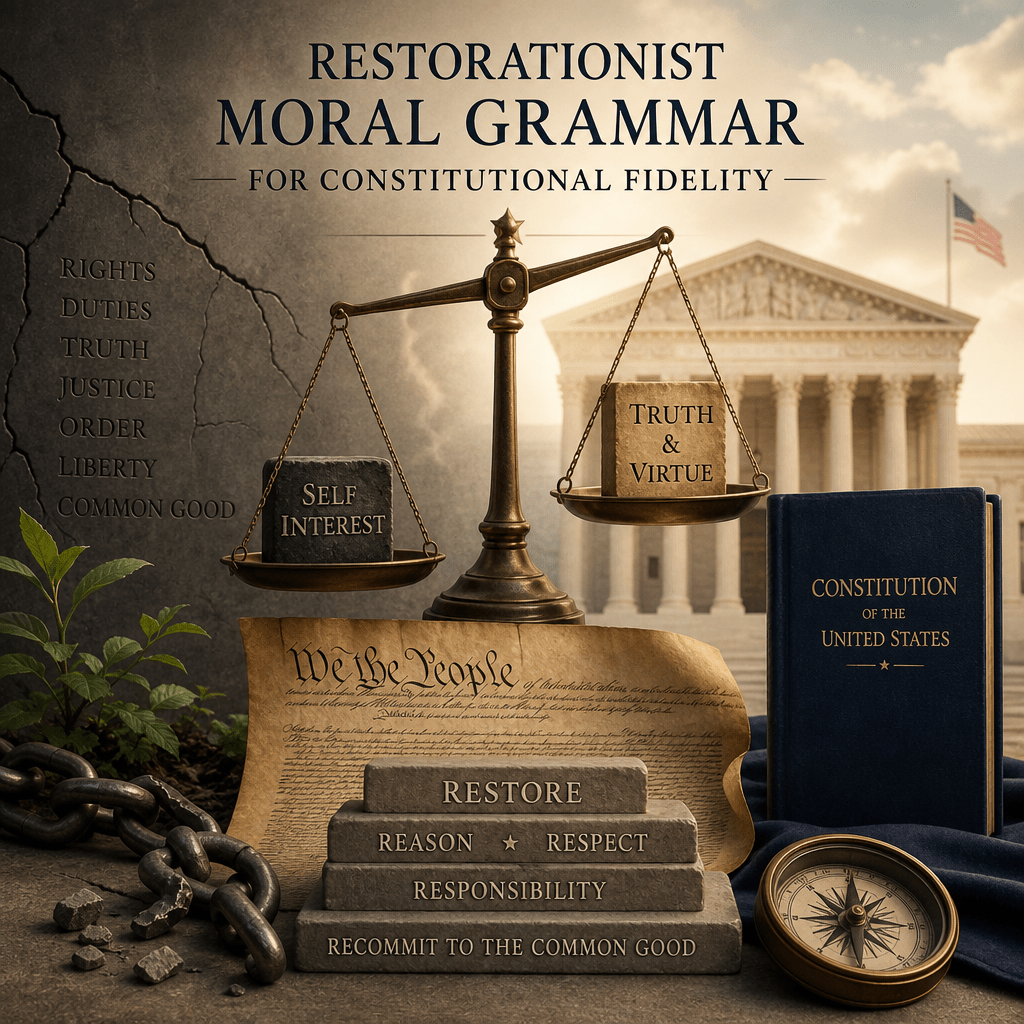
What “Restorationist” Means in This Context
The term Restorationist is often misunderstood. Some hear it and assume nostalgia. Others hear it and assume a religious agenda. In this context, however, the word has a civic meaning. It describes an effort to recover principles that were once more clearly understood and have gradually been neglected.
Restoration does not mean pretending that the past was perfect. It means asking what was true, useful, and necessary in the inherited order. It means identifying the principles that helped a free people govern itself and bringing those principles back into public conversation. A Restorationist recovery therefore examines the past critically while preserving what remains necessary for ordered liberty.
In practical terms, a Restorationist project involves:
- recovering lost civic principles
- restoring an older understanding of ordered liberty
- returning to first principles rather than political fashion
- re-establishing the moral foundation of public life
- connecting rights with duties and freedom with responsibility
A Restorationist does not try to invent a new people from nothing. The purpose is to remember what once held a people together and to apply those enduring lessons responsibly in the present.
This is why the word fits the mission so well. It describes recovery rather than replacement, continuity rather than rupture, and repair rather than permanent revolution. For a fuller definition of the term, see the site’s Restorationist glossary entry.
Why Moral Grammar Matters
Grammar gives structure to language. It tells us how words relate to one another and makes communication possible. A sentence can contain familiar words and still be unintelligible if the relationships among those words have collapsed.
A Moral Grammar performs a similar function in public life. It gives structure to ideas such as conduct, duty, liberty, authority, justice, and responsibility. It helps citizens understand how these concepts relate to one another. It shows why freedom is not identical to impulse, why rights are not the same as demands, and why authority is not automatically tyranny.
When a society shares a moral grammar, citizens can disagree without losing every common reference point. They may debate policy, religion, economics, or the proper role of government while still recognizing ideas such as honesty, restraint, courage, fairness, and accountability.
When that grammar weakens, public language becomes increasingly unstable. People may continue to use the words freedom, justice, equality, and rights, but those words no longer carry a sufficiently shared meaning. Political debate then becomes a contest of power rather than a search for the common good.
The problem is not simply that people disagree. Disagreement is normal in a free society. The deeper problem is that citizens may lose the ability to explain why one form of conduct is honorable, another destructive, and a third merely permissible. Without those distinctions, self-government becomes difficult to sustain. The Restorationist emphasis on moral language seeks to recover those distinctions without demanding uniformity on every political question.
The Founders and the Moral Conditions of Freedom
The Founders did not build a free society on political technique alone. They designed institutions, but they also understood that institutions require a certain kind of citizen. A constitution can establish offices and procedures, yet no document can force a people to practice honesty, restraint, courage, or public responsibility.
The American experiment therefore depended on habits of mind and heart. Those habits included:
- self-restraint in private and public life
- responsibility for the consequences of one’s actions
- truthfulness in civic discussion
- respect for law and lawful authority
- public virtue and concern for the common good
- the willingness to sacrifice short-term advantage for long-term liberty
- accountability before God, neighbor, and future generations
These principles formed part of the Moral Grammar behind the American experiment. They did not eliminate conflict or guarantee perfect behavior. Instead, they gave citizens a framework for judging behavior and correcting failures.
The Founders’ insight was straightforward but demanding: a free government cannot remain free if the people lose the ability to govern themselves. External restraints matter, but internal discipline matters too. Laws can punish wrongdoing after the fact, while character helps prevent wrongdoing and makes lawful institutions credible.
This is why the founding tradition should not be reduced to a set of mechanisms. Elections, courts, legislatures, and written limits are indispensable, but they work best when citizens and officials recognize that power must be restrained and liberty must be used responsibly. In a Restorationist account, these moral conditions are essential supports for the constitutional system rather than optional private preferences.
Why This Is Not a Theological Mission
Calling this work Restorationist does not mean turning politics into theology. That distinction matters. A theological mission seeks to defend, interpret, or proclaim doctrinal claims. A civic restoration mission asks how a free people can preserve the moral and cultural foundations of self-rule.
The question is public rather than sectarian. It concerns the health of citizenship, law, education, institutions, and liberty. It does not require replacing civil society with a churchly order, nor does it require every citizen to share identical theological convictions.
At the same time, a civic mission should not pretend that public life is morally neutral. Every political order relies on assumptions about human nature, responsibility, authority, justice, and the proper use of power. A society may reject religious language, but it cannot escape the need for moral judgments.
The Restorationist purpose is therefore modest in one sense and ambitious in another. It does not seek to impose a single denomination or establish a theological state. It does seek to recover a public moral vocabulary strong enough to support responsibility, restraint, and human dignity.
A nation cannot remain free if it forgets the discipline freedom requires. That claim is civic, even when many of the traditions that shaped it were religious.
Moral Grammar and Self-Government
Self-government is more than voting, campaigning, and passing laws. It is a way of life that assumes people can govern their appetites, loyalties, speech, and public conduct. A constitutional system can distribute power, but citizens must still decide how to use the freedom that system protects.
That is why Moral Grammar matters. It teaches people to distinguish between:
- liberty and license
- rights and demands
- authority and tyranny
- equality and sameness
- justice and preference
- tolerance and indifference
- political power and legitimate authority
These distinctions are not merely academic. They shape daily choices and public policy. Liberty without responsibility becomes license. Authority without limits becomes tyranny. Equality without a meaningful account of justice can become resentment or coercion. Rights without duties can become a language for acquiring benefits without accepting obligations.
A people that cannot tell the difference between freedom and indulgence will eventually lose both. The Restorationist mission seeks to preserve the distinctions that allow liberty to remain ordered rather than destructive.
Self-government also requires patience. Citizens must accept that not every loss is oppression, not every disagreement is injustice, and not every political defeat is illegitimate. A shared moral grammar makes those forms of restraint possible because it gives people reasons to endure limits and respect lawful outcomes.
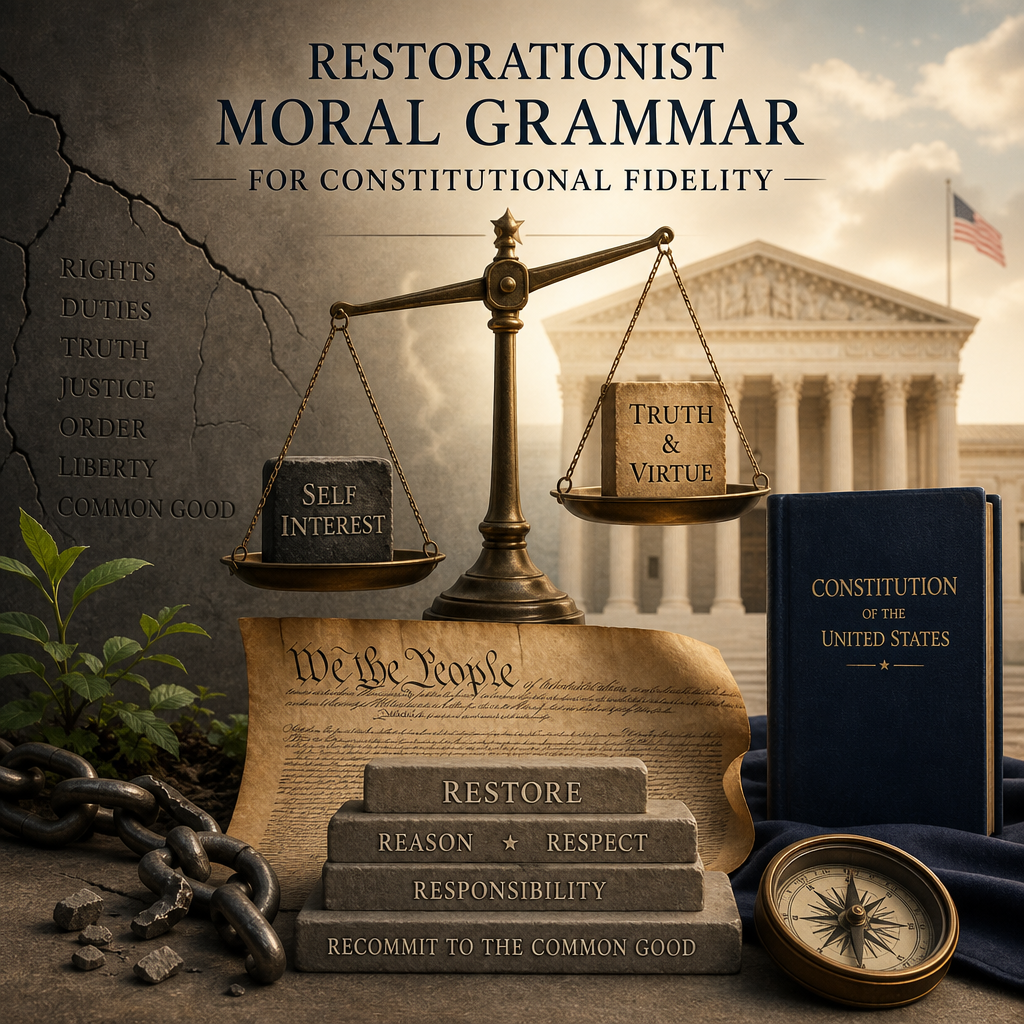
Why Restore Is Better Than Reform
Reform can mean adjustment, improvement, or replacement. The word is useful, but it is not always precise. Restoration identifies a more specific purpose: bringing something back toward its proper or healthy form.
The goal here is not to create a new moral language from scratch. It is to recover the civic language that once made liberty coherent. That language connected rights to obligations, authority to accountability, and freedom to virtue.
This does not require copying every historical practice or ignoring the failures of the past. A responsible restoration distinguishes between enduring principles and temporary arrangements. It asks what should be preserved, what should be corrected, and what should be rejected.
That approach is neither blind nostalgia nor careless innovation. It is a disciplined form of continuity. The past becomes a source of instruction rather than a museum piece, and the present becomes an opportunity to apply old principles to new circumstances.
This is why Restorationist is stronger than a label such as reformer when describing the project. Reform may imply that the existing order is fundamentally sound but needs adjustment. Restoration emphasizes that the underlying moral language itself has been damaged and must be recovered.
Constitutional Fidelity as a Moral Practice
There is another reason the term Restorationist fits this purpose: it connects directly to Constitutional Fidelity. Fidelity is more than loyalty to words on a page. It means faithfulness to the principles, structure, limits, and moral logic behind those words.
Constitutional fidelity does not mean treating the Constitution as a magical solution to every social problem. It means honoring the framework that protects liberty and limits concentrated power. It requires citizens and officials to respect:
- limited government
- enumerated powers
- the rule of law
- separation of powers
- federalism and divided authority
- the dignity and responsibility of the citizen
- the moral obligations that make self-rule possible
The Constitution depends on more than enforcement. It depends on habits of restraint. Officials must accept limits even when breaking them would be politically convenient. Citizens must resist the temptation to demand unlimited benefits from public power. Courts, legislatures, executives, and voters must all recognize that lawful authority is not the same as unlimited authority.
Readers who want to examine the constitutional text directly can consult the Constitution Annotated from Congress.gov, which provides an authoritative reference for the Constitution and its interpretation.
A Restorationist vision supports Constitutional Fidelity because it understands that constitutional government depends on a certain kind of people. Not perfect people, but morally serious people: citizens who know that liberty must be governed by virtue and that power must remain accountable.
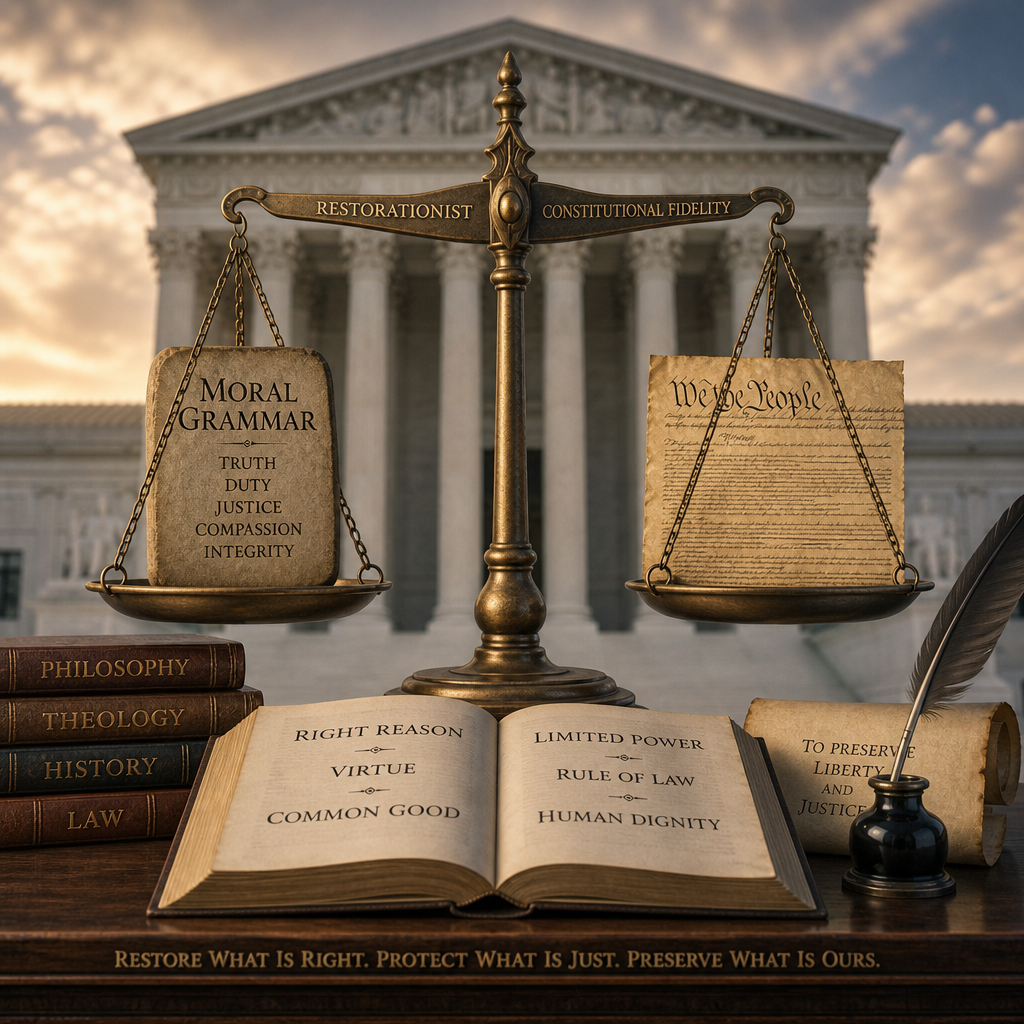
Why the Founders’ Moral Grammar Still Matters Today
Modern politics often speaks in abstractions. It uses the language of rights, identity, policy, power, and preference. Those categories matter, but they are not enough to sustain a free society.
Without Moral Grammar, citizens may stop asking whether a policy is wise, just, humane, or fitting. They may ask only whether it is legal, useful, popular, or advantageous to their group. Public life then becomes a competition for control rather than a shared effort to pursue justice.
This loss of moral depth creates several dangers:
- public debate becomes driven by outrage rather than judgment
- political opponents are treated as enemies rather than fellow citizens
- rights are asserted without corresponding duties
- government is asked to solve problems that require character and community
- short-term emotional demands replace long-term institutional responsibility
A free society needs more than compliance. It needs moral clarity, trustworthy institutions, and citizens who can distinguish what is merely possible from what is good. Returning to the Founders’ Moral Grammar is not backward-looking in a negative sense. It is a way to recover the intellectual and civic resources needed for renewal.
Renewal also requires humility. No generation possesses the whole truth, and no political movement should assume that it can restore public life by slogans alone. The work involves education, practice, example, and patient attention to the habits that shape families, communities, schools, and institutions. A Restorationist renewal therefore depends on sustained civic formation rather than quick political victories.
The Restorationist Task
A Restorationist task is not to romanticize the past. It is to recover the principles that made ordered liberty possible and to apply them honestly. That requires asking difficult questions:
- What moral habits support freedom?
- What civic virtues protect self-government?
- What language helps citizens understand duty?
- What framework keeps power limited?
- What kind of education prepares people for responsible citizenship?
- How can communities renew trust without demanding uniformity?
- What public practices encourage courage, honesty, and accountability?
These are restoration questions, but they are not partisan questions. They reach beneath party platforms and immediate political disputes. They concern the kind of people a constitutional order needs and the kind of culture that allows lawful institutions to endure.
The task begins with language, because language shapes perception. If citizens can again speak clearly about duty, restraint, virtue, authority, and responsibility, they can begin to recover the judgments those words express. Better language will not solve every problem, but confused language makes nearly every problem harder to solve.
The task also includes institutional humility. A Restorationist does not assume that every social problem should be solved by expanding government. Nor does the project assume that government is irrelevant. The better question is which responsibilities belong to citizens, families, communities, churches, associations, and public institutions.
Finally, restoration requires personal practice. The grammar of self-government is learned by doing: keeping promises, telling the truth, accepting consequences, respecting lawful authority, serving neighbors, and exercising freedom without treating every desire as a right.
Restorationist Civic Formation in Practice
The Restorationist approach becomes concrete through civic formation. Citizens do not acquire the habits of self-rule merely by reading constitutional clauses or hearing patriotic slogans. They learn them through repeated encounters with responsibility: completing duties, honoring commitments, listening before judging, accepting lawful limits, and repairing harm when they fail.
This work begins in families and communities, but it also belongs in education. A Restorationist understanding of civic education would teach more than institutional facts. Students should know how the branches of government operate, yet they should also examine why divided powers, due process, truthful speech, and personal restraint matter. Knowledge of procedure becomes more durable when joined to an understanding of purpose.
Civic associations provide another place where the Restorationist mission can be practiced without becoming partisan or sectarian. Neighborhood groups, charities, congregations, service organizations, and local institutions teach people to cooperate across differences. They create opportunities to exercise authority on a human scale, bear costs for shared goods, and discover that freedom includes obligations to others.
The same principles apply to public leadership. A Restorationist standard asks officials not only whether they possess legal power, but whether using that power respects constitutional limits and serves a legitimate public purpose. It also asks citizens to judge leaders by honesty, prudence, restraint, and accountability rather than by partisan victory alone.
None of these practices promises instant renewal. The Restorationist project proceeds through patient formation because moral habits cannot be manufactured by decree. Families, schools, communities, and institutions must model the conduct they hope to preserve. Over time, those repeated acts can rebuild trust, clarify public language, and renew the connection between personal character and constitutional liberty.
Conclusion: Restoring the Grammar of Freedom
The phrase Moral Grammar points to something essential. Freedom is never self-sustaining by accident. It depends on shared understandings, personal character, and language that connects liberty to responsibility.
That is why this is not a theological mission. It is a civic mission to restore the moral and public language that made self-government possible. It seeks neither revolution for its own sake nor a return to every feature of the past. It seeks the recovery of principles that can renew constitutional life.
The word Restorationist fits because it captures a mission rooted in continuity, moral seriousness, and civic repair. It names a willingness to remember what freedom requires and to rebuild the habits that allow freedom to endure.
It is also a mission of Constitutional Fidelity. A people that understands its constitutional framework but forgets the moral habits behind it will eventually weaken that framework from within. A people that recovers its Moral Grammar has a better chance of governing itself with wisdom, restraint, and courage.
Restoration therefore begins with memory but does not end there. It moves from remembering to understanding, from understanding to practice, and from practice to renewal. That is why the mission is worth pursuing: a people that recovers the grammar of freedom can recover the capacity to govern itself.Lost Moral Grammar: Stunning Best Civic Renewal GuideFederalist 10: Stunning Best Guide to Factions7 Powerful Steps to Achieving Emotional Self-Control: The Restorationist Origin Myth ExplainedSubstantive Due Process: Stunning, Best Critique
Leave a Reply