
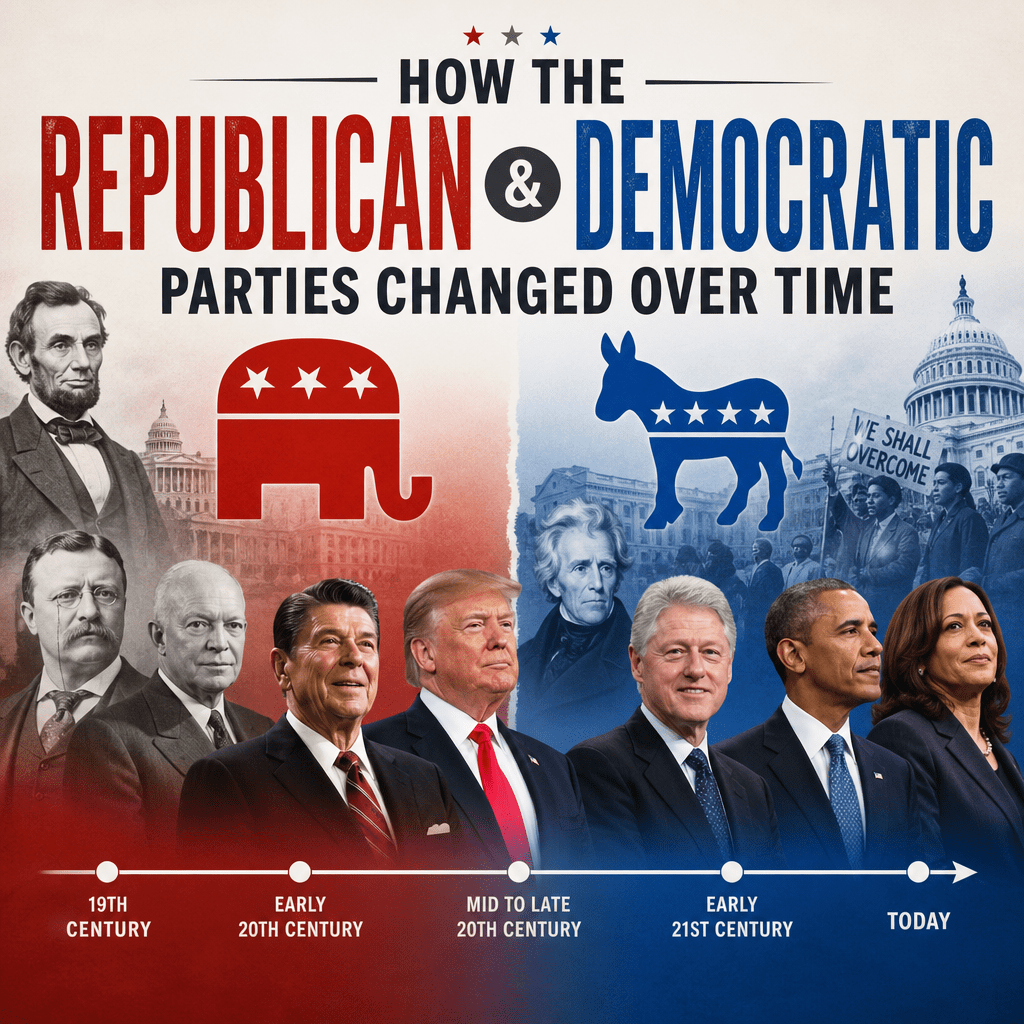
It is a mistake to treat either major American party as ideologically fixed. how the republican and democratic parties changed over time is best understood by examining platforms, coalitions, regional divisions, and legislative records in specific historical contexts.
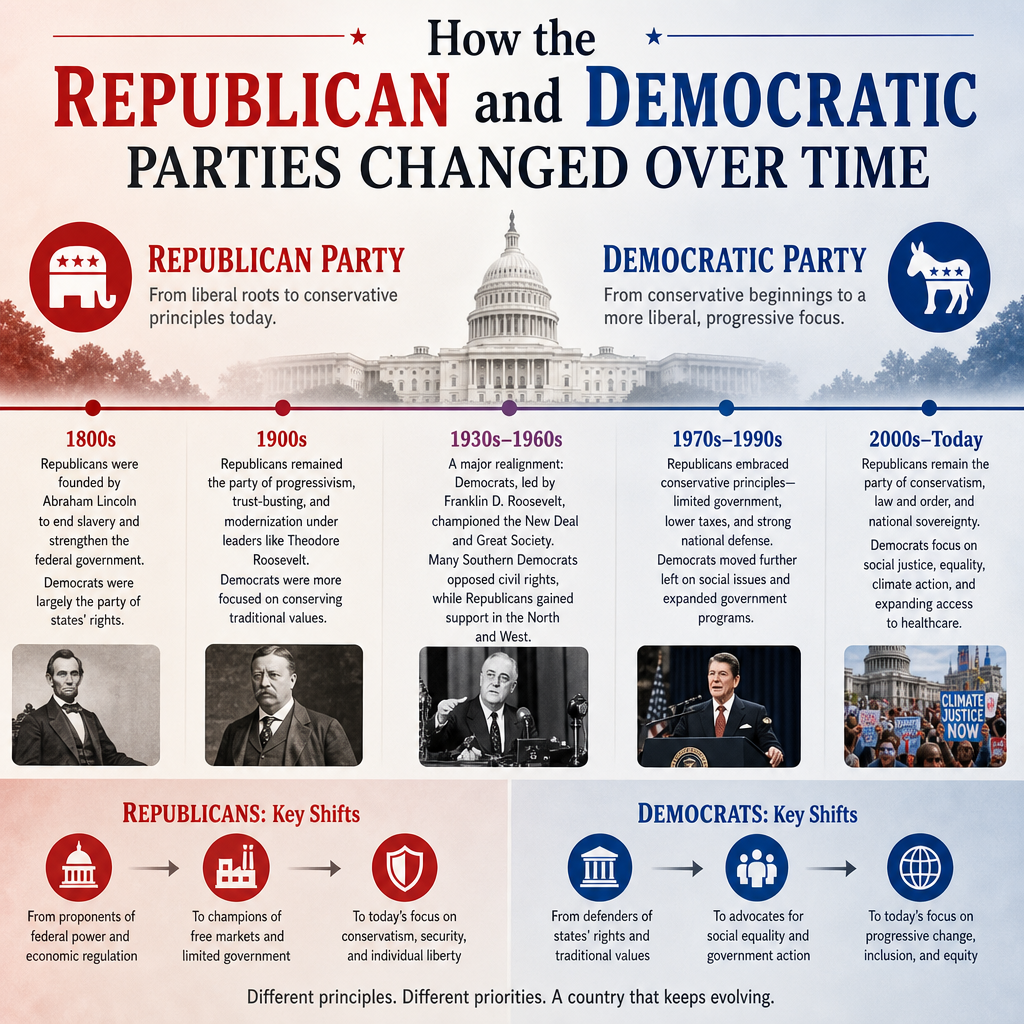
The Republican Party and the Democratic Party have both changed substantially since the 19th century. Understanding how the republican and democratic parties changed over time requires attention to slavery, industrialization, war, immigration, civil rights, religion, economic change, and changing ideas about the role of government.
Table of Contents
How the Republican and Democratic Parties Changed Over Time
The two major parties have not carried one unchanging ideology from their founding to the present. A serious study of how the republican and democratic parties changed over time examines new alliances, lost constituencies, major events, and changing policy priorities.
Political organizations can change their platforms, elected officials can change their priorities, and voters can change which party they support. These developments do not always occur simultaneously. That distinction is central to understanding how the republican and democratic parties changed over time.
Political realignment is usually gradual. Some regions change before others, and factions may preserve older traditions long after national leaders adopt new priorities. The history of how the republican and democratic parties changed over time therefore includes both continuity and disruption.
Words such as “liberal,” “conservative,” “states’ rights,” and “limited government” have not always carried the same practical meaning. Their significance depends on the issue, the period, and the institutions involved. This context helps explain how the republican and democratic parties changed over time without reducing history to slogans.
The most reliable comparison asks what a party platform said, how elected officials voted, which voters supported the party, and how those patterns varied by decade and region. It also asks whether a policy was implemented and what effects it had.
The Republican Party Began as an Anti-Slavery Force
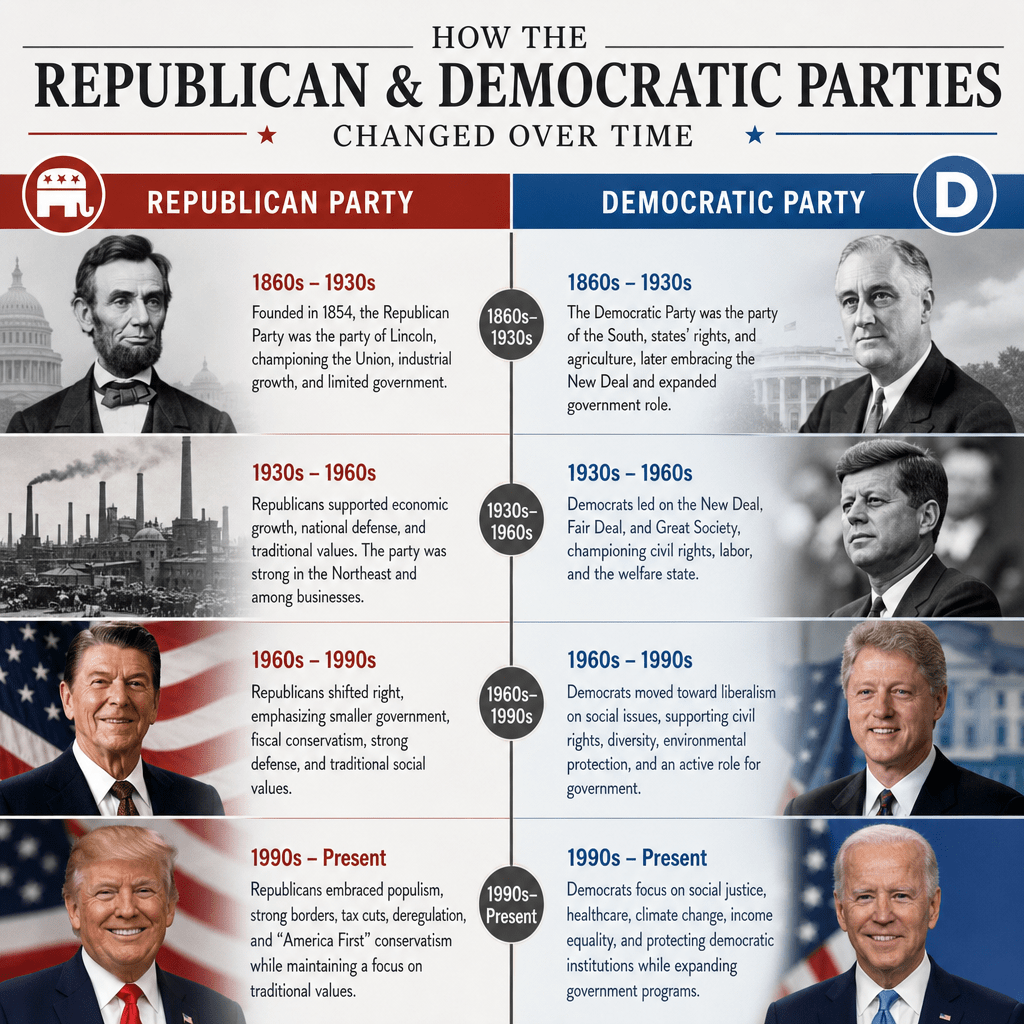
The Republican Party was founded in 1854. Its earliest identity was built around opposition to the expansion of slavery into the western territories. Republicans became the principal anti-slavery party during the crisis preceding the Civil War, although the movement contained different views about abolition, federal power, and racial equality.
The party’s founding circumstances are essential to understanding how the republican and democratic parties changed over time. The Republican coalition brought together former Whigs, anti-slavery Democrats, Free Soilers, and other opponents of slavery’s expansion. They shared an urgent political goal but did not agree on every question involving race, citizenship, or the future of the federal government.
The founding purpose does not mean Republicans have held the same beliefs ever since. After the Civil War, Reconstruction brought federal enforcement, citizenship, voting rights, and the relationship between national and state authority to the center of Republican politics. Later eras brought different priorities, which further illustrates how the republican and democratic parties changed over time.
Over time, Republican coalitions often emphasized limited government, constitutionalism, rule of law, national defense, private enterprise, and skepticism of centralized authority. These themes became especially important through Reconstruction, the industrial era, the Progressive period, the New Deal era, and the modern conservative realignment.
The meaning of those themes also changed. Limited government, for example, could refer to economic regulation in one period and to federal authority over education, civil rights, or social policy in another. That changing meaning is an important part of how the republican and democratic parties changed over time.
The Democratic Party Has a More Complicated Past
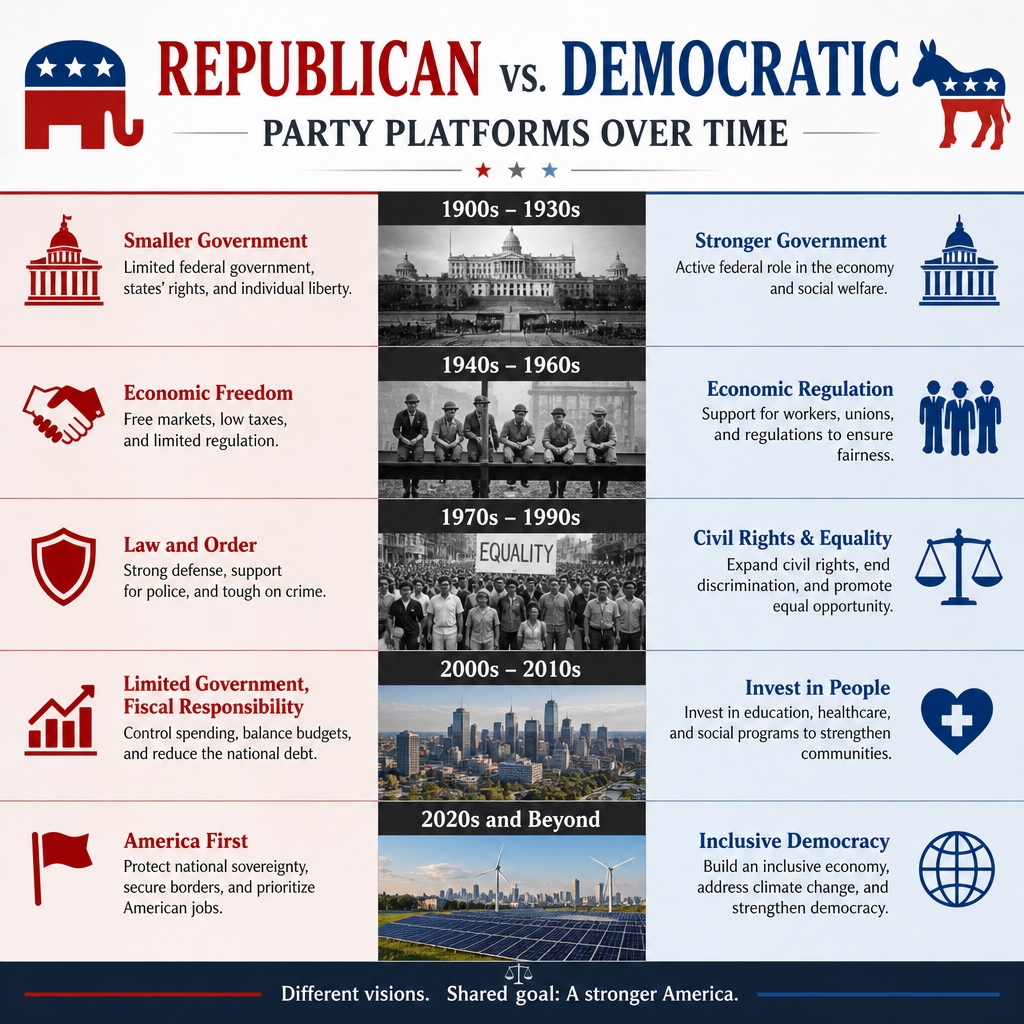
The Democratic Party has a more complicated history because it included powerful regional factions with sharply different views. In the 19th century and well into the 20th century, many Democrats, especially in the South, defended slavery, segregation, and Jim Crow. Southern Democrats often resisted federal civil-rights enforcement and defended local control as a justification for maintaining racial hierarchy.
Any account of how the republican and democratic parties changed over time must acknowledge that the Democratic label covered very different political communities. A Southern Democrat during segregation could have priorities that differed sharply from those of a Northern urban Democrat, a labor organizer, or a reform-minded national leader.
The Democratic Party was never politically uniform. Urban Democrats, labor Democrats, Northern liberals, immigrants, reformers, and Southern segregationists did not share identical goals. Their disagreements could be substantial even when they remained inside the same national coalition. These internal divisions help explain how the republican and democratic parties changed over time.
By the mid-20th century, national Democratic leaders increasingly supported civil-rights legislation. Presidents and lawmakers associated with the national party backed important federal measures, while some Democratic factions and officeholders continued to oppose them. The resulting conflict is essential to understanding how the republican and democratic parties changed over time.
Statements such as “the party of civil rights” or “the party of segregation” flatten a history involving changing platforms, regional divisions, and competing definitions of equality, federalism, and constitutional authority.
Party Realignment Changed Both Coalitions
One of the biggest mistakes in political history is assuming that party labels mean the same thing in every era. The United States has experienced repeated realignments in which voter coalitions, regional loyalties, economic interests, and defining issues changed. This is a major reason how the republican and democratic parties changed over time cannot be reduced to a single timeline.
Party realignment may be visible in election results, but it usually reflects deeper changes in social organizations, regional identity, policy priorities, and perceptions of which party can be trusted to govern. Those developments provide evidence about how the republican and democratic parties changed over time.
Realignment does not mean that every voter changes beliefs or that one election instantly reverses the political system. It can involve a gradual movement of groups between parties, changes in regional voting patterns, and new priorities among party leaders. This gradual process clarifies how the republican and democratic parties changed over time.
- In the 19th century, Republicans were the anti-slavery party, while Democrats included many defenders of slavery and states’ rights.
- During the early and middle decades of the 20th century, both parties contained liberal, conservative, reform, business, labor, and regional factions.
- During the civil-rights era, many Southern white voters began moving away from the Democratic Party, while the national Democratic coalition increasingly identified with civil-rights legislation.
- In later decades, the parties became more ideologically sorted, even though differences within each party remained.
These developments did not produce an instant or perfectly complete transfer of every belief. Some voters changed parties for one issue while retaining older views on another. Some officeholders remained attached to a regional tradition even as their national party moved in a different direction.
Civil Rights Shows How Coalitions Shifted
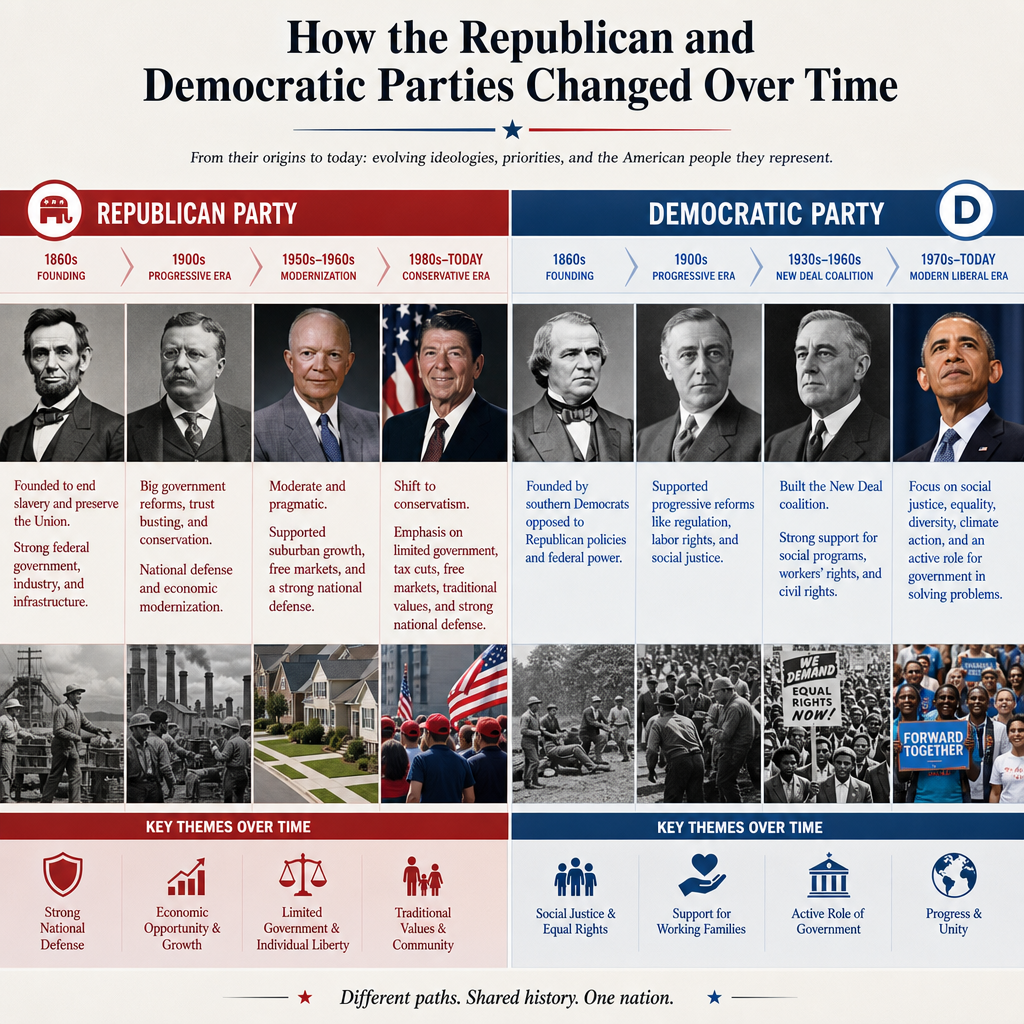
Civil rights is one of the clearest examples of party change. In the 19th century, Republicans were generally associated with emancipation and federal power used against slavery. Many Democrats, particularly Southern Democrats, defended racial hierarchy and local control. The issue is therefore central to how the republican and democratic parties changed over time.
Civil-rights history includes constitutional amendments, federal legislation, presidential action, court decisions, state resistance, and organized grassroots activism. No single vote or quotation captures the whole process, which is why a full account of how the republican and democratic parties changed over time must use multiple kinds of evidence.
In the 20th century, the picture became more complicated. National Democratic leaders such as Harry Truman and Lyndon Johnson supported major civil-rights action, while some Democratic lawmakers and voters resisted those policies. Many Republicans also supported civil-rights laws, although Republican officials and voters differed over federal enforcement, the role of courts, and the political consequences of those laws.
The legislative record is more informative than a slogan. Readers can consult the U.S. Senate’s historical overview of civil-rights legislation to examine major laws and the institutional context in which they were debated.
Civil rights also demonstrates why national and regional history must be considered together. A national platform may move in one direction while state parties, local officials, and individual members continue to reflect older traditions. Over time, those differences may weaken, persist, or produce new conflicts inside a coalition.
Other Controversies Also Reveal Party Change
Busing
Debates over school busing revealed divisions within both parties. Support and opposition did not map neatly onto one permanent ideology. Local politics, race, class, constitutional arguments, and views about public education all shaped positions. Busing helps show how the republican and democratic parties changed over time through disputes that crossed party and regional lines.
Immigration
Party views on immigration have also shifted. Coalitions changed as new immigrant groups entered political life, industries sought different kinds of labor, and voters debated national identity, border enforcement, legal status, and economic effects. Immigration is another lens for examining how the republican and democratic parties changed over time.
Neither party has maintained one position across every period. Business groups, labor organizations, restrictionists, humanitarian advocates, and immigrant communities have not always aligned with a single party. Their changing relationships reveal how the republican and democratic parties changed over time.
Religious Liberty
Religious liberty has likewise been interpreted differently by factions in both parties. Some emphasize individual conscience, free exercise, and limits on state power. Others focus on anti-discrimination rules, public services, equal access, and the government’s obligation to apply laws consistently. These disagreements illuminate how the republican and democratic parties changed over time.
Federal Power
The role of federal power is another issue on which party positions have evolved. At different times, both parties have argued for more central authority or stronger limits on Washington, depending on the policy area and coalition in power. This apparent inconsistency is part of how the republican and democratic parties changed over time, not proof that either party has had one permanent philosophy.
Why Regional and Factional Differences Matter
A party is not a single mind. It is a coalition of regions, classes, religions, industries, interest groups, and political organizations. That coalition changes over time, and national leaders do not always control every state or local branch. Regional history is therefore indispensable to understanding how the republican and democratic parties changed over time.
The South, New England, the industrial Midwest, the West, and major urban centers often developed different political cultures. Those differences influenced party platforms, candidate selection, legislative behavior, and voter loyalty. They also show why how the republican and democratic parties changed over time must be studied by era, region, and faction.
- Which region and historical period are under discussion?
- Which faction inside the party was influential?
- Which leaders or lawmakers held the position?
- Was it part of an official platform or an individual statement?
- What did the party actually do when it held power?
For example, “the Democrats supported segregation” is true of many Southern Democrats during many years. It is not the same as saying every Democrat in every era held that position. Likewise, “the Republicans were the party of limited government” describes an important strand of Republican thought but does not capture every administration, policy choice, or regional faction.
A Serious Historical Argument Requires Evidence
If the goal is honest political history, the best approach is to compare actual records rather than rely on inherited labels. Useful evidence includes national and state party platforms, congressional votes, committee records, presidential actions, executive policies, regional differences, public speeches, campaign materials, voter coalitions, demographic changes, and the practical effects of legislation.
Evidence-based comparison is the foundation for explaining how the republican and democratic parties changed over time. It prevents a single famous speech, election, or controversy from standing in for an entire party’s history.
Platforms show what party organizations formally promised, but they are not the complete record. Legislative votes reveal how lawmakers acted, yet votes may reflect compromises, constituency pressures, or unusual circumstances. Presidential actions, court decisions, state policies, and grassroots movements also matter when assessing how the republican and democratic parties changed over time.
Researchers should compare multiple eras instead of selecting one example that confirms a prior conclusion. They should also distinguish correlation from causation: economic change, migration, institutional conflict, media environments, and candidate personalities can all influence realignment.
Simplified labels are tempting because they make political history easy to repeat. They are not enough because they conceal changes in membership, geography, leadership, and policy. For broader context on how elite conflict and institutional trust can influence political change, see The Pied Piper Problem: How Elite Delegitimization Shapes a Rule-Changing Political Culture.
The Bottom Line
Since the 19th century, both major American parties have changed substantially. The Republican Party began as the principal anti-slavery party and later developed a coalition that often emphasized limited government, constitutionalism, rule of law, national defense, and skepticism of centralized authority.
The Democratic Party has a more complicated history. Many Democrats, especially in the South, defended slavery, segregation, and Jim Crow, while national Democratic leaders in the mid-20th century increasingly embraced civil-rights legislation. Some Democratic factions continued to oppose those reforms.
Reviewing how the republican and democratic parties changed over time makes clear that neither party should be treated as ideologically fixed. Their histories include genuine principles, regional conflicts, strategic adaptations, and internal contradictions.
On civil rights, busing, immigration, religious liberty, the role of institutions, and the scope of federal power, both parties have repeatedly shifted. A fair comparison must distinguish among eras, regions, and factions and must compare specific platforms and legislative records rather than rely on labels such as “the party of civil rights” or “the party of consistency.”
Leave a Reply