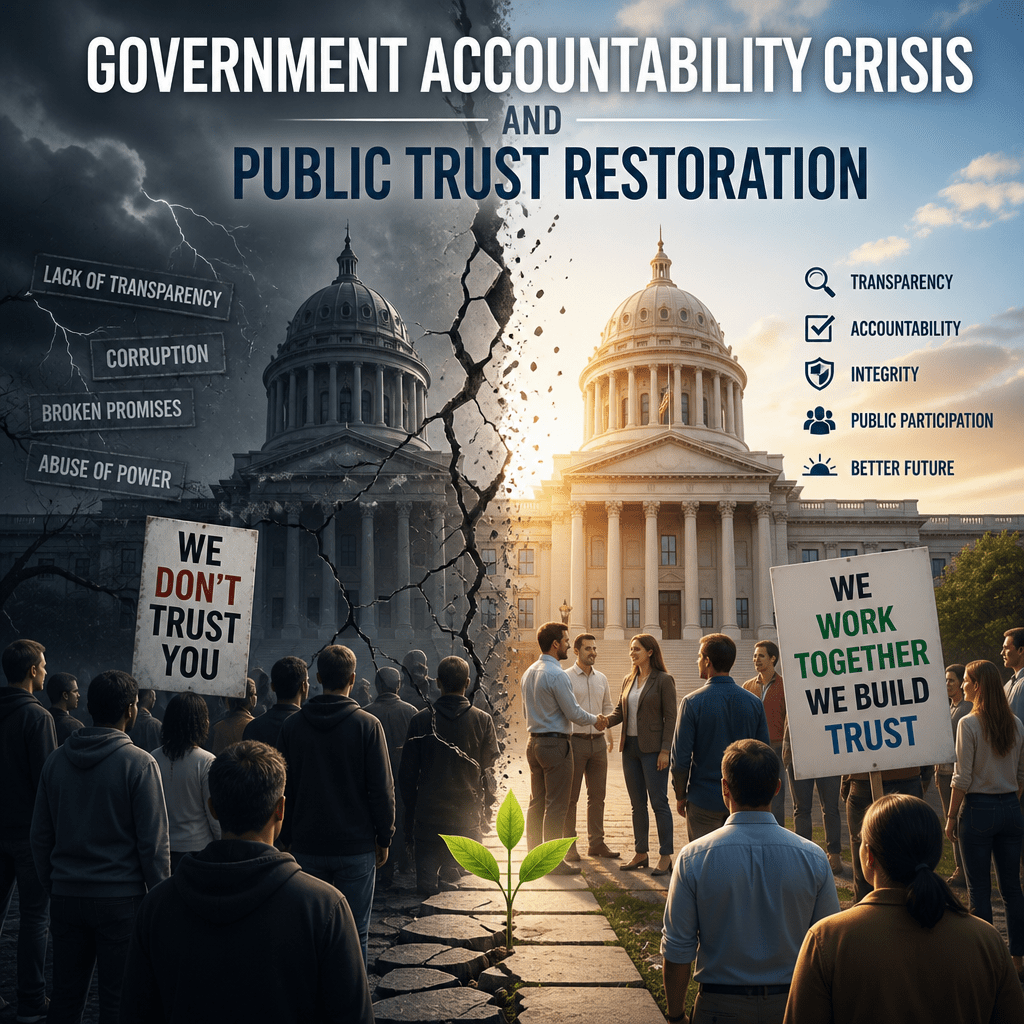
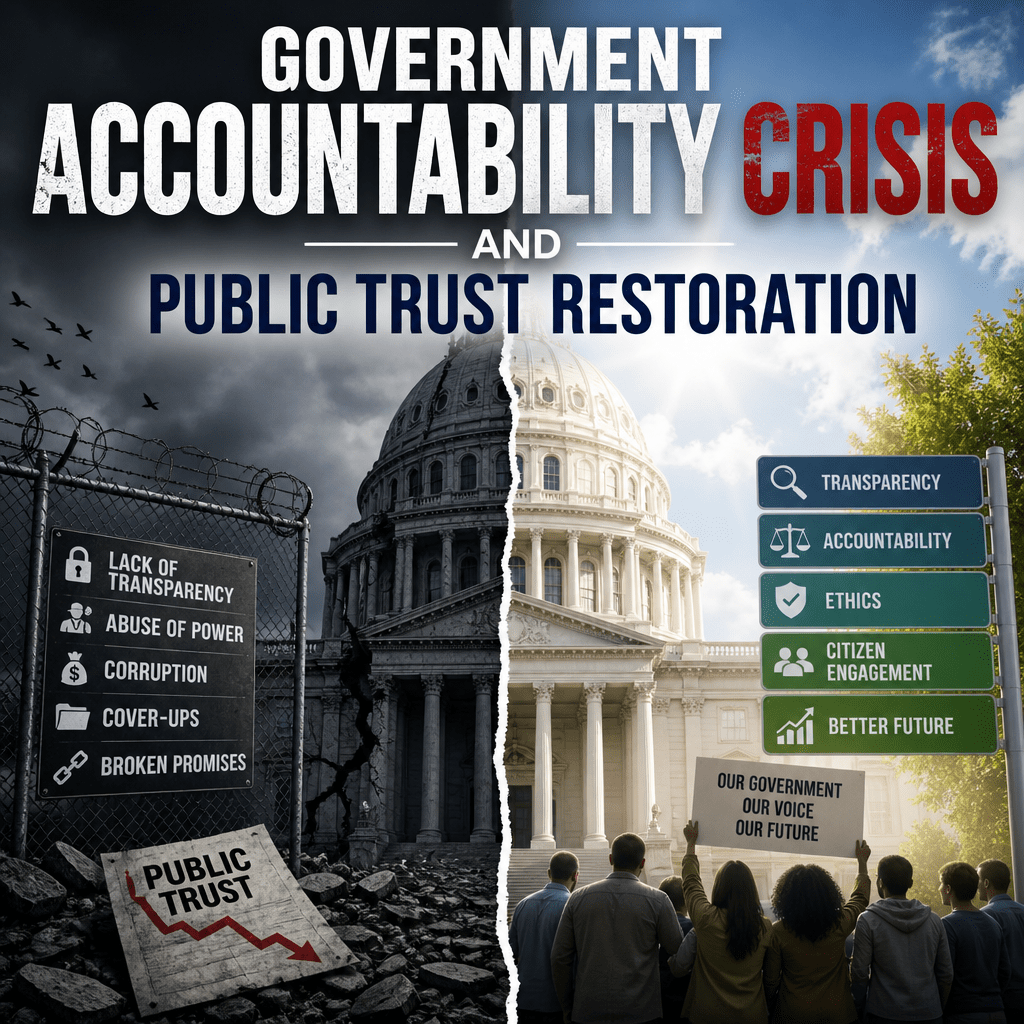
The government accountability crisis is reshaping how Americans view Congress, the executive branch, and the institutions meant to serve the public. Trust in government has fallen to historic lows, and that loss is more than a political problem: it is a democratic one.
When accountability weakens, public officials face fewer consequences. Institutions lose legitimacy. Citizens begin to doubt that government is working for them at all. That decline does not happen overnight; it builds slowly through repeated failures, broken norms, and systems that protect power more than the public.
This government accountability crisis is now visible across branches of government, from Congress to the courts to executive agencies. Repairing it requires more than outrage. It requires structural reform, institutional independence, and a renewed commitment to public service.
The Collapse of Congressional Accountability
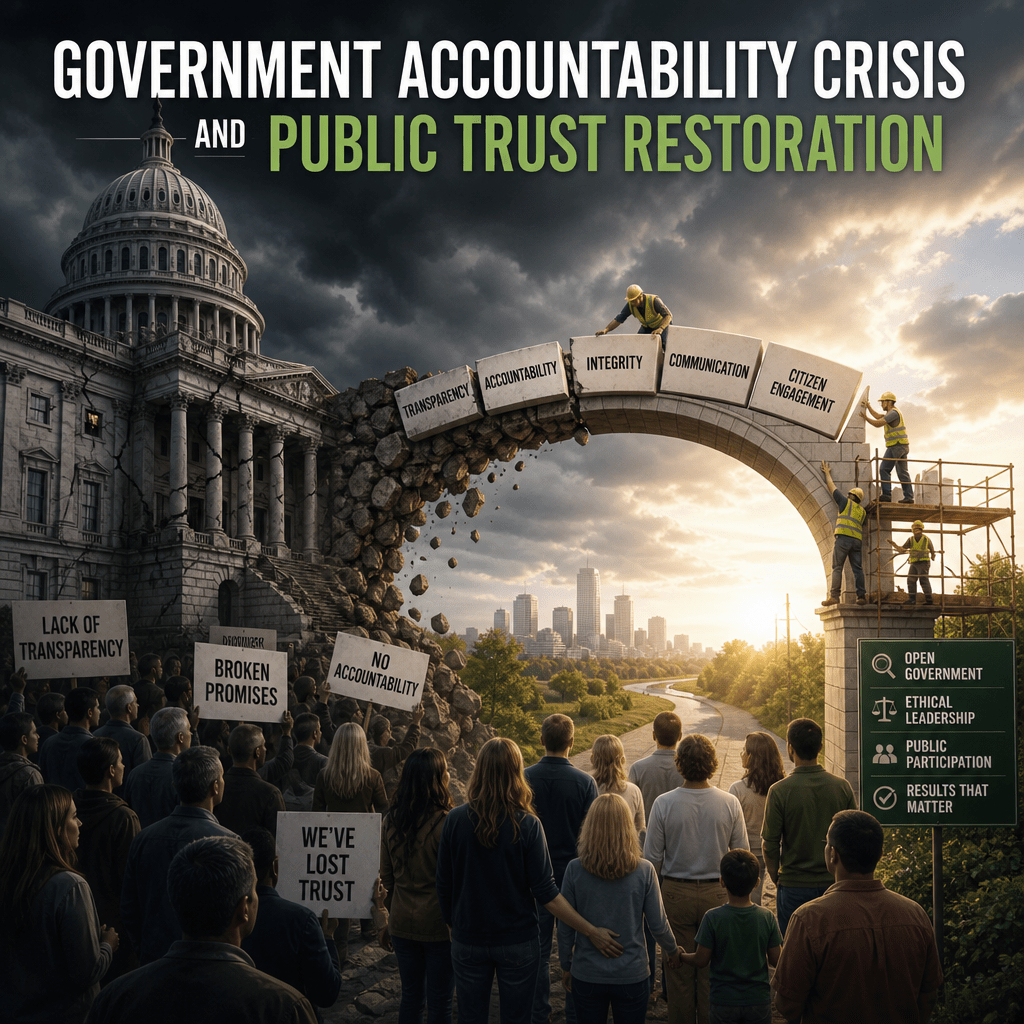
Congress is supposed to be the most accountable branch of government. It is closest to the people, and its members face regular elections. In theory, that should keep them responsive. In practice, that system has broken down.
The government accountability crisis is especially obvious in Congress because the branch that should answer most directly to voters now often seems insulated from them. When election cycles reward loyalty over judgment, lawmakers have less reason to act as stewards of the public good.
Hyperpartisanship has replaced oversight
Partisan loyalty now often matters more than public duty.
Members of Congress are under pressure to stay aligned with their party, even when they disagree privately. Voting against the party can bring punishment, loss of committee power, or even a primary challenge.
This creates a dangerous dynamic. Instead of holding their own side accountable, lawmakers often defend it at all costs. Oversight becomes selective. Criticism becomes strategic. Responsibility disappears. The result is an entrenched political culture that rewards loyalty over truth and short-term advantage over institutional health.
In a healthy republic, the government accountability crisis would trigger bipartisan self-correction. Instead, it too often triggers defensive tribalism. The public sees the pattern clearly: members criticize misconduct only when it harms the other party, then excuse the same conduct when it benefits their own.
Money has distorted representation
Campaign finance is another major cause of the accountability crisis.
Members of Congress spend huge amounts of time raising money from wealthy donors, corporations, and special interests. That changes who they are accountable to.
In many cases, donors have more influence than voters. Lawmakers know that fundraising support can shape their political future. As a result, they often respond to donor priorities before constituent concerns.
This weakens democratic representation and makes it harder for ordinary citizens to be heard. It also reinforces a system in which access, not public service, becomes the real currency of power.
For a deeper look at how institutional drift takes hold, see The Covenant We Forgot.
The government accountability crisis is not only about corruption in the legal sense. It is also about incentives. When elected officials spend more time fundraising than governing, the public interest becomes secondary to political survival.
The legislative process has become opaque
Congress also suffers from a lack of transparency.
Major bills are often written behind closed doors. Amendments may be rushed or blocked. Massive spending packages are sometimes passed with little time for review.
That makes accountability difficult. When citizens cannot see how laws are made, they cannot judge how their representatives behave. When lawmakers vote on bills they have not fully read, public trust declines even further.
Open legislative process is not a luxury. It is the minimum standard required for meaningful public oversight.
The government accountability crisis deepens when secrecy becomes routine rather than exceptional. If people cannot follow the process, they cannot meaningfully supervise it.
That is why regular order matters. Committee hearings, public amendment debates, and recorded votes are not procedural niceties. They are the mechanisms through which the public can evaluate whether Congress is doing its job.
Regular order and public scrutiny matter
Congressional accountability depends on more than elections. It depends on a process that exposes decisions to daylight.
When legislation is rushed through late at night, hidden inside omnibus packages, or assembled through backroom negotiations, the public cannot track responsibility. That creates room for plausible deniability, and plausible deniability is fatal to democratic oversight.
The government accountability crisis therefore has a procedural dimension. Citizens do not just need better representatives; they need a legislative process that allows them to see what representatives are doing.
Accountability Erosion Across Government
The problem is not limited to Congress. Accountability has weakened across the federal government.
What makes the government accountability crisis so dangerous is that it is systemic. When several branches weaken at once, no institution remains fully trusted to check the others.
Executive agencies have become insulated
Executive branch agencies were designed to be monitored. Inspector General offices, audits, and internal oversight are meant to catch abuse.
But those safeguards have often been weakened.
Some watchdog offices have faced retaliation or underfunding. Career civil servants, who provide expertise and continuity, have been sidelined in some cases by political appointees chosen for loyalty rather than competence.
That shift matters. A government staffed by loyalists instead of experts becomes less reliable, less transparent, and more vulnerable to abuse. It also creates a culture in which the appearance of loyalty can matter more than the reality of performance.
The government accountability crisis is especially visible when institutional checks are treated as obstacles instead of safeguards. Inspector Generals and career staff are not decorative parts of government; they are part of its immune system.
The judiciary has become more politicized
The courts were once seen as a relatively stable check on political power.
That perception has changed.
Judicial nominations are now often treated as ideological battles. Judges are increasingly evaluated by how they are expected to rule on partisan issues. This politicization damages the image of judicial independence.
Public confidence falls when courts appear to serve politics instead of law. Ethics concerns and high-profile controversial rulings have only deepened that skepticism.
When the judiciary becomes part of the government accountability crisis, the nation loses one of the few institutions meant to stand above the daily pressures of politics. Courts do not need to be popular, but they do need to be seen as principled and consistent.
For a broader discussion of institutional independence and constitutional restraint, see the DOE and the Collapse of Regular Order.
Law enforcement and intelligence have also been weakened
Public trust in law enforcement and intelligence agencies depends on fairness.
When these agencies are perceived as tools of partisan advantage, confidence breaks down fast.
Selective enforcement, politically charged investigations, and retaliation against whistleblowers all contribute to the sense that rules are not applied evenly.
That is a serious problem. Citizens must believe that federal power is being used to uphold the law, not to target enemies or protect allies.
The government accountability crisis becomes especially corrosive when enforcement agencies are seen as uneven or politicized. The public may disagree about policy, but it should not have to question whether law itself is being applied impartially.
Accountability also depends on the broader constitutional balance described in The Constitutional Fault Line: Article I, Article II, and the Limits of Congressional War Powers, where institutional restraint is treated as a democratic safeguard.
Why Civic Trust Eroded
Institutional trust does not disappear for no reason.
It erodes when people repeatedly see institutions fail to do what they claim to do.
Citizens expect government to serve the public interest, follow rules, and correct itself when problems arise. When that does not happen, trust declines.
This is not just a matter of public mood. It is a sign that the social contract is fraying under the weight of repeated institutional failures.
The government accountability crisis is therefore also a crisis of legitimacy. Institutions cannot command confidence indefinitely if they no longer appear to deserve it.
The signs are everywhere
Polling reflects this collapse. According to long-running public surveys, Congress remains deeply unpopular, many Americans believe government serves special interests rather than the public, confidence in the Supreme Court has declined sharply, and trust in law enforcement and federal institutions is increasingly split by party. For a reliable overview of national trust trends, the Gallup survey on Congress approval shows how persistent the decline has become.
These are not just abstract statistics. They reflect a broad loss of faith in whether institutions are acting in good faith.
That loss is one of the defining features of the modern government accountability crisis. Once citizens believe institutions are serving narrow interests, every decision becomes suspect.
Low trust creates more problems
When people stop trusting government, the consequences spread.
They are less likely to comply with rules. They are more likely to assume bad motives. They become easier targets for misinformation and conspiracy theories. They may also support leaders who promise to destroy the system rather than fix it.
That is the danger of institutional decay. It feeds on itself.
The less people trust government, the harder it becomes for government to function. And the weaker government becomes, the less trust it earns.
The government accountability crisis creates a vicious cycle in which distrust breeds dysfunction and dysfunction breeds even deeper distrust. That cycle is one of the hardest problems democracy faces because it attacks both the machinery of government and the public’s willingness to believe in it.
What Restoration Requires
Rebuilding accountability will not happen through slogans alone.
It will require structural reform, stronger institutions, and a renewed commitment to public service.
Any serious answer to the government accountability crisis must address incentives, transparency, and enforcement together. Fixing one area while ignoring the others will not restore trust.
1. Reduce the influence of money in politics
Campaign finance reform must be part of any serious solution.
The goal is not to silence political speech. It is to reduce the distortion caused by wealthy donors and special interests.
Possible reforms include:
- Public financing of campaigns
- Voter voucher systems
- Stronger limits on the revolving door between government and lobbying
- More disclosure of outside spending
The core issue is simple: as long as elected officials spend more time chasing donors than serving constituents, accountability will remain weak.
Money is not the only cause of the government accountability crisis, but it is one of its strongest accelerants. Reform does not need to eliminate political competition; it needs to reduce the influence of private wealth over public responsibility.
2. Restore transparency in Congress
Congress must return to regular order.
That means:
- Open committee debates
- Public amendment processes
- Enough time for lawmakers and citizens to read major bills
- Fewer massive omnibus packages
- Clear, recorded votes
Legislation should not be negotiated in secret and rushed through in the middle of the night.
A transparent Congress is easier to watch, easier to evaluate, and harder to corrupt.
If the government accountability crisis has taught anything, it is that process matters. The public cannot hold officials accountable for decisions it never had a fair chance to observe.
3. Protect internal checks and independent oversight
Government needs watchdogs that can do their jobs without fear.
That includes:
- Independent Inspectors General
- Strong whistleblower protections
- Adequate funding for audit and oversight offices
- Civil service protections for career experts
- Clear boundaries against political interference in law enforcement
These checks are not optional. They are essential.
Without them, abuse becomes easier and accountability becomes weaker.
Reforms aimed at the government accountability crisis must protect the people who are supposed to detect misuse before it becomes systemic. Oversight only works when the overseers are protected from retaliation.
4. Rebuild discipline inside political parties
Parties themselves must take responsibility.
That means leaders should be willing to call out ethical violations within their own ranks, even when it is politically inconvenient.
It also means refusing to excuse misconduct simply because it benefits one side.
This is difficult in a polarized environment. But without internal standards, external accountability will keep failing.
A party that protects its own at all costs teaches its members that consequences do not matter.
The government accountability crisis cannot be solved entirely by law. Political culture matters, and parties must rediscover the idea that self-discipline is not weakness but a condition of legitimacy.
5. Explain why institutions matter
Restoration also requires better public communication.
People are more likely to support institutions when they understand what those institutions are for.
Congress is not just a battlefield for partisan conflict. It is meant to make law.
Courts are not just political tools. They protect rights and limit power.
Civil servants are not faceless bureaucrats. They are often the people who keep government working.
When leaders explain this clearly, trust becomes easier to rebuild.
When they speak only in partisan terms, legitimacy erodes further.
That is why the language used to address the government accountability crisis matters. Citizens need to hear not only what is broken, but what institutions are supposed to do when they work properly.
6. Return to durable standards, not temporary outrage
Public anger can expose problems, but it cannot by itself create a healthier system.
Restoration requires durable standards: consistent ethics rules, fair procedures, transparent enforcement, and leadership that treats institutional integrity as more important than short-term advantage.
That is the hard part of addressing the government accountability crisis. It is easier to condemn failures than to build systems that prevent them from recurring. But only the second approach lasts.
7. Strengthen public expectations
Citizens also have a role. Democratic accountability depends on public expectations that are clear, persistent, and informed.
Voters should expect explanations, records, and consequences. They should reward candidates who respect institutions and punish those who treat government as a personal weapon.
Public pressure will not solve everything, but it can make reform politically possible.
The government accountability crisis becomes harder to sustain when the electorate refuses to normalize dysfunction.
Why Accountability Is the Foundation of Democracy
Accountability is not a side issue.
It is the basis of democratic government.
Without accountability, power becomes self-protecting. Public office becomes a shield rather than a responsibility. Citizens are left with institutions that still exist, but no longer answer meaningfully to the public.
That is why the crisis matters so much.
If government cannot be held accountable, it cannot be trusted. And if it cannot be trusted, democracy itself becomes weaker.
The government accountability crisis therefore points to a deeper truth: legitimacy depends on consequences. Institutions that cannot correct themselves gradually lose the right to ask for public confidence.
For another example of how institutional breakdown spreads across government, consider Institutional Captivity, which examines how systems drift when oversight and independence collapse.
In that sense, accountability is not merely one democratic virtue among many. It is the condition that makes the others possible.
The Path Back to Public Trust
The government accountability crisis did not emerge suddenly, and it will not be solved quickly. It was built through years of partisan polarization, money-driven incentives, weak oversight, opaque decision-making, and norms that lost their force.
But the path back is still visible.
It runs through campaign finance reform, legislative transparency, stronger watchdogs, protection for independent officials, and a willingness by leaders to enforce standards within their own parties. It also requires a better public understanding of why institutions exist in the first place.
None of these reforms is technically impossible. Most are practical. Many are familiar. They are the kinds of standards that once helped democracy function better, and they can do so again if there is the will to restore them.
The challenge is political.
Repairing the government accountability crisis means embracing reforms that may not produce immediate partisan advantage. It means treating the health of institutions as more important than any single election cycle.
That is difficult, but the alternative is clear: continued erosion, deeper cynicism, and a government that loses the confidence of the people it is supposed to serve.
Restoring accountability is not optional.
It is essential.
Ultimately, the government accountability crisis will only be resolved if citizens, parties, and institutions all accept the same principle: public power must answer to the public.