
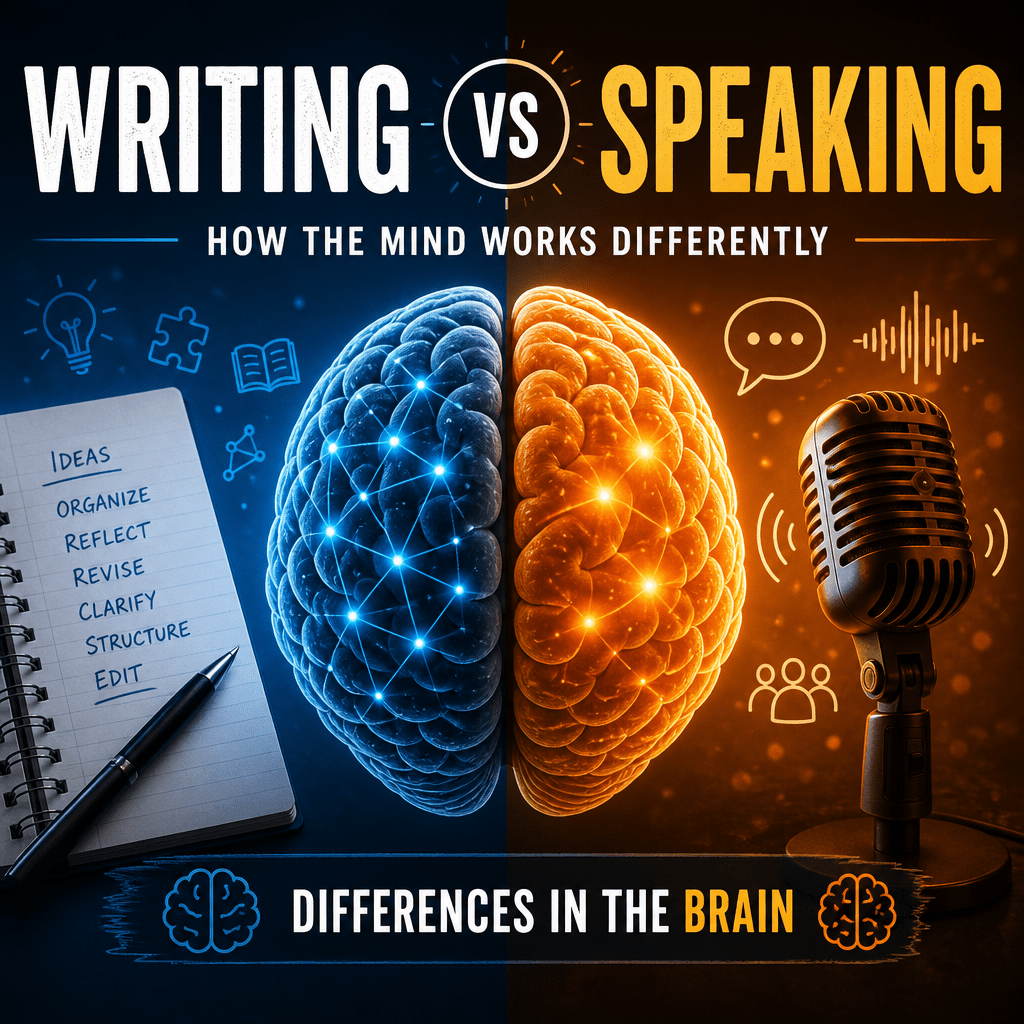
Writing vs Speaking Differences in the Brain: 5 Powerful Insights
Most people assume writing and speaking are simply two forms of the same skill: one appears on a page, the other in the air. But the brain does not treat them as identical. The writing vs speaking differences in the brain are subtle, yet powerful enough to change how we think, remember, and express ourselves. Writing often slows thought down and gives it structure. Speaking pushes thought into motion and reveals it under pressure.
That difference matters more than many people realize. Research in psycholinguistics and cognitive science suggests that written language often shows greater accuracy, stability, and reflection than spoken language. At the same time, speech can be more spontaneous, socially adaptive, and emotionally immediate. Together, they form two distinct modes of mind.
Understanding the writing vs speaking differences in the brain can help us become better communicators, better thinkers, and even more self-aware people. Here are five powerful insights into why the two experiences feel so different.
Writing vs Speaking Differences in the Brain: Why They Feel So Different
Writing and speaking may share language, but they do not share the same mental conditions. Speaking usually happens in real time. You choose words quickly, respond to facial expressions, adjust your tone, and keep moving forward. Writing, by contrast, gives you time to pause, revise, and reflect.
That extra time changes everything.
When we write, the brain can evaluate ideas before committing to them. Weak arguments become easier to spot. Contradictions stand out. Emotions can be named more carefully. The page becomes a space where thought can settle before it is shared.
Speaking is different because it is shaped by immediacy. It is not just about language; it is also about timing, social cues, and pressure. You are not only forming a thought, you are delivering it while managing the listener’s response. That makes speech faster and often more emotionally alive, but it can also make it less precise.
This is why some people sound clear on paper but stumble in conversation, while others speak effortlessly but struggle to organize their ideas in writing. The brain is doing different work in each case.
1. Writing Gives the Brain Time to Think
One of the biggest writing vs speaking differences in the brain is time. Writing lets the mind slow down and organize itself. Speaking does not.
That slowing effect is one reason writing often improves clarity. A writer can pause between ideas, reread a sentence, and rethink the next line. This allows deeper processing than casual speech usually permits. In writing, the brain is not rushing to keep up with the moment. It can examine its own thinking.
This is especially useful in journaling, note-taking, and reflective writing. When people write about their experiences, they often discover insights they did not know they had. The act of writing turns vague feelings into visible language. Once ideas are visible, they become easier to understand and refine.
This is also why many people say they “think better on paper.” Writing is not just a record of thought; it is a tool for creating thought.
2. Speaking and Writing Use Different Cognitive Demands
Another major difference lies in how much mental coordination each mode requires. Speaking depends heavily on working memory, social awareness, and fast language retrieval. You have to remember what you wanted to say, listen to yourself as you speak, and adapt to the other person at the same time.
Writing distributes that load more evenly. You can return to earlier sentences, reorganize paragraphs, and choose exact wording without the pressure of instant delivery. That makes writing more flexible for complex reasoning.
The brain also tends to recruit different resources depending on the task. Speech often leans on fast verbal production and social processing. Writing brings in more planning, editing, and self-monitoring. In practical terms, this means the written word often reflects a more revised version of thought, while speech reflects a more immediate version.
Neither is better in every situation. A quick conversation may be perfect for solving a problem on the spot. A written explanation may be better when the issue is complex, sensitive, or technical. The brain adapts to the demands of the medium.
3. Writing Can Change How We Understand Ourselves
The writing vs speaking differences in the brain are especially clear when it comes to self-awareness. Many people are surprised by what they discover when they write freely. A journal entry can reveal emotional patterns, hidden concerns, or unresolved questions that were not obvious in conversation.
That is because writing creates distance. When thoughts appear on the page, they feel a little less like passing sensations and a little more like objects that can be examined. This distance can be deeply valuable. It helps people ask: Do I really believe this? What am I reacting to? What am I avoiding?
Speaking can also reveal the self, but in a different way. When we talk, we are usually responding to someone else. We adjust ourselves in real time. That means speech often shows the self as it moves through a situation, while writing often shows the self after reflection.
This is why people sometimes say they did not fully understand their feelings until they wrote them down. The page can uncover what the mouth is too busy to notice.
4. Memory Works Differently in Writing and Speech
Memory is another area where writing and speaking diverge. Spoken language depends more heavily on short-term working memory. If you are nervous, distracted, or interrupted, it can become harder to keep your train of thought. That is why people sometimes lose words mid-sentence or forget what they were about to say.
Writing reduces some of that pressure. The page holds the words for you. Because the brain does not have to carry every detail at once, it can focus more on structure, meaning, and revision. This is one reason writing often helps with learning. Notes, summaries, and reflections create a lasting external memory that can be revisited later.
Over time, this can strengthen comprehension and recall. Writing does not just preserve information; it helps organize it into patterns the brain can return to. Speech can be powerful in the moment, but unless it is repeated or recorded, it usually disappears. Writing lasts.
That lasting quality is one reason writing vs speaking differences in the brain matter so much in education, work, and self-development. Writing gives memory a place to land.
5. Emotion Changes the Brain’s Response to Language
Emotion affects both writing and speaking, but not in the same way. When people are anxious, speaking often becomes harder first. Words come faster or slower than intended. The mind blanks. The body becomes more aware of the moment, which can make speech feel fragile.
Writing can still be difficult under emotional strain, but it often offers more control. A person can pause, step away, and return to a draft later. That makes writing useful for processing feelings without being overwhelmed by them.
At the same time, speech has its own emotional strength. A voice can convey warmth, urgency, humor, grief, or reassurance in a way text sometimes cannot. That is why spoken words can feel so comforting in moments of stress. They carry human presence.
So while writing may help us understand emotion, speaking may help us share it. One gives shape to feeling. The other gives feeling an immediate human channel.
Why the Writing vs Speaking Differences in the Brain Matter in Daily Life
These differences are not just academic. They show up everywhere.
A student may write brilliant essays but struggle in class discussion. A manager may speak confidently in meetings but need help drafting a clear memo. A friend may text thoughtfully yet become tongue-tied in person. None of this means one person is smarter than another. It simply means the brain performs differently across language modes.
Recognizing this can make us more patient with ourselves and others. It also helps us use the right medium for the right task. If precision matters, write. If connection matters, speak. If both matter, use both.
Writing can help you sort out your thinking before a conversation. Speaking can help you test your ideas in real time. Together, they form a stronger whole.
How to Strengthen Both Skills
If you want to improve writing and speaking together, start by moving between them.
For writing:
– Write regularly, even for five minutes
– Focus on clarity before style
– Read your writing aloud
– Revise in separate passes
– Use short, direct sentences when needed
For speaking:
– Practice summarizing ideas out loud
– Slow your pace
– Pause before responding
– Record yourself and listen back
– Use a simple structure: point, example, conclusion
A useful habit is to write first and then speak from the page. Or speak first and then write what you meant. This back-and-forth helps bridge the writing vs speaking differences in the brain and makes each skill stronger.
Conclusion: Two Modes, Two Strengths
The writing vs speaking differences in the brain remind us that language is not one single experience. Writing is slower, more reflective, and often more precise. Speaking is faster, more social, and more immediate. Each reveals something different about how the mind works.
Writing can help us discover what we think. Speaking can help us share it with others. Writing builds the structure of thought. Speaking brings that structure to life.
When we learn to use both well, we become clearer, more adaptable, and more honest with ourselves.