
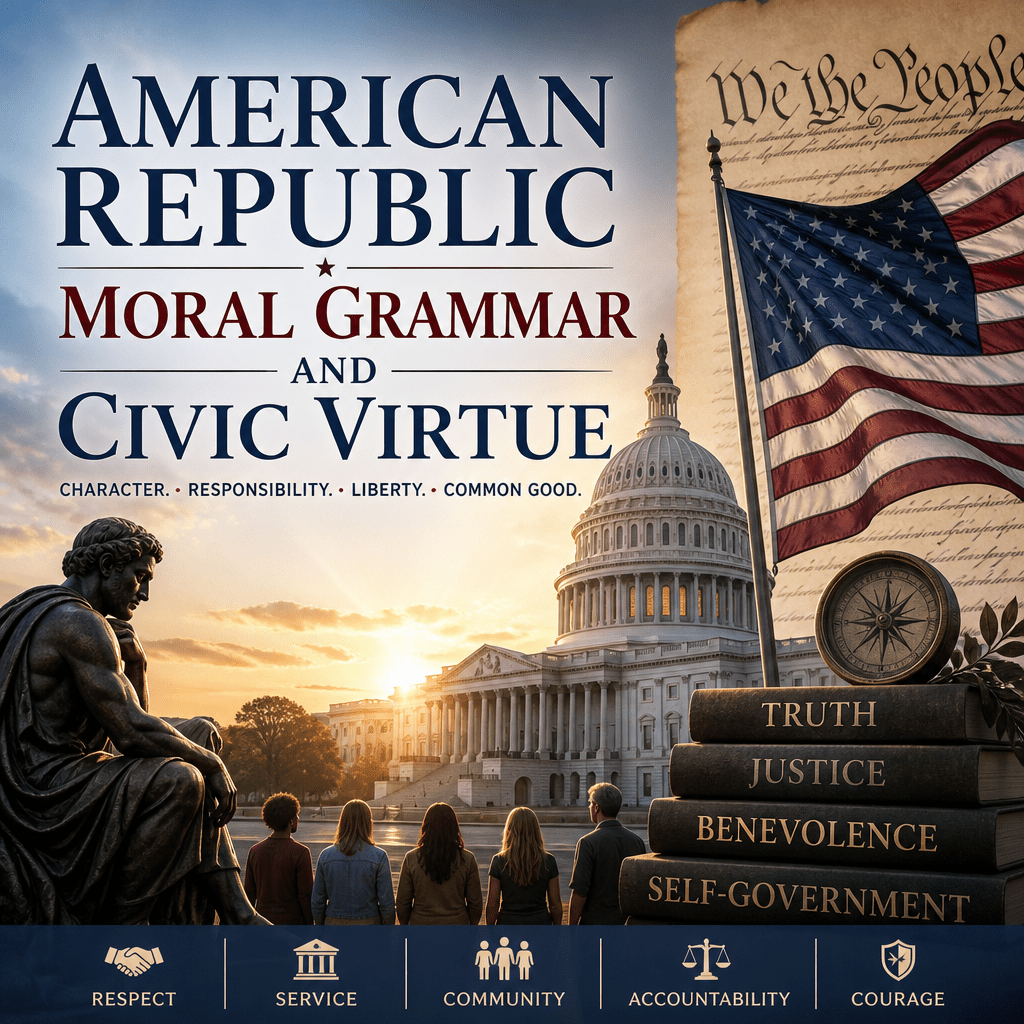
7 Powerful Steps to Achieving Emotional Self-Control: The Restorationist Origin Myth Explained — Lost Moral Grammar: Stunning Best Civic Renewal GuideAmerica’s Founding Tradition was never only about laws, elections, or borders. It was also about character, speech, and the habits that make liberty workable. The founders understood that a free people must share more than institutions. They must share a common way of speaking about right and wrong, duty and restraint, public trust, and private conduct. This shared framework can be called American Republic Moral Grammar.
In this secular sense, “moral” does not require a particular religious belief. It refers to standards of conduct that help people live together well: virtue, honesty, fairness, self-control, reciprocity, and respect for the dignity of others. It includes the Golden Rule—doing unto others as we would have them do unto us. These principles give self-government its vocabulary and its practical shape.
Table of Contents
- What American Republic Moral Grammar Means
- Grammar as a Tool in Every Craft
- The Founding Tradition and Civic Language
- The Secular Meaning of “Moral”
- Virtue and Self-Government
- Civic Roles and Daily Habits
- Institutions and Public Trust
- Putting the Principles Into Practice
- When Public Words Lose Meaning
- Recovering a Civic Grammar
- Conclusion: Liberty Needs Character
What American Republic Moral Grammar Means
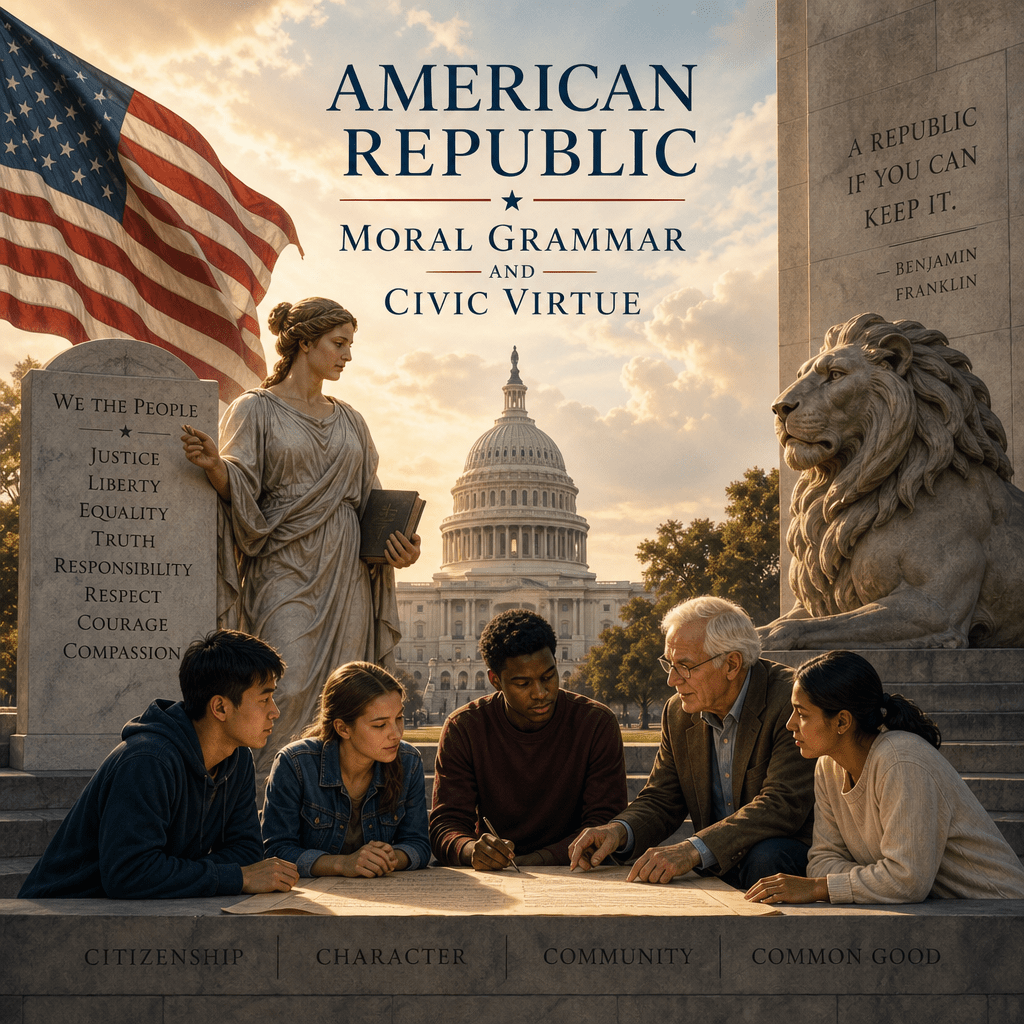
Grammar gives order to words. It helps language make sense by showing how individual terms relate to one another. Moral Grammar performs a similar function in public life. It gives shape to the values that allow citizens to live together under a common rule.
In simple terms, moral grammar is the civic vocabulary of a decent society. It includes ideas such as:
- duty
- honesty
- justice
- restraint
- respect
- trust
- virtue
- responsibility
These words are not ornamental. They describe the habits and expectations that make freedom durable. A citizen who speaks of rights but refuses every duty understands only part of republican liberty. A public official who demands trust while rejecting accountability also breaks the connection between words and conduct.
In the Founding Tradition, freedom was not intended to mean that anything goes. It meant the ability of a people to govern themselves responsibly. Self-government therefore requires self-command. Citizens must be capable of telling the truth, keeping promises, accepting lawful limits, and recognizing that other people possess the same rights they claim for themselves.
American Republic Moral Grammar expresses this relationship between liberty and responsibility. It reminds us that rights need institutions, while institutions need citizens with the character to use them well.
Grammar as a Tool in Every Craft
Every craft has a grammar. A carpenter works with measurements and joinery. A musician works with notation, rhythm, and harmony. A lawyer works with legal terms and precedent. A programmer works with syntax. A baker relies on ratios, temperature, and timing.
Words are tools of the trade in every craft. They help people name problems, explain methods, teach beginners, and judge results. When words are clear, work improves. When words are vague or misleading, the craft suffers. Within American Republic Moral Grammar, civic terms function as practical tools for judging conduct and public decisions.
The same principle applies to civic life. A republic depends on shared words with reasonably stable meanings. Liberty, justice, law, equality, rights, duty, and citizenship are not empty labels. They are working terms. They guide decisions and establish expectations.
If people use “liberty” to mean freedom from every obligation, the word loses its republican meaning. If “justice” means only victory for one’s own side, it no longer points toward fairness. If “rights” are treated as unlimited demands, they cease to coexist with the rights of neighbors. Public argument may continue, but citizens will no longer be debating from a common vocabulary.
Clear civic language does not eliminate disagreement. It makes serious disagreement possible. Citizens can argue about policy while still recognizing the difference between truth and falsehood, law and force, persuasion and coercion, courage and recklessness.
The Founding Tradition and Civic Language
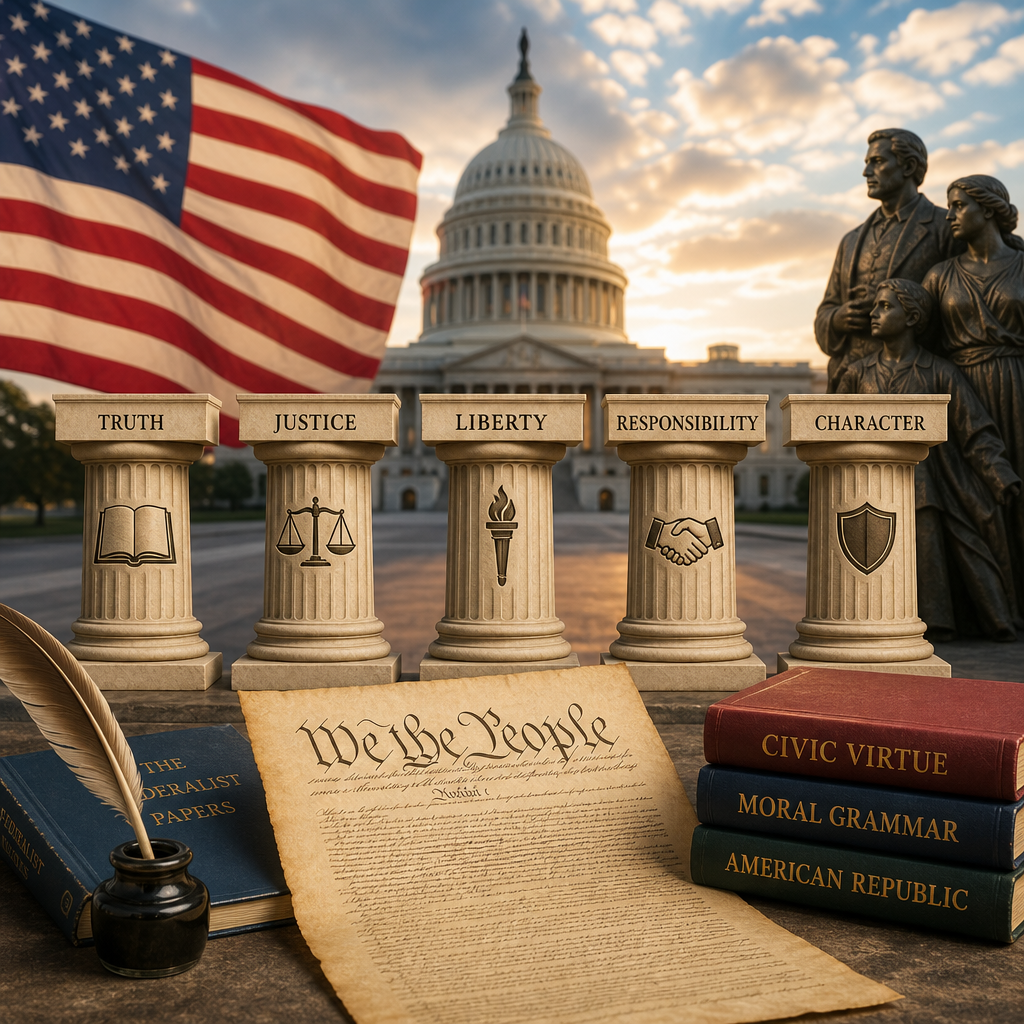
America’s Founding Tradition joined political arrangements to moral expectations. Written constitutions, divided powers, elections, and courts matter, but they cannot by themselves create a responsible people. Institutions provide form. Character determines how that form is used. This union of institutions and character is central to American Republic Moral Grammar.
The founding generation repeatedly appealed to public virtue, prudence, moderation, and responsibility. These were not merely private qualities. They were civic requirements. A representative government could survive disagreement only if citizens and leaders practiced restraint and accepted the legitimacy of lawful outcomes.
This tradition also treated language as a safeguard against arbitrary power. A written constitution depends on words that can be read, interpreted, and applied. Public promises depend on words that retain meaning. Laws depend on citizens who understand that rules apply beyond the momentary advantage of their own faction.
The American formative tradition and its enduring ideals provide a useful context for understanding this connection between inherited principles and public character. The tradition is not a museum piece. It is a set of questions about what citizens owe one another and what kind of habits allow a republic to endure.
The Secular Meaning of “Moral”
Calling this framework “moral” does not turn the discussion into a theological argument. Moral language can be used in a broadly secular sense to describe standards for human conduct. It asks how people should treat one another, what obligations follow from living in a shared society, and which habits build or destroy trust. This secular understanding gives American Republic Moral Grammar relevance across different beliefs and philosophies.
Virtue, in this context, means a developed capacity to act well. Honesty is the habit of representing reality truthfully. Justice means giving people their due and applying standards fairly. Restraint means refusing to use every available power simply because it can be used. Courage means standing for what is right even when doing so is costly.
The Golden Rule gives these ideas a practical test: do unto others as you would have them do unto you. It does not answer every policy question, but it challenges selfish standards. Would we accept surveillance, censorship, favoritism, or arbitrary punishment if those powers were used against us? Would we want opponents to receive the same legal protections we demand for ourselves?
This form of moral reasoning supports pluralism. People may disagree about religion, philosophy, economics, and policy while still agreeing that cruelty, dishonesty, betrayal, and abuse of power are dangerous to public life.
Virtue and Self-Government
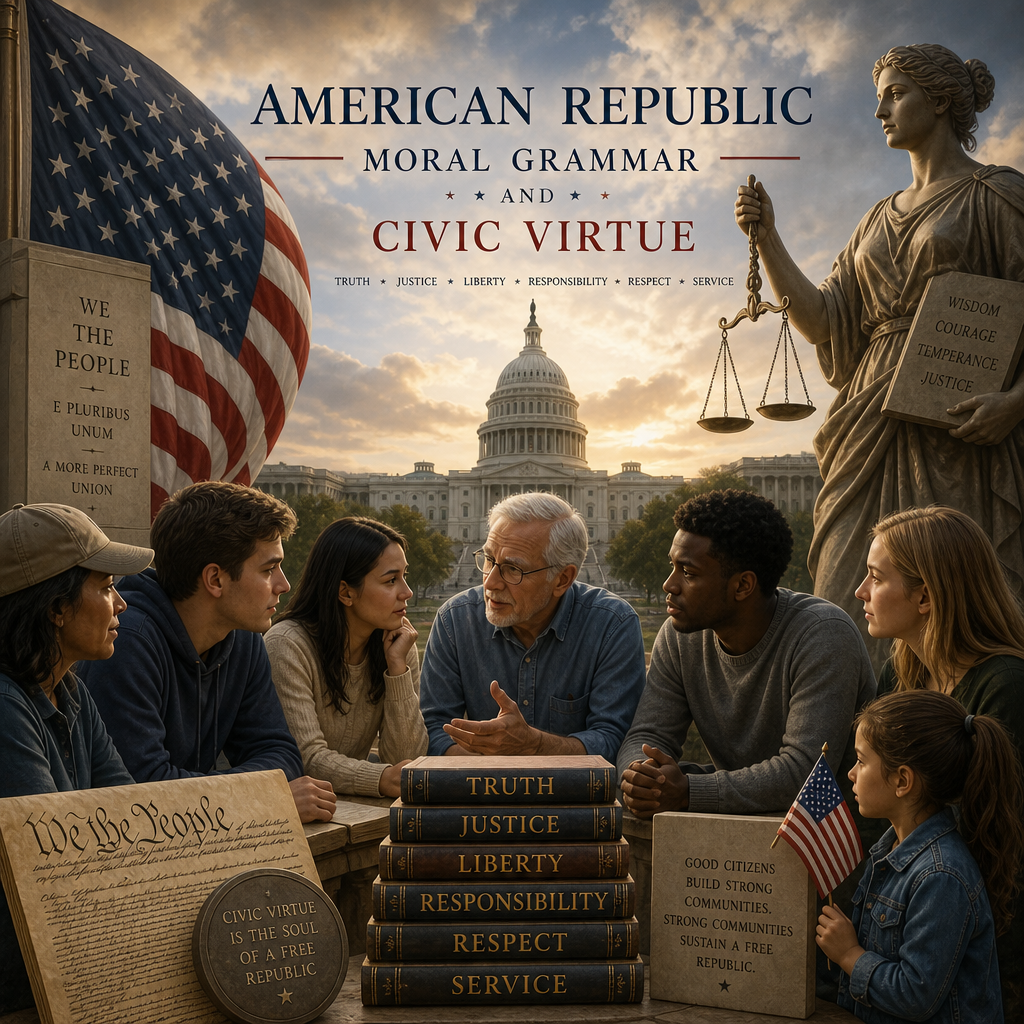
Self-government begins before a citizen enters a voting booth. It begins with the ability to govern one’s own impulses. A person who cannot resist anger, vanity, greed, or resentment will often use public power to satisfy private passions. A society composed of such individuals will struggle to remain free. This personal discipline is therefore essential to American Republic Moral Grammar.
Civic virtue does not mean perfection. It means the repeated practice of qualities that make cooperation possible. A virtuous citizen can admit an error, listen to an opposing argument, keep a commitment, and distinguish personal disappointment from public injustice. Such a citizen can defend a principle without treating every opponent as an enemy.
These habits are especially important in a republic because political power is distributed among ordinary citizens. Voters, jurors, teachers, journalists, public servants, and community leaders all make judgments that affect others. Their decisions cannot be made wise by procedure alone.
Education therefore has a civic purpose. It should teach knowledge and skills, but it should also cultivate intellectual honesty, patience, responsibility, and respect for evidence. A deeper discussion of this relationship appears in the relationship between education and self-government.
American Republic Moral Grammar in Civic Roles and Daily Habits
In ordinary life, American Republic Moral Grammar is not an abstract theory reserved for judges, scholars, or elected officials. It appears when a neighbor keeps a promise, a parent corrects a child without humiliation, a supervisor gives credit fairly, or a voter checks a claim before repeating it. These actions establish patterns of reliability. They teach people that public life is not separate from private conduct, because the habits learned in one setting often shape behavior in the other.
Families, associations, workplaces, and local communities are places where citizens rehearse the responsibilities of freedom. American Republic Moral Grammar gives those responsibilities recognizable names. Patience is needed when others are difficult. Fairness is needed when one has authority. Gratitude is needed when benefits have been received from efforts not one’s own. These are not dramatic achievements, but they form the dispositions that make cooperation less fragile and conflict less destructive.
Teaching Through Example
Children and young adults learn the force of civic words by seeing whether adults honor them. When an adult admits a mistake, explains a decision honestly, or listens before judging, the lesson is more durable than a slogan. American Republic Moral Grammar therefore calls for example as well as instruction. A culture that praises integrity while rewarding deception gives mixed signals; a culture that treats self-command as a strength gives future citizens a more dependable standard.
American Republic Moral Grammar and Public Institutions
Institutions cannot function well if citizens assume that every rule is merely a weapon used by the powerful. Courts, legislatures, schools, newspapers, and voluntary organizations earn legitimacy over time through competence, transparency, and consistent standards. American Republic Moral Grammar helps explain why these standards matter: they connect authority to duty and power to accountability. An institution may possess legal authority, yet still weaken itself if it uses that authority carelessly or speaks in ways that conceal its real reasons.
The same standard applies to those who criticize institutions. American Republic Moral Grammar does not demand passive obedience or forbid forceful dissent. A free people should expose corruption, challenge unjust policies, and insist that officials answer for their actions. Yet criticism is most persuasive when it distinguishes evidence from rumor, error from malice, and reform from destruction. The goal is not to protect every existing practice; it is to preserve the conditions under which correction remains possible.
Public trust also depends on procedural fairness. People are more likely to accept an unfavorable result when they believe they were heard, the rules were known, and similar cases will receive similar treatment. In that sense, American Republic Moral Grammar supports both liberty and order. It asks citizens to resist favoritism, to offer reasons for decisions, and to recognize that a fair process protects opponents today and allies tomorrow.
American Republic Moral Grammar in Practice
Practical civic discipline begins with the way people speak. American Republic Moral Grammar asks a speaker to use words proportionately: a disagreement is not automatically betrayal, an error is not automatically corruption, and a political opponent is not automatically an enemy. Such distinctions do not make public debate timid. They make it more accurate, and accuracy is a form of respect for fellow citizens.
It also changes how citizens receive information. Under American Republic Moral Grammar, sharing a claim carries responsibility. Before passing along a sensational accusation, a person can ask whether the source is credible, whether the evidence supports the conclusion, and whether the same standard would be accepted if the target were an ally. This modest pause protects both truth and reputation, two goods that are easily damaged and difficult to restore.
Participation in local life provides another opportunity for practice. Serving on a school committee, attending a town meeting, helping a neighbor, or volunteering with a civic group requires patience with people who do not think alike. American Republic Moral Grammar supplies a framework for such encounters by joining conviction to reciprocity. Citizens may argue vigorously for their views while extending to others the hearing, lawful protections, and basic dignity they expect for themselves.
Political leaders face a special obligation because their example travels widely. When leaders speak carefully, accept correction, and explain the limits of their own authority, they strengthen the habits a republic needs. When they make contempt fashionable, evade responsibility, or reduce every issue to loyalty, they weaken those habits. American Republic Moral Grammar is therefore a standard for evaluating not only what leaders promise, but also the conduct they normalize.
None of this requires unanimous agreement about public policy. American Republic Moral Grammar permits serious disagreement over taxation, education, foreign affairs, and the scope of government. What it rejects is the belief that disagreement excuses dishonesty, cruelty, or the abandonment of common standards. A republic remains open to debate precisely because its citizens retain enough trust to argue without treating every contest as a license for abuse.
When Public Words Lose Meaning
A republic becomes vulnerable when public words are separated from the conduct they are supposed to describe. Leaders may speak constantly of freedom while silencing criticism. Institutions may invoke justice while applying standards unevenly. Citizens may demand respect while treating neighbors with contempt. Such contradictions violate the standards expressed by American Republic Moral Grammar.
This is more than hypocrisy. It is a breakdown in civic grammar. When words no longer correspond to recognizable standards, language becomes a weapon rather than a means of understanding. Terms such as “democracy,” “truth,” and “rights” can be used to conceal power instead of limiting it.
Rhetoric can also spread habits through imitation. If public figures are rewarded for exaggeration, personal attacks, or refusal to accept responsibility, those behaviors become normal. Citizens begin to assume that every claim is propaganda and every admission of error is weakness. Trust then declines, and declining trust makes cooperation harder. American Republic Moral Grammar counters this decay by joining public claims to consistent standards of conduct.
The remedy is not to abandon rhetoric or public debate. It is to restore accountability to language. People should ask what a word means, what standard it establishes, and whether the speaker is willing to apply that standard consistently.
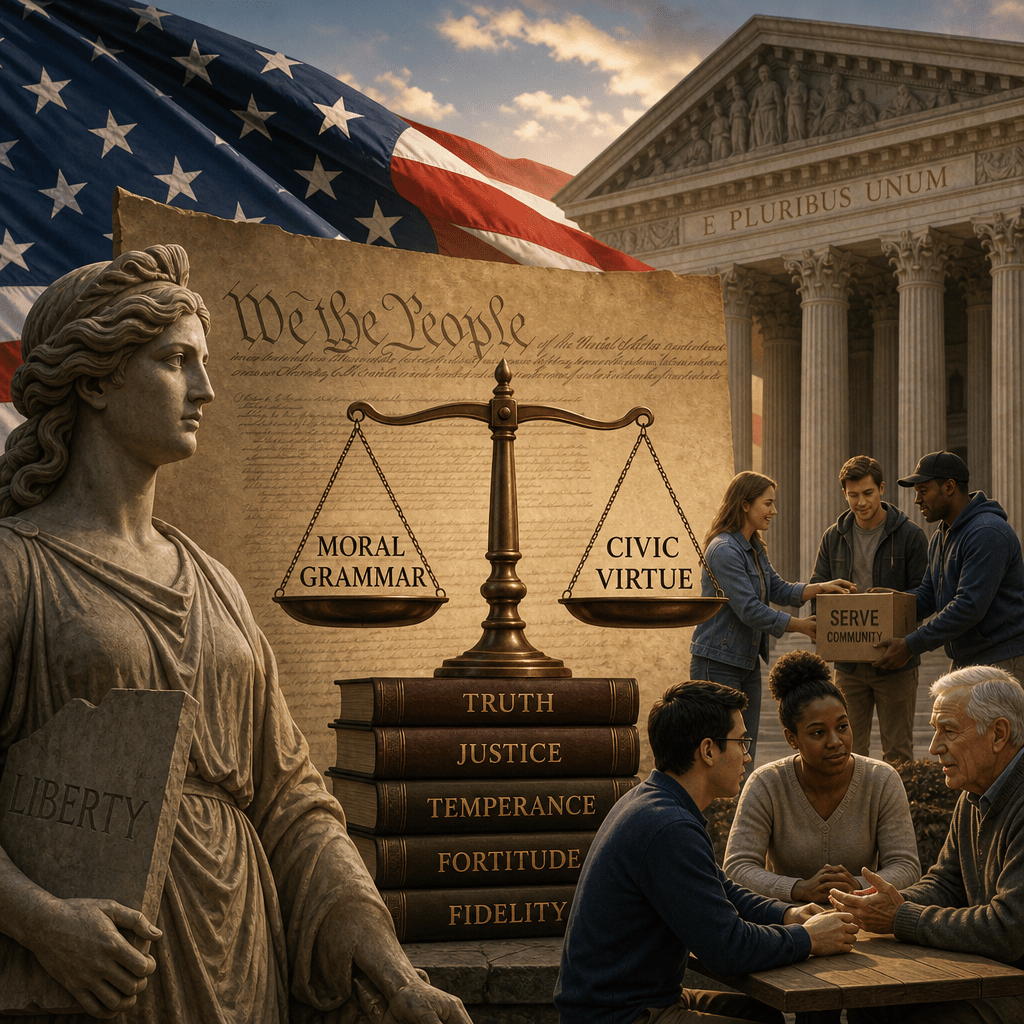
Recovering a Civic Grammar
Recovering moral grammar does not require everyone to share the same personality or political program. It requires a shared commitment to certain basic practices. Renewing American Republic Moral Grammar begins with applying those practices consistently in ordinary civic life.
- Speak precisely. Define important terms and avoid using emotionally charged labels as substitutes for arguments.
- Tell the truth. Distinguish facts, interpretations, predictions, and opinions.
- Apply standards consistently. Do not excuse conduct from allies that would be condemned in opponents.
- Practice reciprocity. Defend rights as principles that belong to everyone, not privileges reserved for one group.
- Accept limits. Recognize that lawful authority, personal freedom, and public responsibility must remain in balance.
- Honor accountability. Expect leaders, institutions, and citizens to explain their decisions and correct mistakes.
- Teach civic virtue. Model patience, fairness, courage, and restraint in families, schools, workplaces, and public forums.
These practices may seem modest, but a republic is sustained through repeated ordinary actions. Keeping a promise, listening before responding, refusing a dishonest advantage, and treating an opponent as a fellow citizen are all forms of constitutional culture.
Readers who want a broader reference point can consult the National Archives collection of America’s founding documents. The texts themselves do not eliminate interpretation, but they help citizens return to the public language through which the nation defined its political commitments.
Conclusion: Liberty Needs Character
American Republic Moral Grammar names the connection between words, conduct, and self-government. Grammar gives language order; civic grammar gives public life a shared structure. It helps citizens understand that liberty is not merely the absence of restraint. It is the responsible use of freedom among people who possess equal dignity and equal claims to justice.
The American Republic depends on more than elections and legal mechanisms. It depends on citizens who can speak honestly, reason fairly, practice restraint, and treat others according to the same standards they claim for themselves. That is the secular moral meaning of virtue in public life.
When a people preserve this grammar, disagreement can remain productive and freedom can remain humane. When they abandon it, rights become demands, debate becomes noise, and institutions lose the trust that allows them to work. The task of every generation is therefore not only to preserve the republic’s structure, but also to renew the character and language that make self-government possible. Preserving American Republic Moral Grammar is part of that continuing civic responsibility.
Leave a Reply