
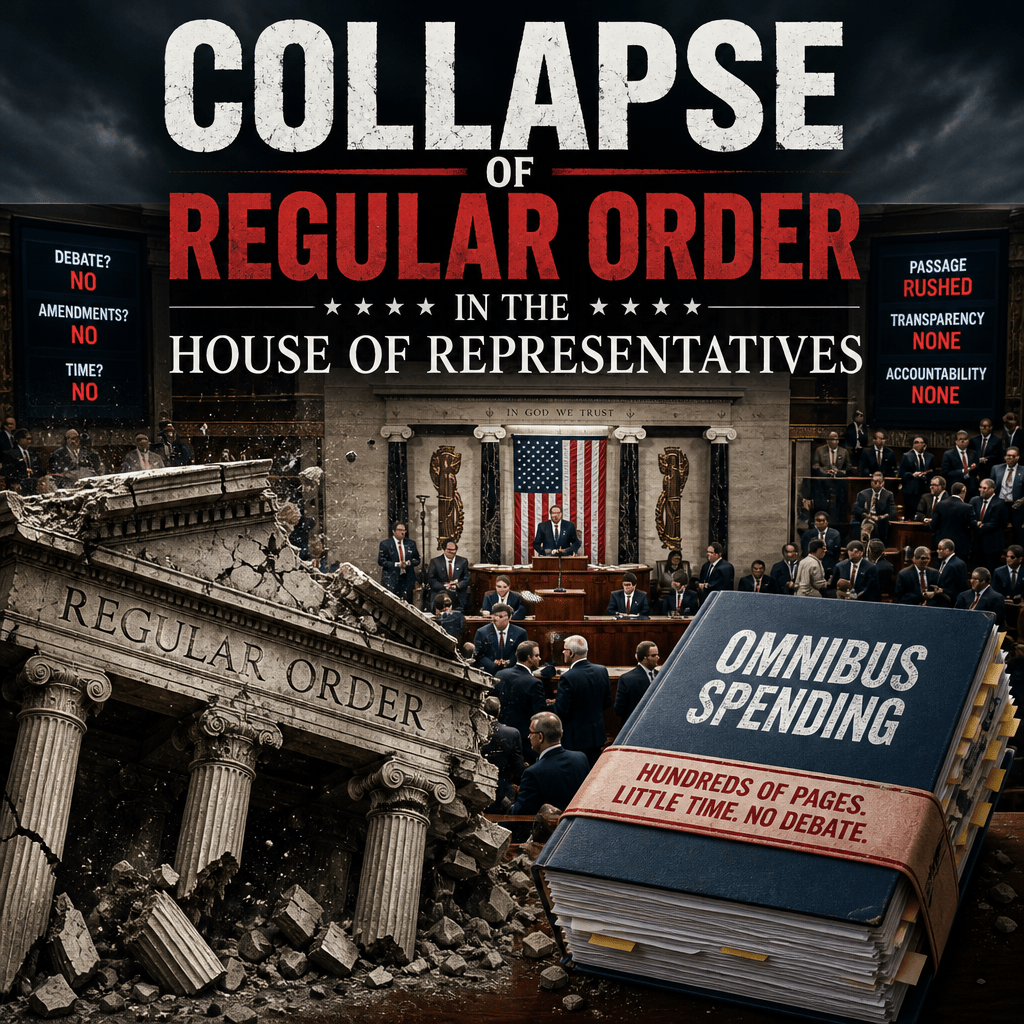
Regular Order was meant to make the House of Representatives a visible school of self-government. It gave citizens a chance to see how public decisions were made and gave representatives a chance to debate, amend, and defend their choices in daylight. That tradition is now badly broken. The collapse of Regular Order has turned the budget process into a test of endurance rather than an exercise in representative judgment.
Congress has not passed all 12 appropriations bills on time in decades. Instead, it relies on shutdown threats, continuing resolutions, and massive omnibus spending packages written behind closed doors. This is not a minor procedural problem. It is a failure of constitutional habits. When Congress stops working this way, the republic stops forming. Restoring Regular Order is therefore about more than calendars and committee rules; it is about recovering the public practices that make self-government possible.
Table of Contents
The Founders Expected Public Deliberation
The Constitution did not create Congress to hide its work. It created a legislature that would debate openly, argue in public, and make spending decisions through a process that allowed scrutiny and accountability. The annual appropriations process was supposed to be slow enough for examination and open enough for citizens to understand.
That process had a civic purpose. It taught citizens how representative government works. It taught lawmakers that they were not merely voting machines. It taught the country that disagreement is part of democracy, not a threat to it. In this sense, Regular Order was an educational practice as much as a legislative procedure.
Article I, Section 9 of the Constitution establishes Congress’s power over federal spending. The Constitution Annotated explanation of the appropriations clause provides useful background on that constitutional responsibility.
In that sense, Regular Order was not simply a rulebook. It was a civic practice. It helped form a free people by connecting public power to public reasoning. When citizens can observe the process, they can distinguish a genuine disagreement over policy from a manufactured emergency. That distinction is essential to public trust.
The principle is simple: government should not ask citizens to accept major decisions that officials themselves have had no meaningful opportunity to examine. Public deliberation takes time, but that time is not wasted. It allows facts to surface, weak arguments to be challenged, and lawmakers to explain what they are willing to defend. Regular Order protects that necessary time for scrutiny.
What Regular Order Was Supposed to Do
Under the constitutional model, Congress should move appropriations through a visible process:
- Committees review the bills.
- Members propose amendments.
- Debates happen on the House floor.
- Votes are taken in public.
- Citizens can follow the choices being made.
That is how representative government should work. It is also how trust is built. When people can see what their leaders are doing, they can judge them honestly. When lawmakers must explain their votes, they are more likely to act responsibly. This is the basic discipline of self-government, and it is the central promise of Regular Order.
Regular Order also distributes responsibility. Committees develop expertise, individual members contribute to the text, and the full House has an opportunity to examine competing priorities. No one should confuse this process with perfect government. Debate can be slow, contentious, and frustrating. Yet those difficulties are preferable to a system in which the important work happens before most representatives or citizens can see it.
When the process is visible, disagreement becomes productive. Members can identify specific provisions, propose alternatives, and accept responsibility for the result. When the process is hidden, a final vote becomes an exercise in pressure rather than judgment. The point of Regular Order is not to eliminate conflict but to place conflict inside a structure where it can be understood.
That structure also protects minority viewpoints. A member who cannot defeat a bill may still expose a weakness, offer an amendment, or persuade the public. Those opportunities make legislation more durable because the final measure has passed through criticism instead of bypassing it.
Omnibus Spending Replaced Deliberation With Pressure
Modern omnibus spending has become the norm. Instead of 12 separate appropriations bills, Congress often bundles everything into one giant package. These bills can run thousands of pages. They are usually negotiated in private by party leaders and released only shortly before the vote. This approach is the opposite of Regular Order, which depends on separate consideration and visible responsibility.
That means most members do not have time to read them. It means the public does not have time to review them. It means accountability is weakened before the vote even happens. Even when the final package contains worthwhile provisions, its size and rushed presentation make informed judgment difficult. Under Regular Order, separate bills would give members and citizens a clearer view of each spending decision.
This is not deliberation. It is management by crisis. When the House of Representatives votes on legislation it did not meaningfully shape, it is no longer functioning as a genuine representative chamber. Members may still cast votes, but the formative work of legislating has already been concentrated in the hands of a few negotiators.
Large spending packages can contain necessary funding, compromises, and provisions that deserve consideration. The criticism is not that every omnibus contains only bad policy. The criticism is that the size and timing of these packages make responsible examination nearly impossible. A good provision does not excuse an opaque process, and an urgent deadline does not eliminate the need for accountability.
The result is a damaging cycle: delay creates urgency, urgency justifies secrecy, secrecy produces a massive package, and the package makes future delay more likely. What began as an exception becomes the operating system. Once that cycle becomes normal, even members who support Regular Order may feel compelled to accept the very practices that undermine it.
Omnibus legislation also makes outcomes harder to evaluate. If dozens of unrelated policy choices are placed in one bill, a representative cannot easily support one section while opposing another. Citizens then receive a simple yes-or-no vote that conceals several different judgments. Separate bills would not guarantee agreement, but they would make disagreement more precise.
Closed-Door Government Weakens Self-Government
A republic depends on citizens seeing how power works. But closed-door budget writing hides the process from everyone except a small group of insiders. Rank-and-file members are handed a finished product. The public sees only the final vote. The real bargaining happens elsewhere.
That creates several problems at once:
- Members lose ownership of the legislation.
- Amendments become rare or meaningless.
- Citizens cannot follow the process.
- Transparency disappears.
- Responsibility gets blurred.
When everyone is involved only at the end, no one is truly accountable at the beginning. Leaders can blame the deadline, members can blame the leaders, and citizens are left trying to understand a document that appeared after the meaningful decisions had already been made. Regular Order exists precisely to prevent this separation between power and responsibility.
That is the opposite of what Regular Order was meant to achieve. Representative government requires more than a recorded vote. It requires a chain of public reasoning that allows citizens to connect proposals, amendments, votes, and consequences. Without that chain, elections become the only visible moment of accountability.
The same concern applies to the House as an institution. A chamber that cannot regularly develop, debate, and amend its own legislation loses institutional knowledge. Members become dependent on leadership offices, staff-negotiated text, and emergency procedures. Over time, the institution forgets how to do its ordinary work. The loss of Regular Order is therefore also a loss of legislative capacity.
Transparency does not mean every negotiation must occur in front of cameras. Legislators need room to work through disagreements. But the public should receive bill text early enough to study it, and members should have a genuine opportunity to propose changes before the final vote. Confidential discussion and public accountability are not opposites; a functioning process requires both. Regular Order can preserve room for negotiation without concealing the final choices from public scrutiny.
The Christmas Recess Has Become a Governing Tool
There is another reason omnibus spending survives: timing.
Congress often waits until late December to finish spending bills. Then lawmakers use the coming Christmas recess as pressure. No one wants to be blamed for forcing members to stay in Washington over the holidays, so the deal gets rushed through. Regular Order is weakened when a personal scheduling concern becomes more powerful than the public’s need for careful legislation.
The result is predictable. The omnibus passes with little public review. Members vote under pressure. The public has little chance to understand or influence the final product. Holiday travel schedules become an informal governing mechanism.
This is not a healthy way to govern. It is a built-in incentive to avoid real scrutiny. A legislature should not be managed by the fear that a necessary vote will disrupt holiday plans. Deadlines should encourage preparation, not create a moment when members must choose between responsible review and a politically painful delay.
If Congress cannot complete its work on time, the answer should not be panic. The answer should be discipline. The House could refuse to treat the recess as an immovable deadline, require more time between bill release and final votes, and make each committee responsible for completing its work before the end of the fiscal year.
Those steps would not make disagreement disappear. They would make delay more costly for the institution rather than more costly for citizens who are asked to accept unread legislation. That is a central purpose of Regular Order: to ensure that leaders, rather than the public, bear the consequences of poor preparation.
Why This Breaks America’s Formative Tradition
America has always depended on more than elections. It has depended on habits. The country was formed by practices that trained citizens in freedom:
- Public debate
- Open disagreement
- Shared rules
- Visible accountability
- Responsibility before power
These habits are part of America’s formative tradition. They shaped the people as much as the institutions. Citizens learn self-government by watching public officials reason, compromise, explain their choices, and accept consequences. Regular Order gives those habits a practical setting rather than leaving them as abstract civic ideals.
That is why the collapse of Regular Order matters so much. It does not merely make government less efficient. It makes government less formative. Citizens cannot learn how to govern themselves from a process they never see. Representatives cannot learn how to represent the public when they are shut out of the drafting process.
A republic cannot be formed by secrecy. A free people cannot be trained by unread legislation. If citizens are expected to trust institutions, those institutions must give citizens a meaningful view of how decisions are reached.
This civic dimension connects the budget process to the wider question of education and citizenship. As discussed in Formed Citizens and the Managed Generation, public institutions shape habits and expectations even when they are not formally schools. Congress teaches by example. When it substitutes pressure for deliberation, it teaches that procedure is disposable and accountability is optional.
The formative effect works in the other direction as well. A visible process teaches patience, evidence, compromise, and responsibility. It shows that public decisions are not merely products delivered by distant managers. They are judgments made by representatives who must answer to other representatives and to the people.
Crisis Budgeting Has Become the Normal Mode
The deepest problem is not one bad year. It is a long pattern of failure. For nearly three decades, Congress has treated the budget process as an emergency, even when it is not. This has normalized temporary fixes and last-minute deals. It has made dysfunction routine and made Regular Order appear unrealistic, even though the regular process is the condition that prevents repeated emergencies.
That is dangerous because crisis management is not the same as governing. Crisis management is fast; governing should be careful. Crisis management is reactive; governing should be deliberate. Crisis management can be justified in rare moments, but when it becomes the default, the constitutional order is weakened from within.
Continuing resolutions can be necessary when appropriations are incomplete. They keep the government operating and can prevent an immediate shutdown. But a temporary measure should remain temporary. When continuing resolutions become the normal substitute for individual appropriations bills, they reduce the incentive to settle priorities through regular debate. Regular Order provides the structure needed to resolve those priorities before an emergency deadline arrives.
The House of Representatives was not designed to live on panic. It was designed to deliberate. A functioning budget process should give the public enough time to understand major choices and lawmakers enough time to amend them. Without that time, the formal existence of a vote hides the practical absence of deliberation.
Repeated crisis budgeting also distorts political incentives. Members can present themselves as rescuers when they help pass a last-minute agreement, even if the same agreement was necessary only because the ordinary process was neglected. A return to Regular Order would make preparation visible and give voters better evidence for evaluating performance.
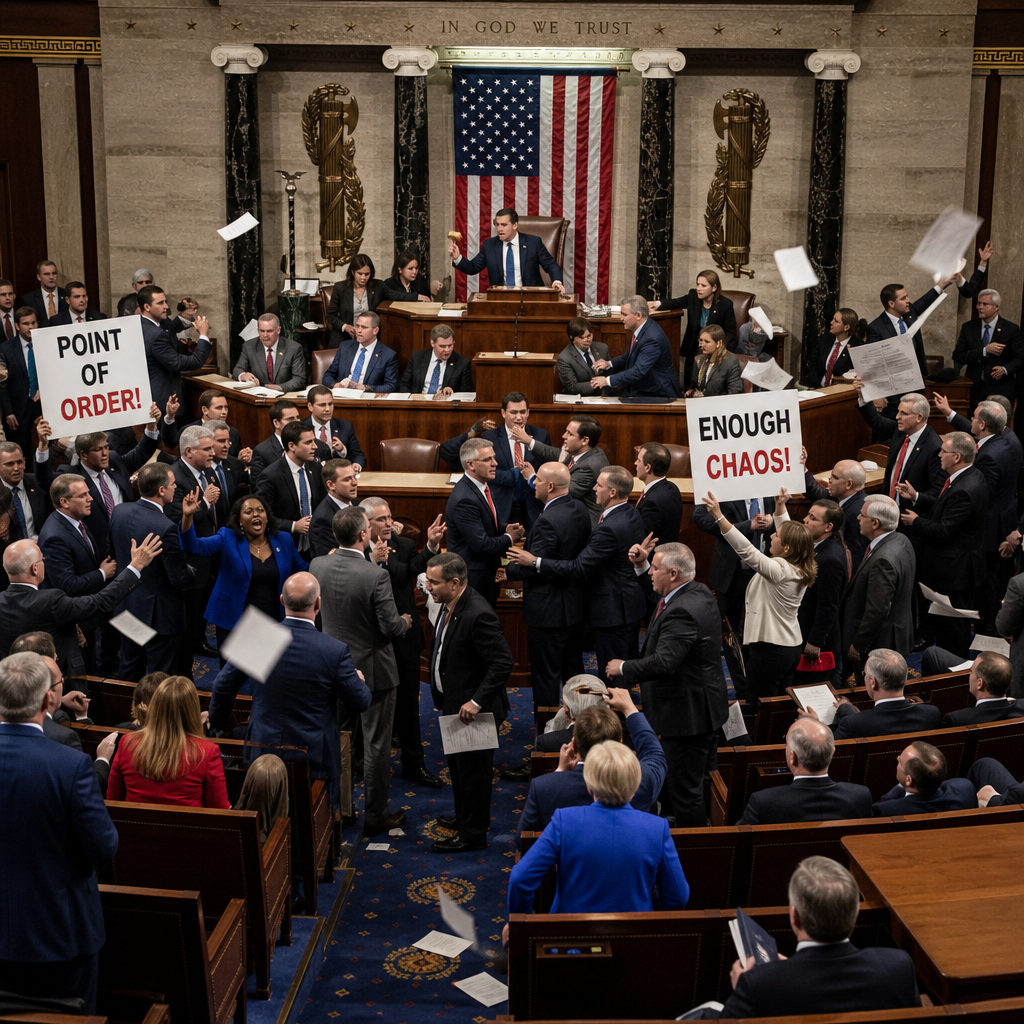
Why the Failure Is Structural, Not Personal
It is tempting to blame individual lawmakers. Sometimes that blame is deserved. But the larger problem is structural. Personal courage matters, yet even conscientious members face strong incentives to accept a process they did not design.
The rules now reward delay, secrecy, and consolidation. They punish openness and amendment. They encourage leaders to negotiate privately and present the result as an ultimatum. That structure produces bad behavior even from decent people.
If the process rewards unread votes, unread votes will happen. If the process rewards last-minute bargains, last-minute bargains will dominate. If the process rewards giant bills over smaller ones, giant bills will keep growing. Regular Order cannot be restored through speeches alone; the rules and incentives must support the behavior the public expects.
This is why the collapse of Regular Order is not just a matter of bad manners. It is a broken system. Changing personalities may improve the tone for a while, but durable improvement requires changing the incentives that govern how bills are drafted, released, debated, and voted on.
Structural reform also requires citizens to judge process, not only outcomes. A spending provision that a voter supports should not make secrecy acceptable. A provision that a voter opposes should not justify abandoning ordinary legislative safeguards. The same rules must apply regardless of which party controls the House.
What a Healthy House of Representatives Would Look Like
Restoring the constitutional role of the House would not require magic. It would require discipline. A serious reform agenda would include:
- Twelve appropriations bills, not one giant omnibus.
- Committee review before leadership deals.
- Time for amendments and debate.
- Public release of bill text well before the vote.
- Less reliance on continuing resolutions.
- A stronger expectation that members read what they pass.
- Clear responsibility for missed deadlines and rushed procedures.
These are not radical ideas. They are basic democratic ones. They would not eliminate conflict, and that is not the goal. Conflict is normal in a republic. The goal is to make conflict visible, accountable, and useful. Regular Order should make it possible for members to disagree without surrendering the institution’s responsibility to deliberate.
Some reformers have proposed biennial budgeting or other changes to the legislative calendar. Fewer deadlines might reduce shutdown threats and provide more time for lawmaking. But a different calendar would help only if Congress also restores transparency, committee participation, and meaningful floor debate. Moving deadlines without repairing the process would merely move the dysfunction.
The most important reform is cultural as well as procedural: members must see themselves as legislators rather than as spectators waiting to approve leadership agreements. A healthy House should make participation possible and expected. That is the institutional meaning of Regular Order: responsibility should be distributed widely enough that representatives can genuinely represent.
Reform should also include a clear minimum review period for major spending legislation. Members need time to read the text, staff need time to identify conflicts, and the public needs time to ask basic questions. A short delay may be inconvenient, but it is less damaging than passing provisions that no one has had a fair chance to understand.
The Republic Needs the Grammar of Self-Government
At its best, Congress does more than spend money. It teaches the country how to govern itself. That lesson disappears when the House of Representatives surrenders its role to secrecy and omnibus spending. The people lose visibility. Members lose responsibility. Debate loses meaning.
And when that happens, the republic weakens.
The answer is not to accept the collapse as normal. The answer is to restore the old grammar of self-government:
- Debate in public.
- Amendments in daylight.
- Votes that can be understood.
- Appropriations that are considered as individual measures.
- Deadlines that encourage preparation rather than panic.
- Leaders who answer for the process they control.
Regular Order cannot guarantee wise decisions. No procedure can remove human error, partisan conflict, or competing interests. What it can do is expose choices to scrutiny and give citizens a fair chance to judge their representatives. It can make failure identifiable rather than hiding it inside a massive package.
The republic also needs citizens who recognize that process is part of substance. How money is appropriated affects whether priorities are understood, whether waste is discovered, and whether representatives can be held responsible. Regular Order is not an administrative luxury; it is the public framework that connects spending decisions to constitutional accountability. Restoring Regular Order would reconnect that framework to the daily work of the House.
That is the minimum a constitutional republic should require. Twelve bills, twelve debates, and twelve opportunities for citizens to see their representatives do the work the Constitution assigns them. Anything less is not a functioning House. And anything less cannot reliably form a free people.
Leave a Reply