

Election Day should mean something clear, final, and fair: the shared day on which citizens exercise suffrage, fulfill a civic responsibility, and cast lawful votes under stable and equal rules. Yet a once-simple constitutional premise has gradually become entangled in statutes, regulations, administrative practices, emergency procedures, and judicial restraint. Mapping that drift is necessary if the nation is to restore confidence in how it chooses its representatives.
The constitutional gaps that enabled drift — in one paragraph
The Constitution establishes a single, national Election Day but never specifies that ballots must be received by that day, never limits how long states may continue processing ballots afterward, and never defines the boundary between legislative authority over election law and administrative authority over election procedure. Congress used its Article I power to set the day for choosing electors but left untouched the question of ballot receipt, curing, provisional acceptance, and post‑Election‑Day timelines, creating a structural hole that states filled with a patchwork of statutes, emergency rules, and administrative guidance. Courts, especially in 2020, declined to resolve whether executive agencies or state courts may alter election procedures without legislative action, effectively allowing drift by refusing to enforce the Constitution’s single‑day architecture. These gaps — the undefined receipt window, the lack of statutory limits on administrative discretion, and judicial unwillingness to police the boundary between legislatures and executives — are the bomb craters that allowed Election Day to expand into Election Week and, in some states, Election Month.
- The Meaning of Election Day
- Suffrage as Civic Responsibility
- The Constitution’s Role in Elections
- Making Election Day Work in Practice
- How the Drift Began
- The Gaps in the Law
- The Growth of Chaotic Statutes and Rules
- The Courts and the Problem of Avoidance
- How Drift Penalizes Lawful States
- Why Public Trust Declines
- A Practical Standard for Reform
- What Must Be Done
- Restoring the Gold Standard
The Meaning of Election Day
Election Day is not just a date on the calendar. It represents a basic promise of self-government. In a constitutional republic, the people choose their representatives, and that choice is not supposed to be vague, delayed, or endlessly redefined after the fact.
The common observance of Election Day gives structure to that promise. It tells the public when the democratic act occurs, creates a shared national moment of decision, and reinforces the idea that elections are not open-ended processes without a recognizable finish line.
That clarity is essential. Without it, citizens cannot easily know when an election truly ends, which rules govern the process, or whether those rules are being administered evenhandedly across states. A system can accommodate carefully enacted procedures for voters who need them while still preserving a clear legal center: a defined time, established standards, and an outcome reached according to rules known in advance.
The federal government itself recognizes a national framework for congressional elections. The relevant statute, 2 U.S.C. § 7 on the time for electing Representatives, illustrates why a common election date has long mattered in federal law. The question is not whether states have important responsibilities in administering elections; they do. The question is whether those responsibilities remain bounded by the constitutional and statutory framework.
Suffrage as Civic Responsibility
Suffrage is often described only as a right. It is that, of course. But it is also a responsibility. Voting is not merely a personal preference or a consumer choice. It is a civic duty tied to the health of the whole republic.
Citizens who vote participate in the common project of self-rule. They help determine the laws, leaders, and direction of the nation. That responsibility carries serious meaning because representative government depends on people who are willing to take part, learn enough to make a judgment, and accept the discipline of lawful procedures.
Early settlers and later generations endured great hardship to build and preserve systems of representative government. They faced distance, danger, scarcity, conflict, uncertainty, and difficult travel. Voting was not always convenient, but the effort required to participate underscored the importance of the act itself. Their commitment helped establish Election Day as a solemn exercise in self-government rather than a matter of convenience.
That history should remind us that suffrage is not trivial. It is among the core obligations and privileges of citizenship. A meaningful ballot requires more than access alone; it also requires a process citizens can understand and trust. When the rules become too fluid or obscure, the civic act loses some of the public confidence that gives it force.
The Constitution’s Role in Elections
The Constitution should serve as the guide for how elections are conducted. It establishes a basic framework, defines a balance of authority between the states and the federal government, and expects election rules to operate within constitutional limits.
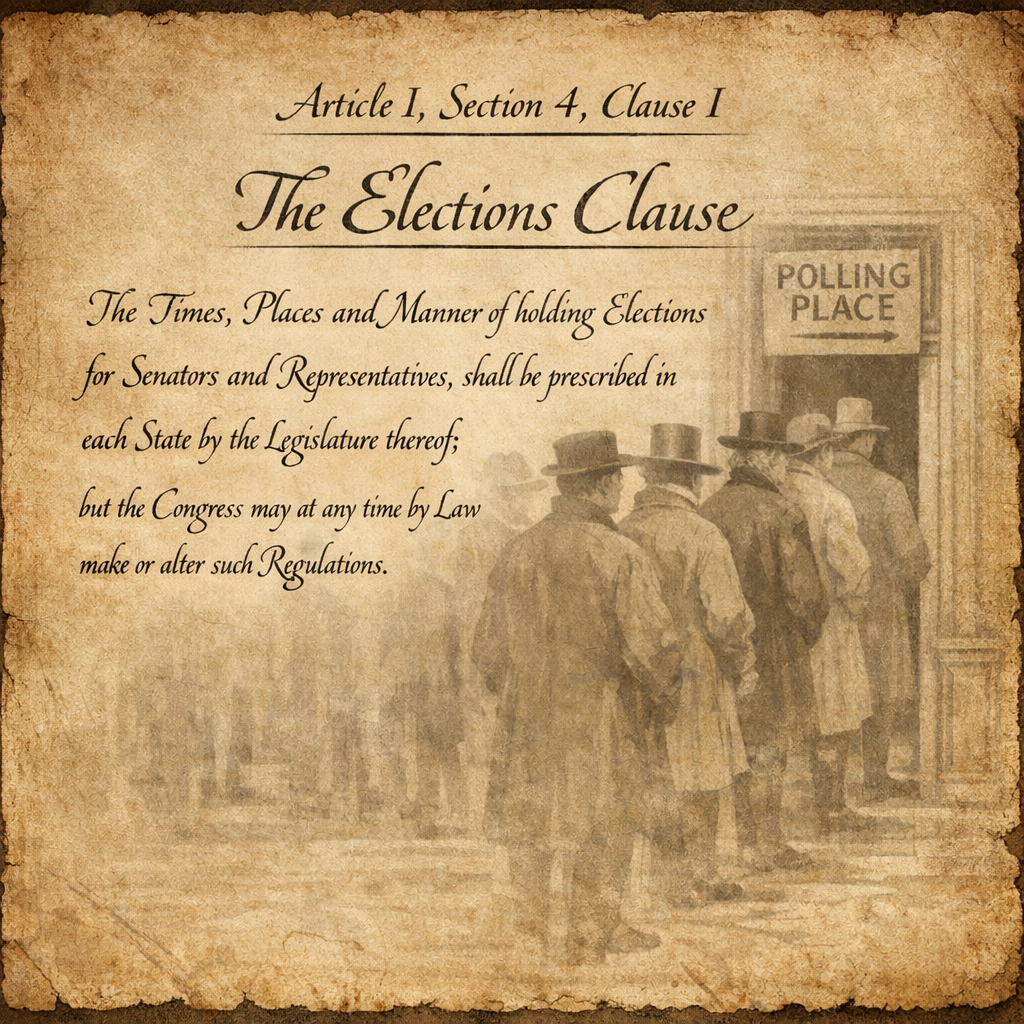
Article I, Section 4 assigns states a substantial role in prescribing the times, places, and manner of holding congressional elections, while also reserving to Congress the authority to make or alter such regulations. That division is important. It neither erases state responsibility nor gives any state official unlimited power to remake election law by administrative preference. Within this allocation of authority, Election Day remains an important legal reference point.
Election Day sits within that larger constitutional arrangement. States administer many practical details, but the rules governing federal elections should be enacted through lawful authority, communicated clearly, and applied with equal seriousness to similarly situated voters.
That framework matters because elections are too important to be left to drift. When election administration departs from constitutional structure, confusion follows. States may create rules in ways that exceed or blur their lawful authority. Agencies and officials may expand procedures through guidance rather than legislation. Courts may decline to intervene even when substantial questions arise.
Each step adds uncertainty. The Constitution was meant to restrain that uncertainty, not enable it. Constitutional government requires more than good intentions from officials; it requires identifiable limits that can be understood, enforced, and defended in public.
Making Election Day Work in Practice
A workable Election Day framework does not require every voter to face identical circumstances. It requires a common legal center around which reasonable procedures can be organized. Voters who are away from home, serving in the military, living with a disability, or facing another lawful obstacle may need different ways to participate, but those accommodations should support the election rather than erase its basic endpoint.
Election Day can remain the decisive reference point while legislatures establish limited procedures for requesting, returning, verifying, and counting ballots. The important distinction is between access arrangements authorized in advance and open-ended discretion created after voting has begun.
When Election Day is treated as a legal anchor, administrators can explain how each exception relates to the larger process. Voters know what deadline applies, election workers know which evidence is required, and observers can assess whether officials are following the same standards across comparable cases.
The purpose of Election Day is not to make participation unnecessarily difficult. It is to give participation a shared structure. A clear endpoint encourages preparation, discourages last-minute rule changes, and helps the public understand when campaigning and voting have given way to counting and certification.
How the Drift Began
The drift did not happen all at once. It developed through gaps in the law, weak enforcement, repeated expansions of administrative power, and a growing willingness to treat temporary exceptions as permanent features of the system. Over time, Election Day became less of a firm endpoint and more of one stage in an extended process.
Small openings in the legal structure became larger over time. Those openings became loopholes. The loopholes became practices. The practices became expectations. Eventually, the expectations hardened into a complex system that can seem far removed from the original constitutional design.
This is how the drift expanded. It moved from a simple Election Day model to a maze of early voting, absentee procedures, extended deadlines, emergency rules, administrative exceptions, and state-by-state variations that make election law difficult for ordinary citizens to follow.
Some changes may be justified in isolated circumstances, and reasonable accommodations can help eligible voters participate. But exceptions must remain exceptions. When they become routine without clear legislative authorization, they create a parallel system whose rules are harder to locate, challenge, and apply consistently.
Procedural complexity also changes incentives. Candidates and advocacy groups increasingly devote resources to litigation, administrative petitions, and last-minute disputes over process. That attention can displace the older expectation that the public should know the essential rules before voting begins and should not have to wait for post-election argument to learn which standards will control.
The Gaps in the Law
The legal system contains what might be called bomb craters: gaps, ambiguities, and unresolved contradictions that distort election administration. These weaknesses allow the drift to spread because officials can fill uncertainty with discretion rather than with rules enacted through the ordinary lawmaking process.
Examples include:
- unclear limits on state rulemaking authority;
- inconsistent standards for absentee voting;
- uneven application of voter registration rules;
- conflicting deadlines for ballot receipt, verification, and counting;
- administrative guidance that functions like law without passing through the legislative process; and
- broad emergency powers that can alter election procedures late in the process.
Each weak point creates room for uneven treatment. A deadline that is firm in one jurisdiction but relaxed in another, or a requirement enforced against one group but not another, invites the belief that rules are contingent rather than binding. That uncertainty weakens Election Day as a common civic and legal standard.
The point is not that every state must administer every detail in exactly the same fashion. Federalism allows variation. The point is that variation must remain within lawful limits and must not undermine the shared constitutional premise behind Election Day. Rules need to be clear enough that voters, election workers, and observers can tell what is required without relying on improvised interpretations.
The Growth of Chaotic Statutes and Rules
As the original structure weakened, layers of statutes and rules multiplied. Election law became a patchwork. In some states, rules are tightly followed. In others, the law is broadened, loosened, or reinterpreted by officials who act as though administrative convenience matters more than constitutional discipline.
This creates confusion for voters, candidates, poll workers, and election observers. It also makes the law feel unstable. When procedures change frequently, are announced late, or are applied differently from place to place, citizens may reasonably ask whether the process is governed by law or merely by discretion.
That is a dangerous question in a democratic system. Legal complexity can be necessary in limited areas, but complexity must not become a shield against accountability. Citizens should be able to identify who made a rule, what authority supports it, when it took effect, and how it will be enforced.
A more disciplined system would distinguish clearly between legislation, regulation, guidance, and emergency action. Legislatures should make the central policy choices. Election administrators should carry out those choices faithfully. Emergency measures should be narrow, temporary, transparent, and subject to meaningful review rather than treated as a substitute for ordinary lawmaking. Keeping Election Day at the center would give those layers of authority a clear point of reference.
The Courts and the Problem of Avoidance
The courts have often shied away from confronting these issues directly. In many cases, challenges to state rulemaking authority are treated cautiously, narrowly, or not at all. Courts may conclude that a dispute is political, too late, insufficiently concrete, procedurally defective, or otherwise unsuitable for judicial intervention.
Those doctrines can serve legitimate purposes. Courts should not decide abstract controversies, and they must respect jurisdictional limits. Yet repeated avoidance can have a practical consequence: the underlying legal question remains unresolved while the challenged practice continues from one cycle to the next.
That reluctance can become precedent. When courts decline to clarify the limits of state authority, officials may treat silence as permission to continue. Over time, judicial restraint can turn into judicial permission by default, even where no court has affirmatively endorsed the underlying practice. For Election Day disputes, that silence can leave voters and officials without a settled legal boundary.
This is one of the most serious aspects of the drift from Election Day as a clear constitutional premise. The law is supposed to settle disputes. When it does not, uncertainty grows stronger with each election cycle, and public confidence depends increasingly on partisan assurances rather than on a shared understanding of legal boundaries.
Courts need not manage elections themselves to provide clarity. They can identify the proper source of authority, insist that changes follow lawful procedures, and resolve timely disputes before voting begins whenever possible. Clear rulings issued early are generally better for voters and administrators than rushed litigation after ballots have been cast.
How Drift Penalizes Lawful States
The drift does not affect all voters equally. States that follow the law closely may end up carrying a heavier burden than states that stretch or loosen the rules. Voters in stricter states may face tighter deadlines, more limited procedures, and stronger enforcement because their state adheres to the standards enacted by its legislature.
Meanwhile, voters in looser states may receive broader exceptions and extended flexibility. That imbalance matters. It can appear to dilute the votes of citizens whose states actually obey the law, creating a system in which compliance comes at a political cost while noncompliance may produce an electoral advantage. This unevenness makes Election Day appear less equal across state lines.
Equal treatment does not demand identical election codes in every state. It does demand that similarly important federal interests not be undermined by unauthorized departures from enacted rules. A common Election Day premise loses meaning if the practical conditions for casting, receiving, and counting ballots are altered through uneven or unclear authority.
The result is not merely administrative disagreement. It touches the principle that every lawful vote should be treated with equal respect. A republic cannot ask citizens to honor the rules while signaling that some jurisdictions may disregard them whenever pressure, convenience, or political advantage points in another direction.
Why Public Trust Declines
People do not need to understand every legal detail to sense when something is wrong. They know when rules seem inconsistent. They know when deadlines change. They know when election procedures are so complicated that no ordinary citizen can easily explain them. And they know when confidence in the final result depends more on procedural debate than on a clear, shared standard.
This is how trust erodes. When voters doubt the integrity of the system, they begin to doubt the legitimacy of outcomes. Even lawful results can feel suspect if the rules appear unstable, selectively applied, or poorly explained.
A democracy cannot survive long on technical compliance alone. It must earn public confidence. That confidence is strengthened when officials publish rules early, explain them plainly, apply them consistently, preserve records, permit lawful observation, and correct errors openly rather than defensively.
The broader work of rebuilding confidence also requires civic habits beyond election administration. The case for transparent institutions and public accountability is developed further in Election Confidence: Stunning Best Trust Builders. Trust is not produced by slogans. It is built when institutions demonstrate that rules apply before, during, and after Election Day.
A Practical Standard for Reform
Election Day procedures should be evaluated by a few durable questions: Who has authority to make the rule? Was the rule adopted through the required process? Was it published early enough for voters and officials to understand? Does it apply consistently? Can a court review it before the result becomes difficult to change?
These questions do not eliminate every disagreement, but they make disagreements easier to resolve. Election Day administration works best when the public can distinguish a statute from an agency instruction, an accommodation from a waiver, and an emergency order from a permanent change.
Clear Election Day rules also protect election workers. Local officials should not have to guess whether a late directive supersedes enacted law or whether a court will later approve an improvised procedure. Written standards, public training, and preserved records create accountability without requiring every worker to become a constitutional scholar.
For voters, the benefit is practical as well as legal. Election Day information should explain registration, identification, ballot return, curing procedures, counting, and certification in plain language. When voters know the rules in advance, participation becomes less intimidating and disputes become narrower.
Finally, Election Day reform should be measured by equal treatment rather than by partisan advantage. The same standards should apply when they help one party and when they help another. That neutrality is difficult to establish after a system has drifted, but it is essential to restoring confidence.
A stable Election Day framework can still accommodate lawful absentee voting, early participation, military voters, voters with disabilities, and genuine emergencies. The goal is not needless rigidity. It is to ensure that flexibility comes from law, remains transparent, and does not become an invitation to rewrite the rules after voting has begun.
What Must Be Done
The solution is not to make elections more confusing. It is to restore clarity. We need to close the windows that allow drift and reinforce the constitutional discipline that gives citizens confidence in the process.
That means:
- reaffirming Election Day as the constitutional center of the voting process;
- limiting rulemaking authority to what the law clearly permits;
- requiring major procedural changes to come through lawful legislative channels;
- reducing loopholes that invite inconsistent administration;
- enforcing deadlines and standards uniformly;
- preventing administrative improvisation from replacing legislative authority;
- demanding timely judicial clarity when states exceed their lawful power; and
- restoring confidence that every lawful vote is treated equally.
These reforms are not radical. They are restorative. They seek to return election law to a firmer constitutional foundation while preserving lawful access to the ballot. They also recognize that durable rules are more humane than last-minute uncertainty: voters, local officials, and volunteers all benefit when they know what is expected of them well before Election Day arrives.
Reform should therefore focus on process as well as outcomes. Legislatures should write comprehensible statutes. Administrators should provide uniform training and public instructions. Courts should resolve disputes promptly when they are properly presented. And citizens should expect officials of every party to honor the same legal limits.
Restoring the Gold Standard
The United States was once regarded as the gold standard of democratic elections. That reputation was built on the idea that elections are governed by law, that suffrage is meaningful, and that citizens can trust the process because its essential rules are clear.
We should want that again: not a system of drift, ambiguity, and endless exception, but a system where Election Day matters, suffrage is respected as a civic duty, and the Constitution guides every stage of the process.
There should be no doubt about the quality of our elections. The goal is not perfection in every administrative detail; no human institution can promise that. The goal is a system robust enough that mistakes can be identified, corrected, and explained without leaving citizens to wonder whether the rules themselves were changed without authority.
If the nation restores constitutional discipline, reinforces the meaning of Election Day, and eliminates conditions that create avoidable uncertainty, it can strengthen public trust and renew the promise of self-government. That is why Election Day must remain a clear legal endpoint as well as a shared civic event. A clear process, applied fairly and governed by law, is the surest path back to the standard the country should seek to uphold.
Leave a Reply