
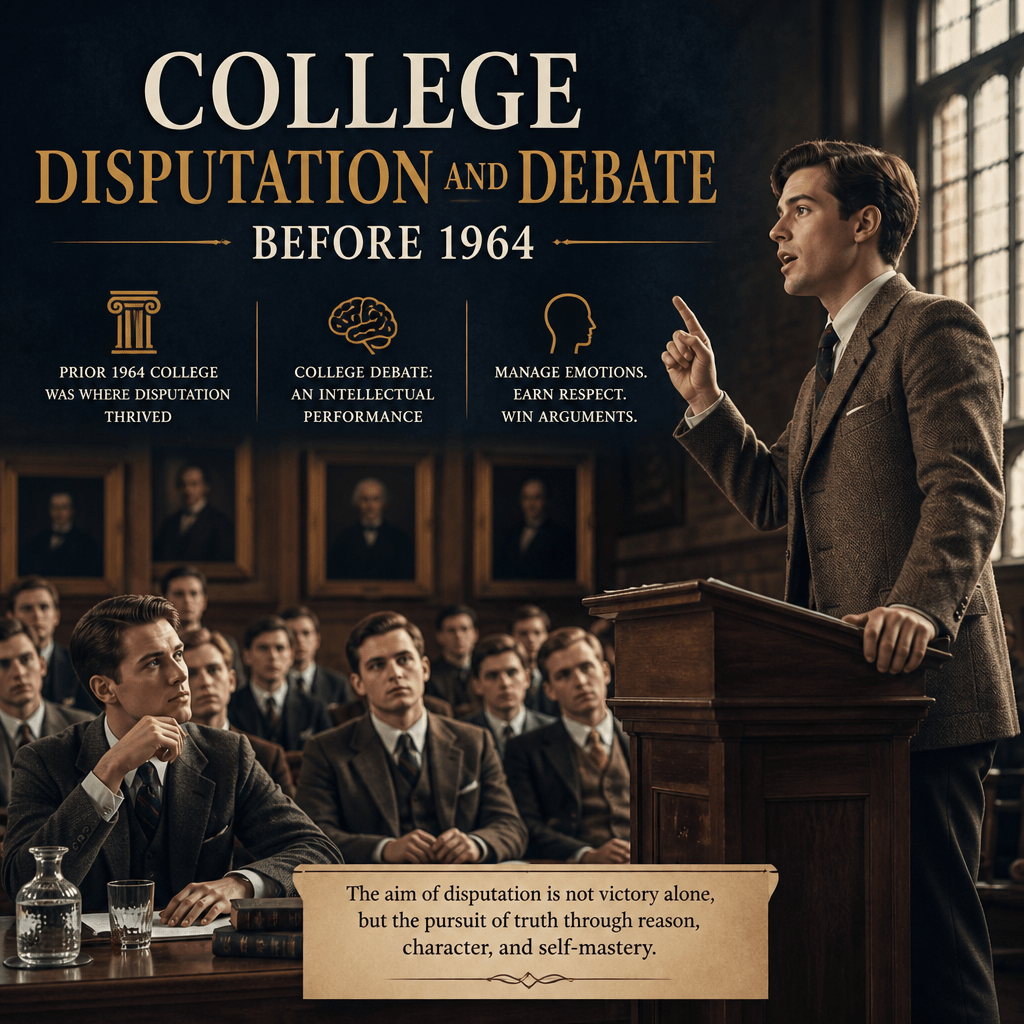
Prior 1964 College Was Where Disputation was often treated as a central part of learning, not an optional extra. Controversial topics were discussed openly, challenged hard, and debated until the students ran out of energy or better arguments.
In that older academic culture, disputation was serious business. Students were expected to defend ideas, answer criticism, and demonstrate intellectual performance under pressure. Your feelings be damned was not a classroom slogan, but it captured the blunt spirit of the era.
That environment shaped how many people learned to think, speak, and argue. It also left behind a useful question: what was gained, and what was lost, when college debate became less confrontational?
For a broader historical context on how higher education has changed over time, the Encyclopaedia Britannica overview of higher education is a useful reference point.
- College Debate Was Serious Business
- Why Disputation Mattered So Much
- Intellectual Performance Was the Point
- Feelings Were Not the Center of the Process
- How Students Learned to Manage Emotions During Debate
- The Classroom Was a Training Ground
- What Disputation Looked Like in Practice
- What We Can Learn From That Era
- The Value of Debate Has Not Disappeared
College Debate Was Serious Business
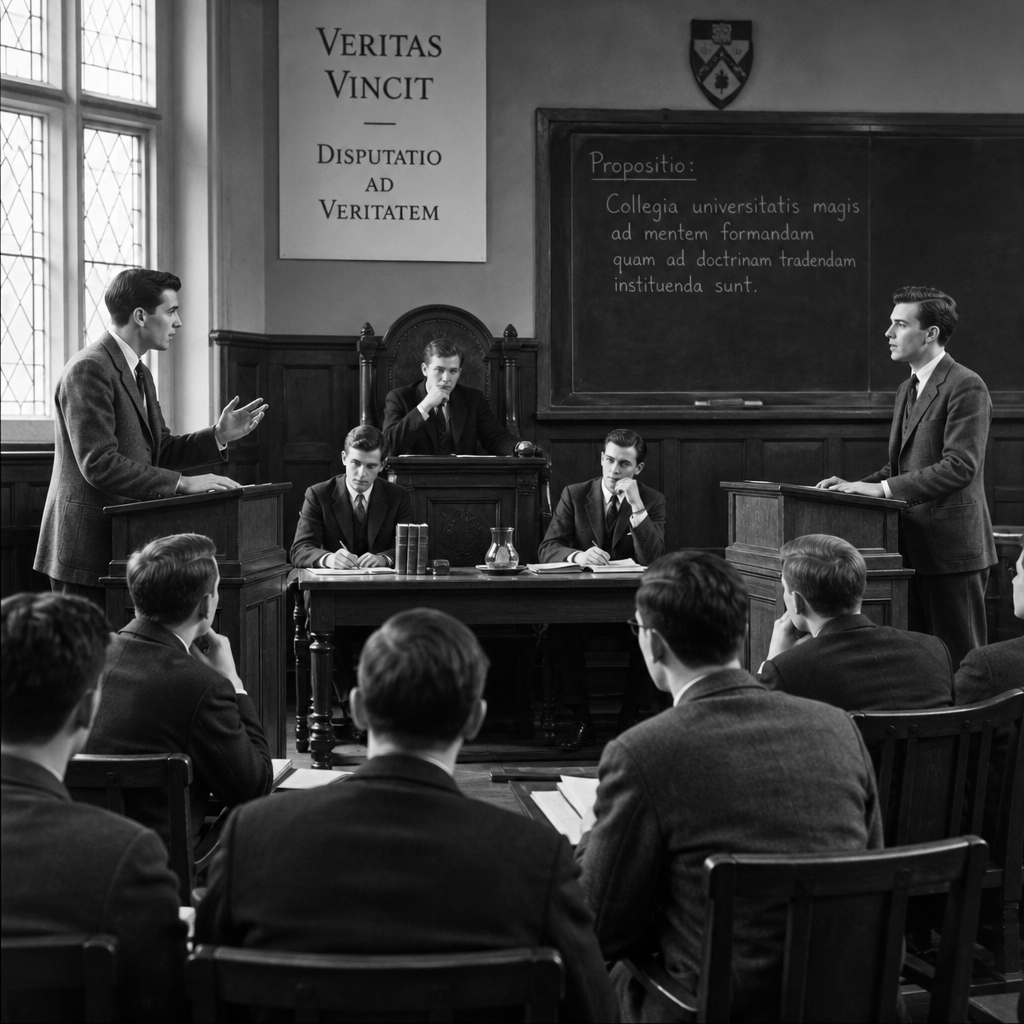
College debate was not treated like a casual club meeting. It was often tied to coursework, grading, and academic standing. Students had to prepare carefully. They needed facts, structure, and persuasive language.
The best students were not always the loudest. They were the ones who could build a logical argument, respond to objections quickly, stay calm under pressure, speak with precision, and defend a claim without losing focus.
This is what made disputation such a serious part of college life. It was not only about winning an argument. It was about proving intellectual performance in real time.
In many cases, college debate was seen as a rehearsal for civic life. Students learned how to hold a position, defend it publicly, and accept the fact that other intelligent people might disagree with them. That lesson was important because it linked classroom learning to the wider world.
Prior 1964 College Was Where Disputation played that role with unusual force. The classroom did not merely transmit information. It trained students to argue, rebut, and stand their ground when an idea came under attack.
That kind of training made academic life demanding, but it also made it memorable. Students could not coast through by repeating broad generalities. They had to know what they were talking about.
Why Disputation Mattered So Much
Before modern education shifted toward broader participation and emotional safety, disputation served a clear purpose.
It trained students to think on their feet.
It forced them to understand both sides of an issue.
It helped them separate weak opinions from strong evidence.
It also taught restraint. A student could not simply feel strongly and expect to be taken seriously. They had to reason, explain, and persuade.
That discipline mattered across many fields:
- law
- theology
- politics
- philosophy
- literature
- public speaking
In each case, the ability to argue well was part of being educated.
Even when the subject was difficult, the expectation was simple: test ideas until they hold or fail. That approach made the classroom less comfortable, but often more rigorous.
Disputation also helped students learn precision. A vague answer could be challenged immediately. A sloppy claim could be dismantled in front of the room. That pressure pushed students to define their terms, support their conclusions, and think several steps ahead.
When college debate was done well, it was not a shouting match. It was a disciplined exchange where each side tried to expose the weaknesses in the other side’s reasoning. That process sharpened everyone involved, even the person who ultimately lost the exchange.
For students who took it seriously, disputation became a habit of mind. They began to ask harder questions, notice gaps in reasoning, and become less impressed by surface-level certainty. That was one reason the old college model produced graduates who often seemed unusually prepared for conflict in the public sphere.
Intellectual Performance Was the Point
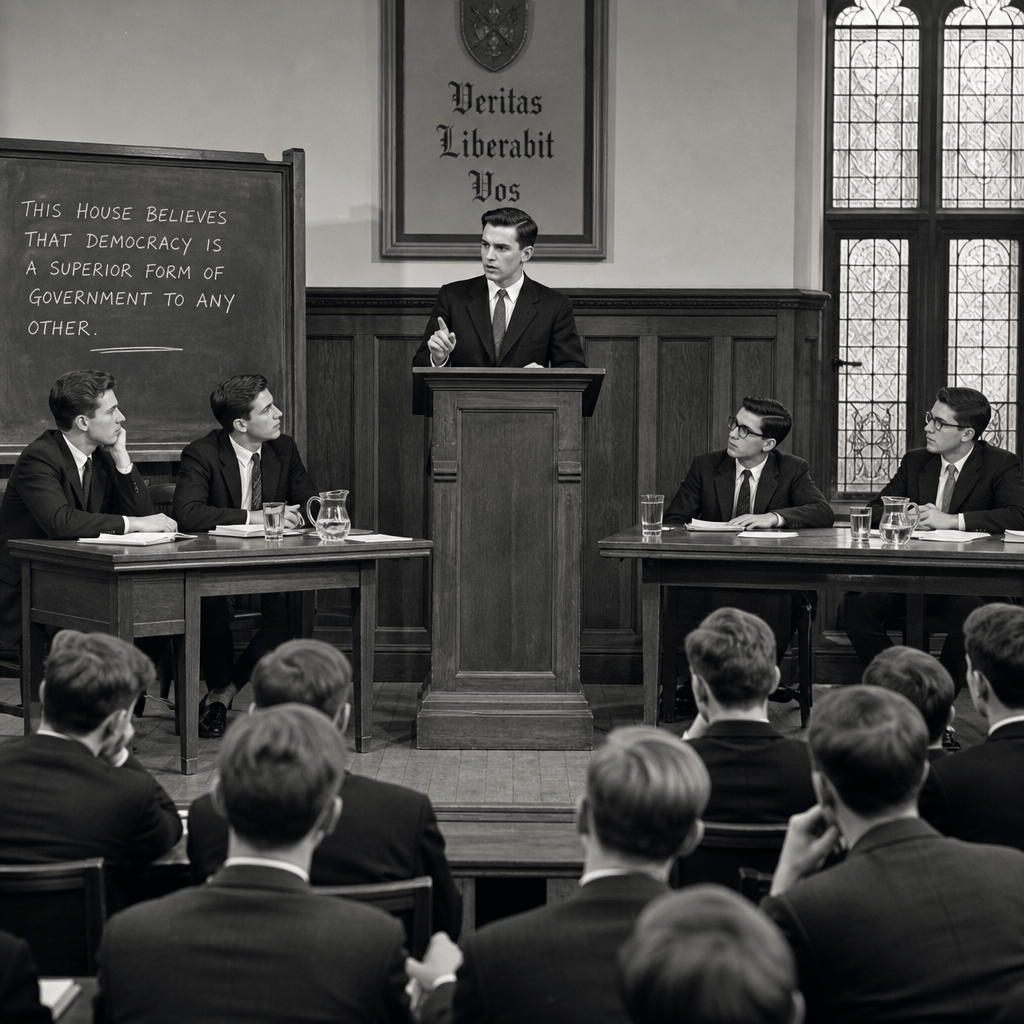
In that era, intellectual performance was often judged in public.
Students were expected to perform their thinking out loud. They had to show how their minds worked.
That meant organizing ideas quickly, remembering facts accurately, using language with care, and handling pressure without breaking down.
This kind of education rewarded mental toughness. It was less about comfort and more about mastery.
A student who could defend a position under attack was seen as prepared for the real world. That is why college debate had such status. It was practice for life, not just a classroom exercise.
There was also a social lesson hidden inside the academic one. Students learned that confidence without structure was weak, and conviction without evidence was even weaker. The strongest argument had to survive contact with criticism.
That expectation created a demanding but memorable standard. It told students that education was not simply the accumulation of facts. It was the ability to use those facts under pressure.
Prior 1964 College Was Where Disputation also functioned as a filter. It separated people who merely had opinions from people who could defend those opinions carefully. That distinction mattered in professions where reasoning, credibility, and verbal control had real consequences.
Students who excelled in this environment did not just memorize material. They learned how to translate knowledge into performance. They knew how to speak in a way that could survive scrutiny, and that was a valuable skill then as it is now.
Over time, this emphasis on performance also shaped standards of scholarship. A good answer was not enough if it could not be explained clearly. A good idea was not enough if it could not stand up to direct questioning. The whole point was to make thought visible and testable.
Feelings Were Not the Center of the Process
The phrase “your feelings be damned” captures the old attitude well.
It was blunt, and often harsh. But it reflects a real shift in educational culture over time.
In the older model, feelings were not ignored completely. But they were not the main measure of success.
What mattered most was the strength of the argument, the quality of evidence, the ability to rebut opposition, and the clarity of thought.
Students were expected to manage emotions during debate. That meant learning how to stay composed when challenged, corrected, or embarrassed.
This was not easy. It was not supposed to be easy.
The challenge itself was part of the training.
That does not mean the old model was perfect. In some cases, harshness could become a substitute for discipline, and public correction could drift into humiliation. Still, the underlying idea remained powerful: the truth of an argument should matter more than the comfort of the person making it.
At the same time, the old culture assumed that students could separate disagreement from personal worth. That assumption made hard conversations possible. It also created a space where a person could be wrong, be corrected, and continue learning without the exchange being treated as a moral crisis.
That expectation is one of the reasons college debate once carried so much weight. It asked students to tolerate friction for the sake of understanding. It required a willingness to hear unpleasant criticism without treating it as an insult to identity.
How Students Learned to Manage Emotions During Debate
Managing emotions during debate was a skill, just like writing or speaking.
Students who succeeded learned how to keep their composure without shutting down.
They practiced habits such as listening before reacting, separating criticism from personal insult, pausing before replying, focusing on the issue rather than the ego, and accepting correction without panic.
These habits helped students argue better.
They also helped them grow.
A strong debater did not need to be emotionless. But they did need discipline. They had to keep their reactions from overpowering their reasoning.
That balance was one of the hidden lessons of college disputation.
It is worth noting that emotional control does not mean emotional suppression. The goal was not to erase feeling, but to keep feeling from taking command of the room. That distinction mattered, and it still matters today.
Students who could do this often became better listeners as well. Once a person learns to pause before reacting, they become more capable of hearing an objection in full before deciding how to answer it.
Prior 1964 College Was Where Disputation made that discipline unavoidable. If a student could not stay calm while being challenged, the whole exchange could collapse. So the system rewarded steadiness, patience, and the ability to recover quickly from embarrassment.
Those habits are useful beyond debate. They help with interviews, meetings, negotiations, and any situation where a person must think clearly while under scrutiny. In that sense, the old college model trained more than speakers. It trained adults.
The Classroom Was a Training Ground
In many ways, the classroom functioned like a gym for the mind.
Students were expected to stretch their ideas.
They were expected to test their assumptions.
They were expected to hear strong opposition and return with a better answer.
This made college debate more than a tradition. It was a method.
The method was simple:
- Present a claim.
- Challenge the claim.
- Defend the claim.
- Refine the claim.
- Repeat until the truth became clearer.
That process built confidence and discipline.
It also created a generation of students who knew how to argue with purpose.
In a healthy academic setting, the classroom becomes a place where disagreement can sharpen judgment rather than poison it. The old disputation model assumed that the best way to learn was to expose ideas to pressure early and often.
That pressure could be uncomfortable, but discomfort was part of the instruction. Students learned to stand their ground when necessary and revise their position when the evidence demanded it. Both outcomes were educational.
The deeper lesson was that intelligence is not just passive understanding. It is active response. A student who can defend, modify, or abandon a position after serious challenge is learning in a way that sticks.
This is one reason college debate mattered so much in the pre-1964 model. It did not only test memory. It tested judgment. It asked whether students could think clearly when the pressure rose and the audience was watching.
What Disputation Looked Like in Practice
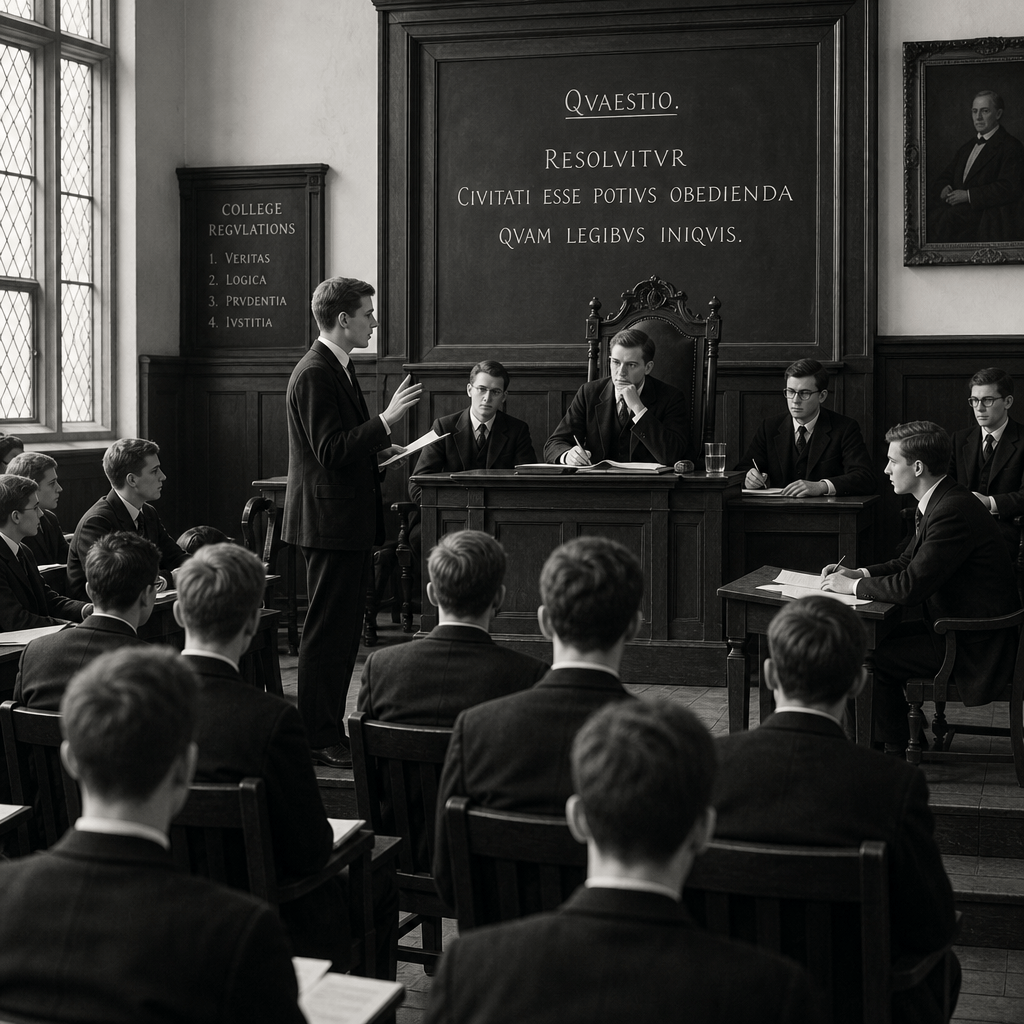
To understand why college disputation mattered, it helps to picture what it looked like in practice. A student might be assigned a position they did not personally favor. They would need to research the issue, organize their thoughts, and present the argument convincingly anyway.
That exercise forced intellectual distance. It taught students how to examine an idea without immediately treating it as a personal identity. That skill is valuable in any era, but especially in a time when public discussion can become emotionally charged very quickly.
The process also rewarded preparation. A student who had done the reading, anticipated objections, and memorized key points had a much better chance of succeeding than someone relying on instinct alone.
In that sense, disputation was not about theatrics. It was about readiness. Good disputation required structure, evidence, timing, and control. Students who could master those elements often found they could also write more clearly and think more carefully.
Common habits of strong debaters
- They researched both sides before speaking.
- They learned to define terms precisely.
- They avoided wandering arguments.
- They answered the actual objection, not a weaker version of it.
- They stayed focused even when the exchange became tense.
Those habits did not just help in class. They carried into professional life, civic life, and personal decision-making.
Strong students also learned that winning the room was not the same as winning the argument. A flashy delivery could impress for a moment, but a weak line of reasoning would still fail under examination. That is why the older model valued substance over style, even when style still mattered.
At its best, the practice of disputation trained humility. It showed students that they could be corrected publicly and still remain competent. It also reminded them that being challenged is not the same thing as being defeated.
For many students, that realization was transformative. Once they understood that criticism could be useful, they became less defensive and more effective. That shift often made them better learners for the rest of their lives.
Why a Hard Debate Culture Could Still Produce Better Thinkers
A hard debate culture sounds intimidating, and in some cases it was. But it could also produce better thinkers because it refused to let vague claims pass unexamined.
Students had to know why they believed what they believed. They had to explain the logic behind their view rather than rely on tone or social approval.
That requirement made college debate a valuable intellectual discipline. It pushed students toward clarity, and clarity is one of the foundations of good judgment.
When people are required to answer difficult questions, they often discover the weak spots in their own reasoning. That discovery can be uncomfortable, but it is also useful. The student who learns where an argument fails is better prepared to strengthen it later.
Prior 1964 College Was Where Disputation because the institution assumed that a person could improve by being pressed. It trusted that minds grew stronger through contest, not through protection alone.
There is wisdom in that assumption, provided the contest remains fair. A classroom that challenges ideas without treating students with contempt can build resilience and insight at the same time. That combination is hard to beat.
What We Can Learn From That Era
The old style of college disputation has limits. It could be harsh, exclusionary, and overly rigid.
But it also had strengths worth remembering.
It reminded students that disagreement is not a threat. It is a tool.
It showed that ideas get stronger when tested.
It taught that disagreement can be productive when rules, logic, and respect are present.
Most of all, it made college a place where students learned how to think under pressure.
That lesson still matters today.
Modern readers do not need to romanticize the past to recognize its value. A classroom can be humane and still demanding. It can protect student dignity and still insist on rigorous argument. The best version of education probably combines both.
That balance is harder to maintain than a purely gentle model or a purely combative one. But it is also more durable. Students benefit when they are challenged seriously and treated fairly at the same time.
The old model also reminds us that not every difficult conversation is harmful. Some are necessary. Some are the only way ideas become clear. A good education should leave room for that kind of pressure without turning it into cruelty.
So while the language of the past may sound severe, the underlying lesson remains relevant: if students never have to defend an idea, they may never fully understand it.
The Value of Debate Has Not Disappeared
Modern colleges often focus on inclusion, collaboration, and emotional well-being. Those goals are important.
But there is still room for disputation.
Students still need to learn how to face difficult ideas, defend their views, engage opposing arguments, manage emotions during debate, and perform intellectually under pressure.
Without those skills, education becomes too soft.
With them, education becomes stronger, deeper, and more useful.
That is especially true in a culture that often rewards quick reactions over careful thought. A student trained to slow down, reason clearly, and answer criticism thoughtfully has an advantage that lasts well beyond college.
In practical terms, that means the old spirit of college debate still has value even if its style has changed. The goal is not to recreate every rough edge of the past. The goal is to preserve the discipline that made academic argument meaningful.
If nothing else, the older model reminds us that hard conversations are not always bad conversations. Sometimes they are the conversations that teach the most.
That is why the phrase Prior 1964 College Was Where Disputation still resonates. It names an approach to learning that trusted argument, pressure, and correction as tools for growth.
And even now, that trust is worth considering.
Conclusion
Prior to 1964, college was where disputation happened in full view.
Controversial topics were discussed openly. College debate was serious. Intellectual performance was expected. And students were often told, in no uncertain terms, to manage emotions during debate and keep going.
That old approach was tough. Sometimes it was too tough.
But it made one thing clear.
College was not just about comfort. It was about challenge.
It was about learning how to think, argue, and endure.
And in that world, feelings were not the final authority. Ideas were.
The phrase Prior 1964 College was where Disputation may sound blunt today, but it points to a real educational ideal: rigorous debate as a path to clearer thinking. Even now, that ideal remains worth considering.
College debate, when practiced well, still teaches students how to listen carefully, respond intelligently, and hold their ground without losing their composure. Those lessons never really go out of style.