
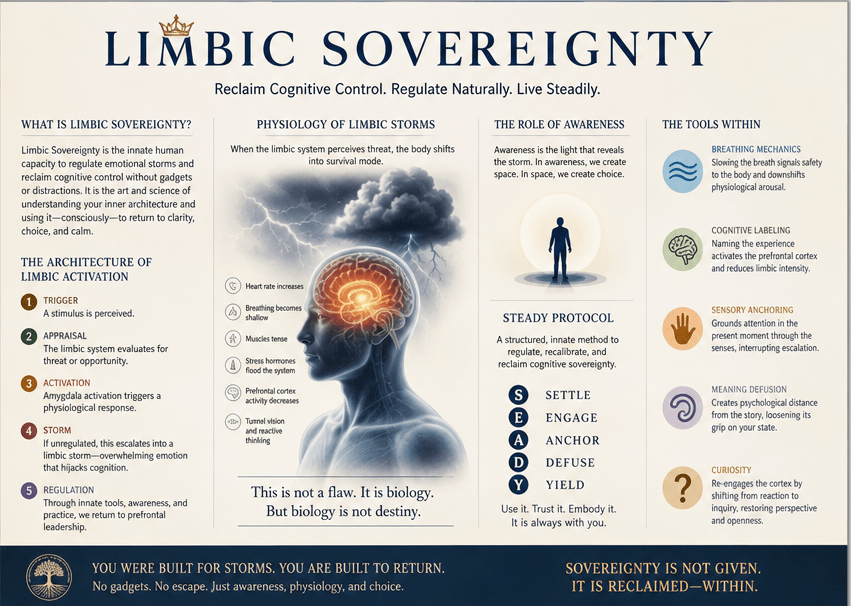
Reclaiming Executive Governance During the Emotional Storm
From The Architecture of the Self: Neuroscience, Mastery, and the Practiced Mind
The argument begins the way all the worst ones do — not with a declaration but with a temperature. One moment you are a rational adult holding a cup of coffee in your own kitchen; the next, something your partner says ignites a heat in your sternum that has no name but every texture: tight, electric, accelerating, filling your chest like smoke filling a room. Your jaw clamps down. The field of your vision narrows, as if the walls of the kitchen have slid two feet inward. Whatever she said — it was something about the car, about money, about last Tuesday — it no longer matters, because the specifics have been swallowed by something older and larger than both of you. You hear yourself say things you will spend the rest of the day regretting. You are, in the most precise neurological sense, no longer entirely yourself. The part of you that makes deliberate choices, that considers consequences, that can hold two ideas in tension and evaluate them — that part has gone dark. What remains is ancient, fast, and entirely convinced it is right.
This is not a moral failure. It is not evidence of a damaged personality or a poor upbringing, though both of those things may shape the particular triggers that launch the cascade. What you are experiencing in that kitchen is a precisely orchestrated biological emergency response — one that evolved over hundreds of millions of years to keep vertebrates alive in the presence of predators. The system was never designed for the kitchen. It was designed for the savanna. And it is spectacularly good at its original job. The problem is calibration, not architecture. The smoke alarm is not broken. It simply cannot tell the difference between a house fire and burnt toast.
This chapter is about the alarm and the hand that can reach up and silence it — not by ripping it from the wall, but by learning the precise sequence of actions that tells the nervous system the building is safe. What follows is the science of what happens inside the skull during states of high emotional arousal, the evolutionary logic of why it happens, and a structured, evidence-based protocol called STEADY for recovering executive governance when the storm arrives. The capacity this protocol cultivates has a name: limbic sovereignty — the practiced ability to reclaim cortical governance during states of high emotional activation, not by denying the emotion, but by understanding the neurological terrain well enough to navigate it. You are not a passenger in your own nervous system. The tools for the return journey have been there all along.
SECTION 1: THE ARCHITECTURE OF THE LIMBIC STORM
Somewhere near the center of each of your temporal lobes, buried beneath layers of newer cortical tissue, sits a structure roughly the size and shape of an almond. Its name comes from the Greek for almond — amygdala — and its function, stripped to its essence, is to ask a single question about everything that enters your sensorium: Is this a threat? It asks this question faster than consciousness can follow. It asks it before language has a chance to form an opinion. And when it decides the answer is yes, it does not wait for a committee vote.
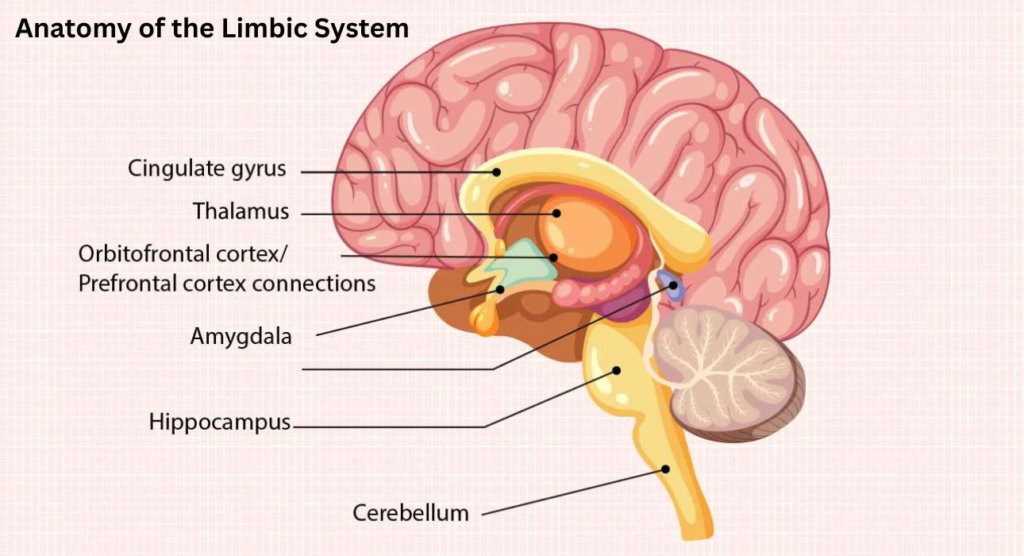
The neuroscientist Joseph LeDoux mapped the amygdala’s two input pathways with an elegance that changed how we understand emotional experience. The first pathway — what LeDoux called the low road — runs directly from the sensory thalamus (the brain’s primary relay station for incoming sensory data) to the amygdala. This pathway involves only a single synaptic connection, making it extraordinarily fast. The information it carries is rough — a blurry, low-resolution sketch of the incoming stimulus — but it arrives in time. In evolutionary terms, it is better to mistake a stick for a snake a thousand times than to take the half-second necessary to verify and be wrong once. The second pathway — the high road — routes sensory information through the cortex first, producing a rich, detailed, contextually accurate analysis of what is actually happening. This pathway is slower by approximately twelve milliseconds, a gap that may seem trivial until you consider that the amygdala has already begun launching its response before the cortex has finished reading the fine print.
When the amygdala’s threat-detection circuitry fires, it sends signals through the central nucleus of the amygdala — its primary output hub — down to the lateral hypothalamus and brainstem. Within seconds, heart rate climbs, blood pressure rises, respiration deepens and accelerates, blood is shunted from the digestive organs and extremities toward the large muscle groups, and the pupils dilate. This is the autonomic cascade: the body converting itself into a delivery vehicle for immediate physical action. Simultaneously, the HPA axis — the hypothalamic-pituitary-adrenal axis, the brain’s long-range hormonal alarm system — activates, instructing the adrenal glands to flood the bloodstream with cortisol and adrenaline. These hormones sustain and amplify the arousal state, ensuring that even after the immediate trigger has passed, the body remains mobilized.
The journalist and psychologist Daniel Goleman gave this cascade a phrase that has earned permanent residence in the popular vocabulary of emotional intelligence: the amygdala hijack. The term is evocative because it is accurate. During acute emotional activation, the amygdala does not merely influence the rest of the brain — it effectively commandeers it. Most consequentially, it suppresses the prefrontal cortex (PFC), the broad anterior region of the brain responsible for planning, judgment, impulse control, working memory, and what we loosely call reason. The PFC is the seat of everything we consider distinctly human about our cognition: the capacity to hold a long-term goal in mind while tolerating short-term frustration, to consider another person’s perspective while managing our own, to pause between stimulus and response. During a full limbic storm, this region goes substantially offline. The cortical hijack is the part of the amygdala hijack that nobody talks about enough — it is not merely that emotion surges; it is that the faculty most capable of regulating emotion simultaneously withdraws.
This is the architecture of the storm. It is not a character flaw. It is a smoke alarm engineered for a world that no longer exists, responding with the same full-alarm urgency whether the building is burning or the toast is slightly overdone. Understanding this — truly internalizing it — is the first act of limbic sovereignty, because you cannot govern a territory you believe to be ungovernable.
SECTION 2: THE LOST ART OF NATURAL REGULATION
For the overwhelming majority of human evolutionary history, the physiological resolution of a threat response was built into the threat itself. If the amygdala fired because of a predator, the body ran or fought — and in running or fighting, it metabolized the cortisol and adrenaline the HPA axis had so efficiently produced. The stress hormones were burned as fuel for exactly the purpose for which they were synthesized. The biological loop closed. When the threat passed, the organism was tired rather than frantic, and sleep — the deepest neurological restoration process available to the brain — completed the cycle. Physiological regulation was not a practice our ancestors pursued; it was an automatic consequence of the world they inhabited.
The modern sedentary condition breaks this loop at almost every point. The triggers that activate our amygdalae today — a terse email from a supervisor, a social slight at a dinner party, a financial worry that arrives at two in the morning and has no physical form at all — produce the same hormonal cascade as the predator, but they offer no physical resolution. We sit at our desks, cortisol quietly accumulating in our bloodstreams, thinking our way around the problem rather than running through it. The stress physiology lingers because the biological loop has no closing mechanism.
Evolution, however, did not leave us with only movement as a regulator. It built co-regulation into the social architecture of human life. Psychiatrist and researcher Stephen Porges, in developing what he called the Polyvagal Theory, illuminated the neurobiological mechanisms by which the presence of a calm, attuned other person directly modulates our autonomic state. The cues of safety — a low, melodic voice; a relaxed, open facial expression; slow and regulated breathing — are processed by a branch of the vagus nerve associated with social engagement, and they signal to our nervous systems that the environment is secure. We regulate each other constantly, below the level of awareness, through proximity and presence. The infant co-regulates with the mother. The soldier co-regulates with the platoon. The bereaved person co-regulates with a friend who sits quietly and does not try to fix anything.
Beyond movement and social proximity, ancient human cultures maintained limbic regulation through a suite of practices that modern psychology is only now beginning to recognize as neurobiologically sophisticated. Rhythmic movement — drumming, chanting, dance, communal labor — entrains the nervous system through the same oscillatory mechanisms that underpin modern heart rate variability training. Narrative — the act of telling one’s story to a witness — integrates traumatic experience through the left hemisphere’s language processing, reducing the right hemisphere’s raw emotional charge. Ritual, the structured enactment of meaning at moments of transition, provides the limbic system with temporal containment: a beginning, a middle, and an end to experiences that might otherwise feel boundless.
The modern predicament is, in large part, a problem of lost infrastructure. We have inherited anxious nervous systems and stripped away most of the environmental scaffolding that once held them. We are isolated more than our biology expects, moving our bodies less than our stress-hormone production requires, sleeping less than our hippocampal consolidation needs, and embedded in social media environments that provide the visual vocabulary of connection while delivering, neurobiologically, something closer to its opposite. Into this deficit we pour an extraordinary amount of cognitive effort — we try to think our way through emotional flooding — not realizing that the very organ required for such thinking is the one that goes offline when the flood arrives. Structured, intentional practice can restore what instinct and culture once provided. That practice is what the STEADY protocol is designed to do.
SECTION 3: THE ROLE OF AWARENESS — SPOTTING THE SURGE
The first letter of STEADY stands for the first step: Spot the surge. It sounds almost insultingly simple. Yet consider what is actually being proposed. You are being asked, in the middle of a process designed by evolution to bypass deliberate awareness, to become aware of that process. You are being asked to notice the flood while standing in it.
The capacity that makes this possible is called interoception — the brain’s ongoing sensing of its own internal bodily state. Interoception is not the same as thinking about how you feel. It is the direct, pre-linguistic registration of physiological signals arising from the body’s organs, muscles, and vasculature: the thud of a racing heart, the compression of a clenched jaw, the heat that rises through the sternum before words have formed, the sudden sense of narrowing that precedes the loss of perspective. These signals arrive through dedicated neural pathways and are processed primarily in the insular cortex — a folded region tucked within the lateral sulcus that functions as the brain’s primary body-map. Strong interoceptive awareness predicts better emotional regulation, faster recovery from stress, and greater empathy — because knowing your own body’s signals is neurologically similar to reading someone else’s.
The problem is that during a limbic storm, the very faculty capable of doing this noticing — the prefrontal cortex — is being actively suppressed. Most people in a full amygdala hijack are the last to know they are in one. From the inside, a hijacked state feels like clarity: the certainty is absolute, the rightness is total, the narrative feels not like an emotional distortion but like an unusually accurate perception of reality. This is the deepest trick the alarm system plays — it does not announce itself as an alarm. It masquerades as truth.
The body, however, tells the story that the mind has already decided to overlook. A racing heart. Tension spreading across the trapezius muscles at the base of the skull. Constriction in the throat. Heat in the face and upper chest. A sudden impoverishment of thought, the mental landscape narrowing from its usual panoramic breadth to a single, bright, urgent point of focus. These are the instruments on the cockpit panel, and they are reading long before the pilot notices the altitude dropping.
Learning to recognize these signals is not a passive undertaking. It requires deliberate cultivation — noticing, naming, and logging body-based correlates of emotional states during low-stakes moments, so that the recognition pathways are well-worn enough to activate even when cortical capacity is reduced. The practice involves what contemplative traditions across cultures have called the witness self — the observer who watches experience as it unfolds without immediately fusing with it. In neuroscientific terms, cultivating the witness self is equivalent to building a more robust and responsive interoceptive network, one capable of generating a signal strong enough to reach a partially suppressed prefrontal cortex.
There is a practical move that encodes this beautifully. At the moment of noticing a body signal — any body signal of emotional activation — name it in plain physical language. Not “I feel angry,” which is already an interpretation, but “my jaw is clenched,” “there is heat rising in my chest,” “my hands have tightened.” This act of somatic naming is not merely preparation for regulation. It is regulation, already begun. Because the moment you name a physical sensation, you have engaged a thin sliver of linguistic, left-hemispheric, cortical processing — and in doing so, you have fractionally relit the executive lamp in a dark room. The paradox of awareness is this: the instant you notice you are inside a storm, you have already, by some measure, stepped outside it. You are no longer only the weather. You are, however partially, also the sky.
SECTION 4: THE MECHANICS OF BREATHING — TAKING CONTROL
The second step of STEADY is: Take control of breathing. Of all the leverage points available to a person standing in the middle of a limbic storm, the breath is the most underestimated and the most powerful. To understand why, it helps to appreciate what makes breathing neurologically unique.
Almost every process regulated by the autonomic nervous system — heart rate, blood pressure, digestion, immune response, hormonal secretion — is involuntary. You cannot decide to lower your blood pressure the way you decide to raise your hand. You cannot instruct your digestive enzymes to stand down. But you can decide, right now, to breathe slowly. Breathing sits at the intersection of the voluntary and involuntary nervous systems — it runs on automatic when you are not attending to it, and it submits to conscious control the moment you choose to exercise it. This dual citizenship makes it the single most accessible lever in the entire autonomic nervous system, and the one most directly connected to the states we most need to change.
The mechanism runs through a remarkable structure called the vagus nerve — the tenth cranial nerve and the primary highway of the parasympathetic nervous system, the “rest-and-digest” counterpart to the “fight-or-flight” sympathetic system. The vagus nerve runs from the brainstem down through the neck and chest, innervating the heart, lungs, and abdominal organs. Critically, a large proportion of its fibers are afferent — they carry information upward from the body to the brain, rather than downward. When you exhale slowly and fully, you stretch the pulmonary tissue of the lower lungs, stimulating vagal afferents that send a signal to the brainstem: slow the heart. The brainstem complies by releasing acetylcholine — the parasympathetic neurotransmitter — at the sinoatrial node of the heart. The heart rate drops. The autonomic balance tips from sympathetic dominance toward parasympathetic. The alarm, if not silenced, is turned down.
This fluctuation of heart rate with breathing has a name: respiratory sinus arrhythmia, or RSA. During inhalation, heart rate rises slightly; during exhalation, it falls. The amplitude of this oscillation is one component of what physiologists measure when they assess heart rate variability, or HRV — a marker of autonomic flexibility and health that has become one of the most robust physiological indicators of stress resilience. When exhalation is longer than inhalation, RSA amplitude increases, meaning the heart rate oscillation grows larger, reflecting stronger parasympathetic engagement. At approximately six breaths per minute — a frequency engineers would describe as 0.1 Hz — a phenomenon called resonance frequency breathing occurs: the cardiovascular system’s oscillatory components synchronize, HRV amplitude reaches its peak, baroreflex sensitivity (the system’s ability to regulate blood pressure) maximizes, and the coupling between heart and respiratory rhythms achieves its greatest coherence. The body, in this state, is as efficiently regulated as it can be.
The specific pattern recommended in the STEADY protocol — inhale for four counts, hold for one count, exhale for six counts — is not arbitrary. The extended exhale is the active ingredient: at eleven seconds per cycle, this pattern approaches resonance frequency. The one-count hold at the top of the inhale briefly suspends the sympathetic escalation that inhalation tends to promote, before delivering the longer, vagally stimulating exhalation. The hold at the top is not a dramatic pause — it is a calibration beat, a moment of suspension before the descent. The breathing is through the nose where possible, as nasal breathing produces greater nitric oxide — a potent vasodilator — and generates more complete RSA cycling than oral breathing.
The payoff is not merely cardiac. Research using functional near-infrared spectroscopy (fNIRS) — a neuroimaging technique that measures oxygenation changes in cortical tissue — has shown that slow, nasal, exhale-extended breathing increases oxyhemoglobin concentration in the right lateral prefrontal cortex. In plain terms: the breathing pattern literally re-oxygenates the executive brain. Studies correlating HRV gains with prefrontal recruitment confirm what the fNIRS work suggests — the vagal pathway does not merely calm the body; it relights the lamp of cortical governance. The 4-1-6 breath is not a relaxation technique. It is a precision physiological intervention — an act of neurological self-governance delivered through the most basic biological act a human being performs.
SECTION 5: COGNITIVE LABELING — ENGAGE THE WORD
The third step of STEADY is: Engage labeling. The breath has begun to lower arousal, the prefrontal lamp has brightened fractionally, and now the protocol turns to language — not for the purpose of explanation or analysis, but for something more immediate and more powerful: the act of naming the emotion itself.
Matthew Lieberman and colleagues at UCLA demonstrated, in a series of fMRI studies that have since been widely replicated and extended, that the act of putting a feeling into words — what Lieberman called affect labeling — produces measurable reductions in amygdala reactivity. When a participant was shown an emotionally provocative image and asked to choose the word that best described what they felt, amygdala activation decreased. The reduction was comparable in magnitude to what was observed during deliberate cognitive reappraisal — the effortful, conscious strategy of reinterpreting an event to change its emotional significance. But here is the crucial distinction: affect labeling achieved this regulatory effect even when regulation was not the participant’s goal. Subjects who were simply asked to label an emotion, without any instruction to feel better or think differently, still showed the amygdala suppression. The act itself is the mechanism.
The neural pathway Lieberman and colleagues traced runs like this: labeling an emotion activates the right ventrolateral prefrontal cortex (RVLPFC), a region associated with symbolic processing and response inhibition. This activation propagates to the medial prefrontal cortex (MPFC), which then sends inhibitory signals back to the amygdala. Language, in other words, has a direct neurological pipeline to the alarm system — not through effortful suppression, but through the simple act of naming. Words function as a kind of cortical flag dropped into the limbic floodwaters: a signal from the newer brain to the ancient one that says, I see what this is.
Taxonomic precision matters here more than people expect. Vague, low-resolution labels — “I feel bad,” “I’m upset,” “something’s wrong” — produce correspondingly modest regulatory effects. Specific, differentiated labels — “this is humiliation,” “this is dread,” “this is grief, not anger” — produce stronger ones. This is not a trivial semantic point. The brain does not respond to emotional language the way a jukebox responds to a coin — it responds to the richness and accuracy of the classification. Emotional granularity, the capacity to distinguish finely among emotional states, is itself a learned skill, and it is one of the most reliable predictors of psychological wellbeing across the lifespan.
There is an additional refinement that clinical practice has found useful: labeling in the third person, or as a mental event rather than a first-person reality. Instead of “I am furious,” the practitioner learns to say — silently, internally — “I notice that rage is present,” or “I observe that my mind is telling me I have been wronged.” These phrasings carry a structural difference from their first-person counterparts. They position the self as an observer of the emotional event rather than identical with it. Research in what psychologists call self-distancing — a growing literature associated with the work of Ethan Kross at the University of Michigan — suggests that this grammatical shift reduces emotional reactivity and improves the quality of self-reflection. It is not a diminishment of the experience. It is a change in spatial relationship to it: from being inside the wave to watching the wave from the shore.
SECTION 6: SENSORY ANCHORING — ANCHOR EXTERNALLY
The fourth step of STEADY is: Anchor externally. The breath has begun to restore autonomic balance. The label has engaged the RVLPFC and sent an inhibitory signal toward the amygdala. Now the protocol turns to the external environment — because during a limbic storm, the brain’s attention has been entirely conscripted inward. It is running simulations. It is rehearsing the argument that hasn’t happened yet. It is cycling through worst-case narratives with the obsessive thoroughness of a system convinced the data are real. Sensory anchoring is the deliberate interruption of this inward spiral by returning attention to the richness of the present-moment environment.
The mechanism is competitive. The nervous system allocates attentional resources the way a government allocates budget — what gets funding in one area comes at the cost of another. The amygdala-driven threat simulation loop requires considerable attentional bandwidth. Deliberate, detailed sensory processing of the external environment requires overlapping resources. When you intentionally engage specific, fine-grained sensory processing — not a glance around the room but a sustained, linguistically elaborated attention to particular details — you recruit prefrontal and parietal resources that the amygdala loop cannot simultaneously monopolize. The nervous system cannot, at full fidelity, both simulate an imagined catastrophe and process the actual texture of the table under your fingertips.
The practical form of this step involves deliberately attending to three to five specific sensory details in the immediate environment and describing each with language. Not “there is a window,” but “there is a rectangular window with a thin aluminum frame, and the light coming through it is slightly warm, the yellow of mid-morning rather than noon.” Not “there is a sound,” but “there is a low, rhythmic hum from the building’s ventilation system, steady and indifferent.” This linguistic elaboration of sensory detail does two things simultaneously: it recruits left-hemisphere language processing, which counterbalances the right-hemisphere-dominant threat response, and it grounds the narrative of the moment in what is actually, verifiably present rather than in what the threat-simulation engine is projecting. Proprioceptive cues are especially stabilizing: the pressure of both feet flat on the floor, the weight of the body in the chair, the sensation of clothing against skin. These signals carry a quiet but powerful message: you are here, in a body, in a place. The coordinates of now are available.
When the storm is severe enough, there is a faster and more powerful option: cold water applied to the face. This activates what physiologists call the mammalian dive reflex — a phylogenetically ancient autonomic response, present across virtually all air-breathing mammals, that was originally designed to conserve oxygen during submersion. Cold receptors in the trigeminal region of the face send signals to the brainstem that trigger a rapid, involuntary reduction in heart rate and a redistribution of blood flow toward the core and the brain. The dive reflex is one of the most immediate parasympathetic interventions available without pharmacology — it can produce measurable heart rate reduction within thirty to sixty seconds. Splashing cold water on the face during a severe limbic surge is not theater. It is applied autonomic neuroscience.
Anchoring returns a person to what meditators across traditions have called the present moment, but it does so not through effortful concentration but through the architecture of sensory competition. The frame worth carrying: return to the coordinates of now. Now has a texture, a temperature, a quality of light. The future — where the catastrophe lives — has none of these things. It cannot be touched. It cannot be heard. It exists only in the simulation engine, and the simulation engine, however vivid, is not the world.
SECTION 7: MEANING DEFUSION — DEFUSE THE STORY
The fifth step of STEADY is: Defuse meaning. To understand what this step is doing and why it is necessary, it helps to understand a concept developed by the psychologist Steven C. Hayes in the theoretical framework he built called Acceptance and Commitment Therapy, or ACT. The concept is cognitive fusion — the tendency of the mind to become so embedded in a thought that it ceases to experience the thought as a thought and instead experiences it as reality itself.
Cognitive fusion is the default mode of untrained cognition. “I am going to fail” — when fused — is phenomenologically indistinguishable from “it is raining.” Both feel like unambiguous reports about the state of the world. The first, of course, is not a report at all — it is a prediction, generated by a particular neural assembly that has been shaped by particular experiences, running a particular interpretive algorithm at a particular moment of elevated arousal. But fusion collapses the distance between the thought and the thinker, between the map and the territory. In the fused state, the mind is not having the thought. The mind is the thought.
During a limbic storm, fusion does not merely accompany the emotional surge — it amplifies it through a closed feedback loop. The emotional activation makes the catastrophic interpretation feel more credible. The more credible interpretation feels, the more the threat signal escalates. The more the threat signal escalates, the more the PFC is suppressed. The more the PFC is suppressed, the less capacity remains to question the interpretation. The loop is elegant and merciless. Defusion breaks it — not by arguing with the content of the thought, not by replacing the catastrophic interpretation with an optimistic one, but by changing the experiential relationship between the observer and the thought. The thought does not disappear. It loses its authority to command behavior.
The practical vocabulary of defusion is worth learning with precision. “I notice my mind is generating the story that this situation is irreparable.” “There goes the prediction machine again.” “This is a thought, not a fact — I can hold it without acting from it.” These phrases do something structurally important: they interpolate a grammatical distance between the “I” and the content of the mental event. They position what ACT calls the observing self — a perspective that can hold any experience without being defined by it — above and slightly outside the content of the specific thought. This is not dissociation, not denial, not the suppression that research has consistently shown to backfire by increasing the very thing it attempts to remove. Defusion is more like what a scientist does with an unverified hypothesis: holds it with interest, examines its properties, and withholds allegiance until the evidence warrants it. The thought is real. Its claim to authority over reality is not.
What defusion creates, in neurobiological terms, is room. When the meaning of an event is no longer fused with a threat response — when “she questioned my judgment in front of the team” is no longer automatically processed as “I am inadequate and the social structure I depend on is collapsing” — the prefrontal cortex has space to generate alternative interpretations. It can consider context. It can access memory of past recoveries. It can hold the person who said the thing as a complex human being rather than a vector of hostility. This is precisely the investigative flexibility the recovering PFC needs to do its job. Defusion is not the end of the emotional experience. It is the clearing of the cognitive runway that allows the executive brain to land.
SECTION 8: CURIOSITY AS CORTICAL RE-ENGAGEMENT — YIELD TO CURIOSITY
The sixth and final step of STEADY is: Yield to curiosity. Of all the steps in the protocol, this is the one most easily mistaken for a soft suggestion — a pleasant aspiration appended to a series of hard interventions. It is nothing of the kind. It is, in fact, the arrival: the state that the preceding five steps have been preparing the ground for, and the one that most reliably signals that the storm has passed its peak and the navigator has retaken the wheel.
Fear and curiosity are, in a deep neurological sense, opposites. Fear narrows. It compresses the field of possible responses to a short list of survival options, each of them urgent and physical. Fear asks a single, economical question: How do I survive this? Curiosity opens. It expands the field of inquiry, tolerates ambiguity, and sustains engagement with complexity. Curiosity asks: What is actually happening here? These two orientations do not merely feel different — they recruit different neural architecture. Fear is dominated by amygdalar and subcortical processing. Curiosity activates the anterior cingulate cortex — a region associated with open monitoring, conflict detection, and flexible attention — and the dorsolateral prefrontal cortex, the seat of working memory, abstract reasoning, and deliberate, exploratory thought. To become genuinely curious about one’s own inner state is not a mood. It is evidence of prefrontal re-engagement. It is the cortex returning to work.
The protocol does not ask you to manufacture curiosity in the depths of the storm — that would be an exercise in futility, like being asked to appreciate the architecture of a building while it is falling on you. What it asks, at this final step, is that you yield to curiosity once the preceding steps have sufficiently lowered the arousal and loosened the grip of the fused narrative. Yielding is the right word: curiosity does not have to be forced once the conditions that suppressed it have been relieved. It arises naturally in the presence of an open and partially restored PFC, the way sunlight fills a room the moment the blackout curtain is raised.
The practical vocabulary of curiosity turns out to be a set of genuinely investigative questions — not rhetorical ones, but real questions that the recovering PFC is actually equipped to explore. “What is this emotion trying to protect?” Most limbic storms are guarding something real: a genuine need, a legitimate value, a past wound that has been retriggered. Curiosity finds this thing with more accuracy than accusation ever could. “What would I need to believe for this situation to feel as threatening as my nervous system is treating it?” This question exposes the interpretive layer — the assumptions running beneath the emotional charge — and makes them available for examination. “What am I missing?” This is perhaps the most powerful question a partially hijacked mind can ask, because it is a deliberate admission that the storm has narrowed the field of view, and that the field might be wider than the storm suggests.
Practiced over time, this final step changes something more fundamental than the resolution of any individual storm. Repeated curiosity about one’s own inner states — approached with warmth rather than judgment, with the scientist’s interest rather than the prosecutor’s agenda — gradually transforms the relationship between the cortex and the limbic system. Instead of an adversarial arrangement in which the newer brain is perpetually attempting to suppress or override the older one, the relationship becomes collaborative: the PFC learning to read the limbic signal not as an enemy to defeat but as a messenger carrying information about what matters, what is threatened, what needs attending to. Emotional intelligence, at its deepest level, is not the management of emotion — it is the informed and respectful partnership with it.
The storm does not end because the wind stops. It ends because a skilled navigator has learned to read the weather, adjust the sails, and find the passage through. The navigator does not wish for calmer seas. The navigator gets better at sailing.
| The STEADY Protocol at a Glance Step Action What It Does S — Spot the Surge Notice body-based signals of activation: jaw, chest, heart, vision, breath. Activates the witness self; begins fractional cortical re-engagement through interoceptive awareness. T — Take Control of Breathing Inhale 4 counts, hold 1, exhale 6. Repeat for at least 5 cycles through the nose. Stimulates vagal afferents, drives RSA, shifts autonomic balance toward parasympathetic dominance, and re-oxygenates the PFC. E — Engage Labeling Name the emotion with precision: “This is anger,” “I notice shame is present,” “There is dread here.” Activates the RVLPFC, which sends inhibitory signals to the amygdala, measurably reducing its reactivity without effortful suppression. A — Anchor Externally Describe 3–5 specific sensory details of the immediate environment in language; or apply cold water to the face. Redirects attentional resources away from threat simulation; recruits left-hemisphere processing; exploits sensory competition for bandwidth. D — Defuse Meaning “I notice my mind is telling me the story that…” — observe the thought without fusing with its authority. Breaks the fusion-amplification feedback loop; creates cognitive room for the PFC to generate alternative interpretations. Y — Yield to Curiosity Ask: “What is this emotion protecting?” “What am I missing?” “What would I need to believe for this to feel so threatening?” Activates the anterior cingulate cortex and dlPFC; signals full cortical re-engagement; reframes the limbic signal as information rather than emergency. |
LIMBIC SOVEREIGNTY IN PRACTICE
The STEADY protocol is best understood as a single coherent arc rather than a list of discrete techniques. Each step creates the neurological conditions for the next. Spotting the surge without breathing will leave arousal climbing. Breathing without labeling will produce calm without clarity. Labeling without anchoring risks returning to the inward spiral. Anchoring without defusion will stall at the level of present-moment awareness without resolving the meaning-layer of the storm. Defusion without curiosity ends in detachment rather than wisdom. The protocol moves from the most basic physiological level — body sensation, breath — through progressively more cortical operations — language, perception, cognition, meta-cognition — tracking the neurological order in which recovery actually occurs. It is not a hierarchy of importance. It is a sequence of readiness.
The most important thing to understand about limbic sovereignty is that it is a skill, not a trait. It is not a personality feature that some fortunate people are born with and others must simply admire from a distance. It is an acquired competency, developed through deliberate practice, built into the nervous system through the same mechanism that builds every other competency: repetition. The brain is plastic — this is not a metaphor but a literal description of its cellular biology. Dendritic arborization grows in proportion to the frequency of activation. Myelination strengthens the white-matter pathways through which practiced responses travel. The neural circuits that enable cortical governance of limbic activation are not fixed at birth; they are forged through use. Every time you practice any component of this protocol — even in a low-stakes moment, as a drill — you are making the real-time deployment of that component fractionally more available.
A common and understandable objection arises here: “I cannot do this in the middle of a storm. By the time I remember the protocol, I’m already three minutes into saying something I can’t take back.” This objection is correct and misses the point simultaneously. The goal of repeated practice is not to execute all six steps flawlessly while standing at the peak of a hijack. The goal is to catch the storm earlier in its escalation curve each time — to notice the first whisper of jaw tension before it becomes a clenched fist, to feel the first degree of temperature rise before it becomes a flood. The window of intervention is small at the beginning of a practice. It grows. The body becomes more legible to itself. The signals become recognizable sooner. The protocol becomes less a deliberate checklist and more a practiced orientation — a way the nervous system has learned to turn toward itself in moments of activation rather than away.
It is worth pausing to note that the territory this protocol maps has been explored, under different names and through different instruments, by every serious tradition of inner cultivation the human record contains. The ancient Stoics understood that between stimulus and response there is a space, and that the cultivation of that space is the work of a philosophical life. The Buddhist meditators of the Pali tradition developed an entire contemplative science around the direct observation of mental events as events — what they called sati, mindfulness — rather than as transparent windows onto reality. The trauma-informed clinicians of the twenty-first century — Bessel van der Kolk, Peter Levine, Janina Fisher — have arrived, through the hard empirical work of clinical neuroscience, at practices whose logic exactly recapitulates what those earlier traditions encoded: return to the body, regulate the breath, name what is present, loosen the grip of the story, remain curious.
| “Between stimulus and response there is a space. In that space is our power to choose our response. In our response lies our growth and our freedom.” — Often attributed to Viktor Frankl, Man’s Search for Meaning |
Limbic sovereignty is not the aspiration to live without storms. The storms will come — neurobiologically guaranteed, evolutionarily baked in. The amygdala will fire on a Tuesday afternoon when you least expect it, over something that, from the outside, appears trivially small. The hormones will flood. The PFC will dim. The smoke alarm will go off in the kitchen again. Sovereignty is not the absence of this. It is the capacity to navigate it without losing yourself — to move through the storm without becoming the storm, to arrive on the other side with enough of your faculties intact to act from your values rather than your fear. It is the difference between being carried by the current and knowing how to swim. And it is learned, quietly and incrementally, not in the storm itself but in the ten thousand ordinary moments that precede it — in the daily practice of noticing your breath, naming your experience, and choosing, moment by moment, to be the navigator rather than the weather.
The mind that knows itself is harder to break. This is not optimism. It is neuroscience.
Limbic Sovereignty • Chapter Seven • The Architecture of the Self
Leave a Reply