
A Restorationist Essay on America’s Constitutional Divide
BY V.A. BARAC
May 20, 2026
“If men were angels, no government would be necessary. If angels were to govern men, neither external nor internal controls on government would be necessary. In framing a government which is to be administered by men over men, the great difficulty lies in this: you must first enable the government to control the governed; and in the next place oblige it to control itself.”
— James Madison, Federalist No. 51 (1788)
I. THE TWO FREEDOMS
There is a word in American political life that is used with equal passion by people who want opposite things. That word is freedom. It appears in speeches, protest signs, court opinions, campaign slogans, and legislation of every kind. It is invoked by those who want government to expand and by those who want it to shrink. Both sides speak it with conviction. Both claim it as their inheritance. And yet, once the discussion turns to meaning—what freedom requires, what it forbids, who it protects, and from whom—the agreement collapses almost immediately.
One understanding of freedom treats it as the absence of coercion. Under this view, a free person should be able to speak without censorship, worship without interference, keep and bear arms without prior permission, enter contracts freely, and enjoy the fruits of labor without arbitrary confiscation. This is freedom as a boundary, a line the state must not cross. It is the freedom the colonists appealed to in their grievances against the Crown, the freedom Madison protected through checks and balances, and the freedom Jefferson described as an inalienable endowment rather than a gift from government.
The other understanding treats freedom as the presence of conditions. In this view, people are not truly free unless they have access to healthcare, housing, education, a living wage, or a secure retirement. This is freedom as a floor, not a fence. It cannot be achieved by limiting government; it depends on government action—taxation, regulation, redistribution, and administrative power. Franklin D. Roosevelt gave this vision its most famous American expression in 1944 when he proposed a “Second Bill of Rights” to ensure economic security in an industrial society.
These two ideas are not merely different policy preferences. They come from different philosophical traditions. Scholars call them negative liberty and positive liberty, a distinction popularized by Isaiah Berlin in his 1958 lecture “Two Concepts of Liberty.” Negative liberty asks: where may the individual act without interference? Positive liberty asks: what conditions make meaningful self-direction possible? The American founding tradition is rooted in the first. The progressive tradition is rooted in the second. The conflict between them is not a minor disagreement within American politics. It is the central constitutional tension of the age.
This essay makes a direct argument: the American constitutional order was built around the negative conception of freedom. Replacing it with the positive conception, however noble the intention, is not a natural extension of the original order. It is a departure from it. If America is to resolve its deepest disputes honestly, it must begin by recovering the framework its founders actually built.
Focus Keyword in the Constitution: Two Freedoms, One Nation
II. WHAT THE FOUNDERS ACTUALLY BUILT
Read the Bill of Rights as a structural document, not as a ceremonial one, and its logic becomes unmistakable. Congress shall make no law respecting an establishment of religion, or prohibiting the free exercise thereof. Congress shall not abridge the freedom of speech or of the press. The right of the people to keep and bear arms shall not be infringed. The people shall be secure against unreasonable searches and seizures. No person shall be deprived of life, liberty, or property without due process of law.
The pattern is clear: the first ten amendments are limits on government. They are prohibitions, not promises of provision. They do not command the state to create benefits. They tell the state what it may not do.
This was not accidental. James Madison understood government as a necessary danger, not a benevolent provider. In Federalist No. 51, he wrote with unsentimental clarity that human beings are not angels and that power, even when exercised through democratic institutions, tends toward abuse unless restrained. That insight explains the Constitution’s architecture: separation of powers, federalism, bicameralism, enumerated powers, checks and balances. The system was designed to create friction, not speed. It was built to make governing harder because the greater fear was not too little government, but too little restraint on government.
Beneath that structure lies a philosophy of rights that modern politics often blurs. In the founding tradition, rights are not created by government. They are pre-political. They exist by virtue of personhood. The Declaration of Independence says they are “endowed by their Creator.” Government’s role is to recognize and protect them, not invent them. This distinction is crucial. If rights exist before the state, then the state is limited by them. If rights are granted by the state, then they can be redefined, expanded, or revoked by whoever controls the state.
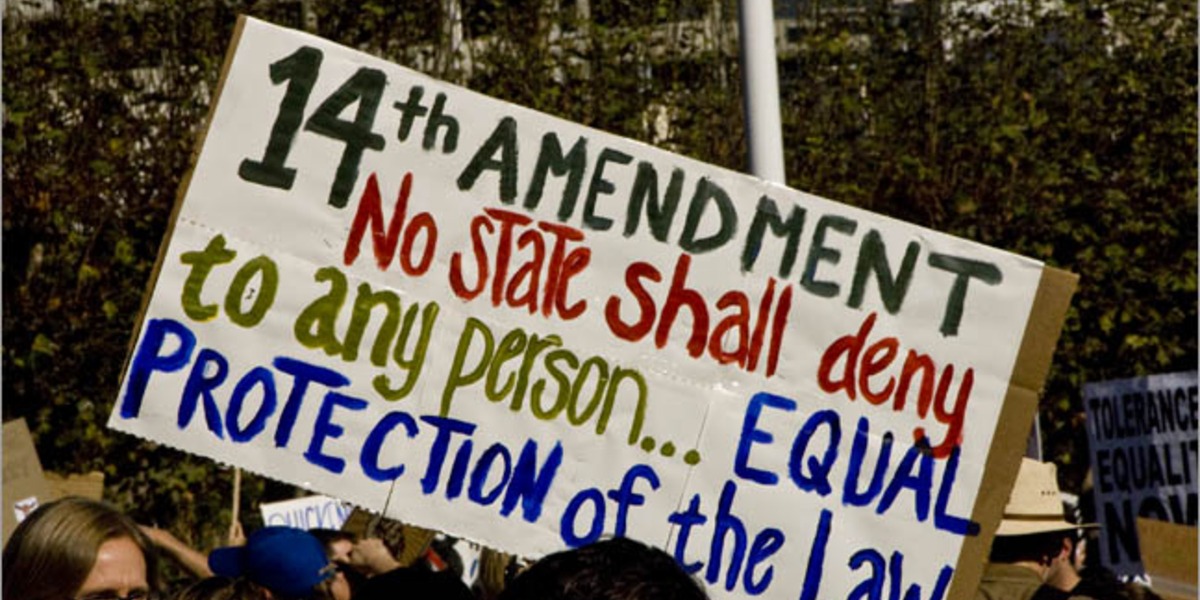
The Fourteenth Amendment is often presented as evidence that the Constitution naturally evolves into a positive-rights document. But a closer reading supports a more restrained conclusion. The amendment was designed to remove state-imposed barriers to liberty, especially the legal structures that denied equal protection on the basis of race. It was meant to prohibit discrimination and secure equal standing under law. It did not instruct government to provide material goods. The later expansion of the amendment into a general mandate for state provision is not a straightforward reading of the text. It is a transformation of the text.
The founders also knew that the future would differ from the past. They did not imagine 1789 as the final word. They created Article V precisely so the Constitution could be amended openly and legitimately. If the people wish to add a right to healthcare, housing, or some other public entitlement, they may do so by constitutional amendment. The mechanism exists. That is the point. A constitutional republic is not frozen in time, but it changes by formal consent, not by interpretive drift disguised as fidelity.
Focus Keyword in the Debate Over Rights: Two Freedoms, One Nation
III. THE RHETORICAL BATTLEFIELD
The conflict between these two freedoms would be hard enough if it were argued honestly. It is made far worse by the language used to conceal the difference.
The first tactic is rights creep: the habit of attaching the word right to nearly any desirable policy outcome. The “right to healthcare.” The “right to a living wage.” The “right to housing.” The “right to broadband.” Each phrase imports the moral force of the rights tradition into what is often, in constitutional terms, a policy preference.
This matters because a right in the founding sense imposes a duty of restraint. My right to speak freely means others may not silence me. My right to property means others may not take it. These rights cost nothing except forbearance. By contrast, a so-called positive right imposes a duty of provision. If I have a right to healthcare, someone must supply it—doctors, hospitals, taxpayers, insurers, or the state. That means resources must be taken from others through taxation or regulation. A positive right therefore depends on limiting someone else’s property rights and labor. That is not a rhetorical trick. It is the basic logic of redistribution.
The second tactic is the use of “democracy” as a bludgeon against constitutional limits. Phrases like “our democracy” are often deployed not to celebrate self-government, but to attack institutions that restrain temporary majorities: the Electoral College, equal state representation in the Senate, lifetime judicial tenure, and the filibuster. Yet the founders were not designing pure majoritarianism. They feared it. Madison warned in Federalist No. 10 about the violence of faction, and the Constitution was built to protect rights from being swallowed by majority passion. When democracy is used to justify weakening constitutional safeguards, it is being turned against the very system that makes democracy possible.
The third tactic is the “living Constitution” as public slogan. There are serious legal thinkers who argue that constitutional interpretation must adapt over time. But in political rhetoric, the phrase often functions as a shortcut: it allows people to claim constitutional legitimacy for positions the text does not support. If a preferred policy can be called constitutional because the Constitution’s “spirit” has evolved, then there is no need to amend anything. The Restorationist view is simpler and more demanding: if the people want a new constitutional rule, they should write one.
The fourth tactic is the false equivalence between freedom and equality of outcome. Some now describe deregulation, tax relief, or gun rights as “freedom for the powerful,” while calling redistribution “freedom for the many.” But freedom is not the same as equal results. The First Amendment does not guarantee successful speech. The Second Amendment does not guarantee safety. The right to contract does not guarantee prosperity. Freedom protects process, not outcome. Once equality of outcome is substituted for liberty, the language of freedom has been repurposed for a different moral project.
The Cost of Confusion
When two incompatible definitions of freedom are allowed to circulate without resolution, the result is not pluralism. It is incoherence. And incoherence in politics is not harmless. It creates opportunities for power.
Consider constitutional debate in this environment. A Restorationist points to the First Amendment and argues against compelled speech. A progressive replies that concentrated media ownership requires regulation to make speech meaningful. A Restorationist points to the Fourth Amendment and argues against warrantless surveillance. A progressive replies that modern threats require flexibility the founders could not have imagined. At each turn, the text is answered not with a better reading of the text, but with a utilitarian claim that current needs are too urgent to be limited by old language.
When constitutional argument is constantly overridden by expedience, the Constitution ceases to function as law and becomes merely one input among many in a political contest. It loses authority. It loses finality. Most importantly, it loses the ability to settle disputes rather than merely reflect them.
This confusion is often useful. A confused public is easier to mobilize. If freedom can mean anything, it can be made to support nearly any agenda. The result is a war of competing grievances dressed in the vocabulary of liberty. Each side accuses the other of tyranny. Each side claims to defend the Founders. But if the shared language has been emptied of stable meaning, no real argument can occur. Only mobilization remains.
That is the deeper concern of the Restorationist project. Bad policies can be reversed. Elections can be won and lost. What is much harder to recover, once lost, is the framework that allows correction in the first place. When constitutional structures are dismissed as anti-democratic, when courts are treated as illegitimate because their rulings are inconvenient, when the amendment process is bypassed in favor of reinterpretation, the system of self-correction weakens. A republic that cannot correct itself is not merely dysfunctional. It is vulnerable.
The Restorationist Case for Two Freedoms, One Nation
Restoration is not nostalgia. That objection misunderstands the argument from the start. No serious Restorationist wants to return to 1789 as a social arrangement. The founding era included slavery, property restrictions on voting, and the exclusion of women from civic life. Those injustices were real, and they were profound. The Restorationist case is not about preserving those conditions. It is about restoring the operating principles of constitutional self-government: limited powers, natural rights, separation of powers, federalism, and the rule of law.
In practice, that means something very specific. The answer to unjust laws is not simply more government aimed in a different direction. It is greater fidelity to constitutional restraints. The answer to inequality is not the redistribution of liberty, but the removal of government-created barriers that deny equal opportunity: discriminatory law, cronyism, regulatory capture, and favoritism for the well-connected. The answer to political dysfunction is not to bypass constitutional structures because they are inconvenient, but to strengthen them so they can do their job.
There is, however, a serious objection that must be faced honestly. The Constitution did coexist with slavery. It did coexist with Jim Crow. It did not protect many marginalized people when it should have. If the constitutional framework was so sound, why did it fail so badly for so long?
The Restorationist answer is that the failures were not failures of principle. They were failures of fidelity to principle. The language of equality was betrayed by institutions that refused to honor it. The answer to betrayal, however, is not abandonment. It is enforcement. The civil rights movement at its most constitutionally serious was deeply Restorationist. Thurgood Marshall did not argue that the Constitution was irrelevant. He argued that it was being violated. Martin Luther King Jr. repeatedly appealed to the founding promise, calling America to live up to what it had already declared about human equality. That was not a rejection of the constitutional order. It was one of its greatest moral affirmations.
The lesson is clear: where there is a gap between constitutional promise and historical reality, the answer is fidelity, not substitution. If the framework is replaced, the standard for judging injustice is lost.
Speaking Clearly in a Time of Confusion
In an era of political noise, one of the most radical acts available to a serious citizen is the insistence on precise language. Not precision as pedantry, but precision as honesty.
When someone invokes freedom, ask: freedom from what, or freedom to do what? The two are not interchangeable. One describes a protected sphere around the individual. The other describes a claim on the labor or resources of others.
When someone invokes rights, ask: who bears the corresponding duty, and by what constitutional authority? A right without a defined duty is not a right at all. It is a wish.
When someone invokes democracy, ask: do they mean the constitutional republic the founders designed, or an unchecked majoritarianism they explicitly feared? Those are not the same system.
America’s constitutional divide will not be resolved by slogans. It will not be healed by pretending the two freedoms are identical. It will be resolved, if it is resolved at all, by returning to the framework that can distinguish them and govern the conflict between them. That framework does not eliminate disagreement. It makes disagreement lawful, intelligible, and manageable.
The republic, as Benjamin Franklin is said to have remarked, is a republic—if you can keep it. Keeping it requires more than sentiment. It requires citizens who understand what it is, (Incomplete: max_output_tokens)
Federalist 10: Stunning Best Guide to FactionsBetter Questions: Stunning Best Decision Guide