
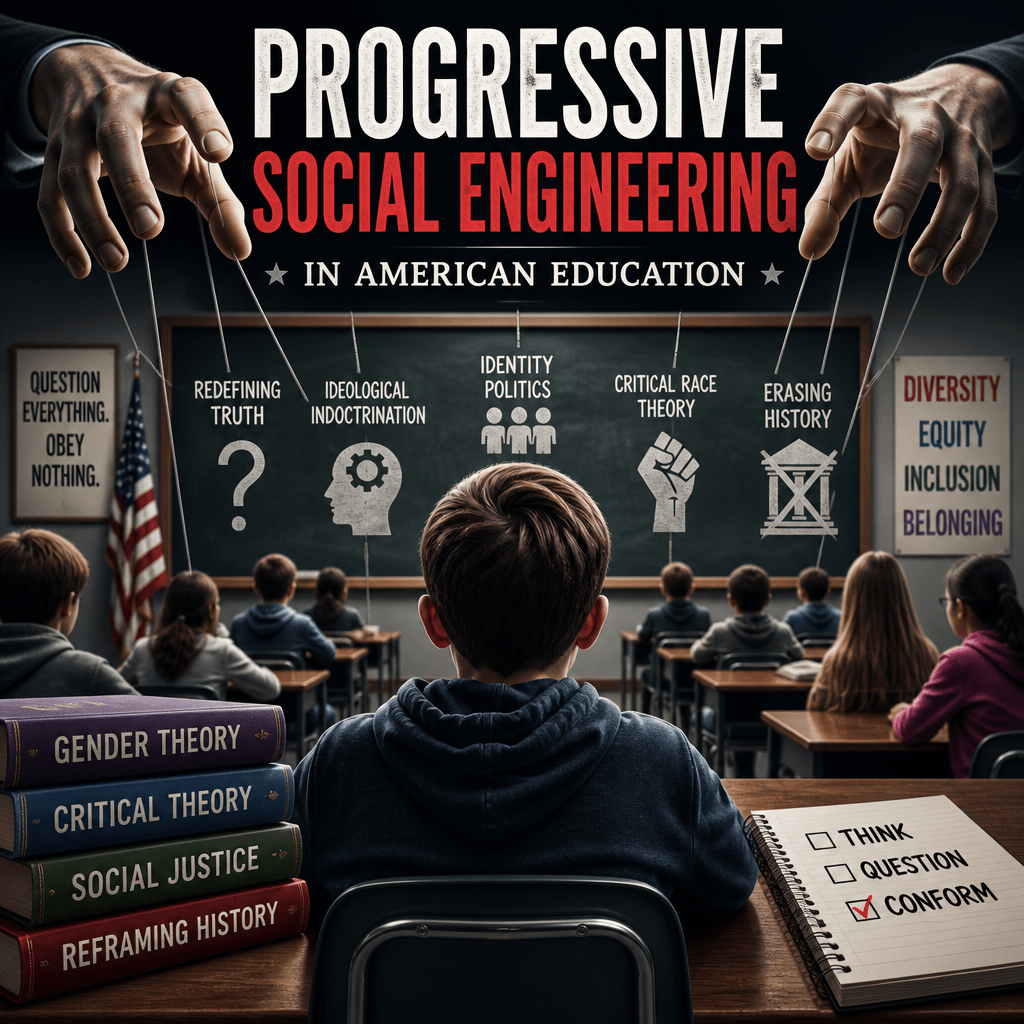
Progressive Social Engineering has reshaped American education over the last twenty years, shifting schools and universities away from civic formation and toward ideological training, identity management, and institutional control. The American Founders understood a basic truth: free government depends on an educated people.
Thomas Jefferson put it plainly when he said that “whenever the people are well informed, they can be trusted with their own government.” John Adams made the same point in different words: “liberty can not be preserved without a general knowledge among the people.” Jefferson also warned, “If a nation expects to be ignorant and free, in a state of civilization, it expects what never was and never will be.”
These quotes still matter because they remind us that education was never meant to be only about job training or test scores. It was supposed to help form citizens, build character, strengthen judgment, and prepare people for the duties of liberty. That older purpose once shaped the nation’s understanding of schooling. For a broader civic lens, see the Founders’ warning in Two Constitutional Visions: Conservatives, Progressives, and the Founders’ Warning About Democracy.
Table of Contents
- Education Was Once About Formation
- Progressive Social Engineering Changed the Mission
- The Family Was Weakened First
- Schools Cannot Carry Every Burden
- Higher Education Drives the System Downstream
- Curriculum Has Become More Politicized
- The Effects Are Visible
- The Teacher Shortage Is Also a Formation Problem
- When Children Are Poorly Formed, Civic Life Weakens
- Formation Is a Civilizational Need
- What Education Should Recover
- The Core Problem Is Purpose
Over the last twenty years, American education has moved away from civic formation and toward ideological training, identity management, and institutional control. That shift has reshaped schools, universities, teacher training, and even the expectations placed on classrooms. Progressive Social Engineering did not arrive all at once. It moved gradually through policy language, academic fashion, administrative habits, and teacher preparation programs.
That is why the issue is so hard to see clearly. It rarely appears as a single dramatic takeover. Instead, it accumulates through small changes in mission, vocabulary, and authority. Schools begin to look less like places of learning and more like places of behavioral management. The change is easy to describe only after it has already become normal.
Education Was Once About Formation
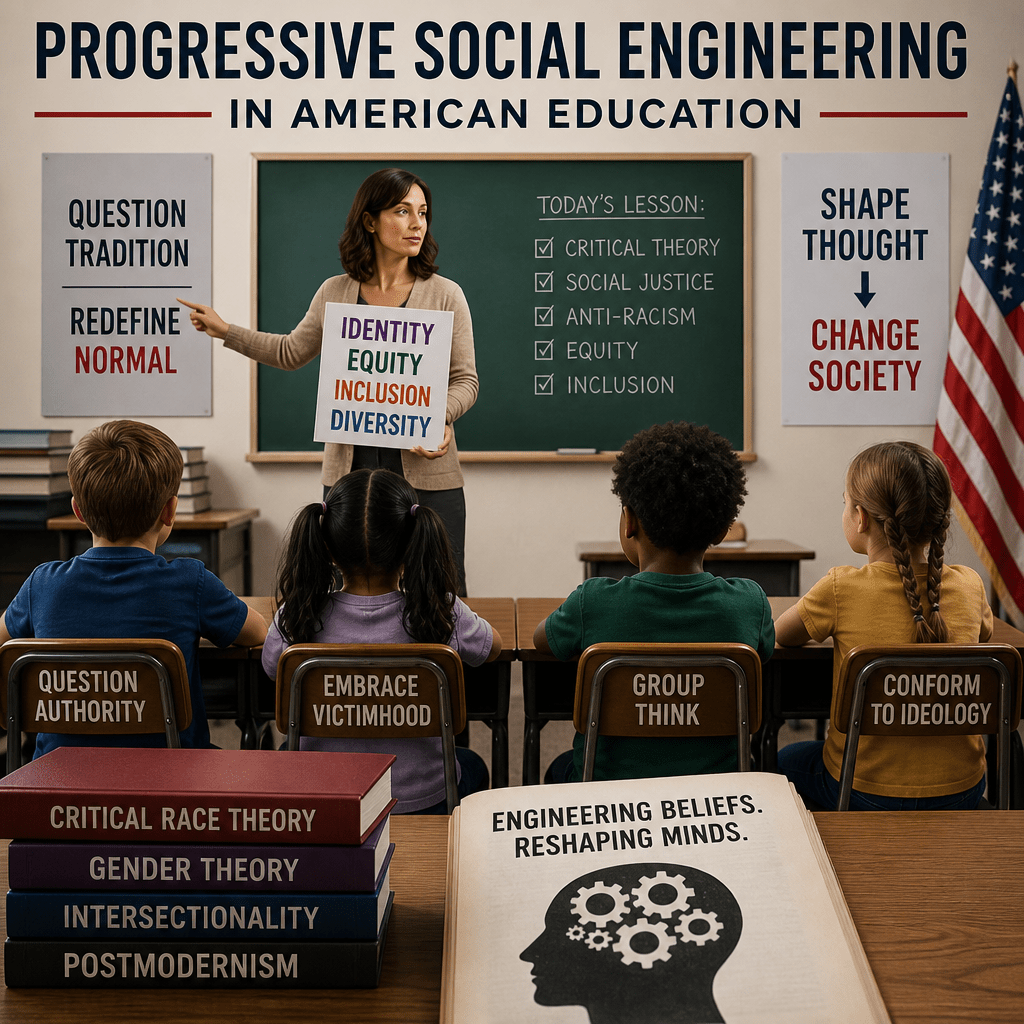
For much of American history, education was tied to self-government. Schools were expected to teach reading, writing, arithmetic, history, civic responsibility, and moral discipline. The goal was not perfection. The goal was formation.
A free republic needs people who can read carefully, think clearly, and act responsibly. It needs citizens who understand duty, authority, and restraint. It needs households, schools, churches, and local communities that work together to shape character. That older understanding of education treated students as future citizens, not as raw material for institutional experimentation.
The newer model often treats them as subjects to be managed. That change is at the heart of Progressive Social Engineering. Once the school is viewed primarily as a lever for social redesign, academic instruction becomes secondary to behavioral shaping. The student is no longer first a learner. The student becomes a project.
That shift is why so much educational language now sounds managerial. Terms like “outcomes,” “alignment,” “interventions,” “frameworks,” and “social-emotional learning” are not neutral. They reveal a belief that human beings can be assembled and corrected through expert systems. Some management is necessary in any institution, but education becomes distorted when administration replaces formation.
Progressive Social Engineering Changed the Mission
Progressive education began with a promise. It claimed that schools could do more than transmit knowledge. It argued that schools could improve society, shape behavior, and guide human outcomes through expert administration. At first, that sounded practical.
But over time, the model changed the purpose of schooling itself. Instead of forming citizens, schools increasingly began to function as tools of Progressive Social Engineering. That means education became less about shared knowledge and more about shaping beliefs, attitudes, and identity. Students were not only taught what to know. They were taught how to see themselves, how to interpret society, and which moral conclusions to accept.
This shift matters because education always carries assumptions. The question is not whether schools shape students. They do. The real question is: shape them into what? Schools cannot avoid forming people. They can only choose the character of that formation. If the school stops aiming at truth and virtue, something else will fill the vacuum.
The modern system often fills that vacuum with politicized categories, institutional caution, and emotional deference to current cultural trends. In that setting, Progressive Social Engineering becomes less a theory than a daily practice. Students learn to read social life through approved narratives, while the harder work of reasoning, comparison, and judgment recedes.
The Family Was Weakened First
This change in education did not happen in isolation. It was part of a larger transfer of formative power away from the household and into outside institutions. As family authority weakened, schools were expected to absorb more and more of what used to belong to parents.
That included discipline, emotional support, moral instruction, social mediation, behavioral correction, and identity formation. But schools were never built to replace the home. A school can teach mathematics. It cannot replace a father. It cannot replace a mother. It cannot replace the daily work of discipline, affection, and accountability that belongs to the family.
That is why this larger story connects to the breakdown described in Self-Governing Republic: Stunning Failure of Education. Once the household is weakened, institutions downstream are forced to compensate. They cannot really do the same work, so they improvise. The result is confusion for children and exhaustion for adults.
When the family weakens, the school is asked to do too much. And when schools are made responsible for what families once carried, confusion follows. This is one reason education has become so unstable. Schools were once expected to teach literacy, numeracy, and civic understanding. Now they are often expected to provide emotional regulation, moral guidance, social mediation, identity management, and even basic behavioral formation.
Those are not academic tasks. They are parental tasks. When institutions are made responsible for what families once carried, the burden grows too heavy for the institution to bear. Progressive Social Engineering thrives in that environment because the weakened family leaves a vacuum that expert systems are eager to fill.
Schools Cannot Carry Every Burden
The modern classroom is often expected to do impossible things. Teachers are asked to be instructors, counselors, social workers, behavioral managers, emotional regulators, mediators, and ideological moderators. Those are not the same job.
A teacher can guide learning. A teacher can model discipline. A teacher can support growth. But a teacher cannot substitute for the household economy of formation that a child needs over time. No classroom system can carry every burden that once belonged to family life, local culture, and shared moral expectation.
When schools are overloaded with duties they were never designed to bear, everyone feels the pressure. Students become unsettled. Parents become frustrated. Teachers become exhausted. The institution becomes brittle. Progressive Social Engineering often adds to this brittleness because it introduces more missions without reducing any of the existing ones. The school is told to teach more, heal more, manage more, and moralize more, all at once.
That is not sustainable. In practice, it tends to produce more paperwork, more administrative layers, and less time for actual instruction. It also creates a strange moral inversion: the more the system claims to care for children, the less room it leaves for the concrete work that children actually need.
Higher Education Drives the System Downstream
One of the most important changes in the last twenty years has been the rise of ideological training in universities, teacher colleges, and policy networks. These institutions do not merely educate students. They train the people who later shape the rest of the education system.
That includes teachers, principals, administrators, curriculum designers, journalists, and policy professionals. When universities normalize politicized frameworks, those frameworks travel downstream into K–12 schools and public policy. This is how ideological training becomes institutional culture.
It begins in higher education. Then it enters school districts. Then it shapes teacher preparation. Then it becomes part of the ordinary language of classrooms. By the time parents notice the pattern, the vocabulary has already hardened into policy assumptions.
The result is not just a change in content. It is a change in moral architecture. Schools begin to act as if certain conclusions are assumed in advance. Inquiry remains on the surface, but the range of permissible answers narrows. That is one of the central features of Progressive Social Engineering: it presents itself as openness while quietly enforcing intellectual direction.
For a broader discussion of how institutions shape perception, see the standards work of the National Institute of Standards and Technology, which shows how assumptions and measurement frameworks influence outcomes even when systems claim neutrality.
Curriculum Has Become More Politicized
In many schools, the goal of education is no longer neutral instruction. It is often the promotion of a moral or political framework. That framework may be presented as inclusive, equitable, or restorative. But in practice, it often narrows open inquiry and pushes students toward predetermined conclusions.
Instead of encouraging students to ask what is true, what happened, what the evidence shows, and what the strongest argument on each side might be, they are often pushed to ask what side they should be on, what identity category they belong to, and what conclusions are morally acceptable before the discussion begins.
That is a serious shift. Education should train the mind to seek truth. It should not train the mind to repeat approved slogans. And when schooling consistently rewards conformity over thought, students learn that intellectual caution is safer than honest inquiry.
This is one reason the political temperature around schools has risen. Curriculum is no longer seen as merely curricular. It is understood as a battleground over worldview. That is not healthy for students, and it is not healthy for civic life.
The Effects Are Visible
The decline in education is not abstract. It shows up in daily life. We see it in lower literacy standards, eroded discipline, weakened teacher authority, distrust from parents, student disengagement, administrative overload, and higher turnover among teachers.
Children learn quickly when institutions are inconsistent. They learn when authority is real and when it is negotiable. They learn whether rules matter. They learn whether adults are united or divided. They learn whether schools are stable places of formation or contested spaces of social conflict.
When the school loses coherence, students do not become freer. They become less formed. The school may still look active, but activity is not the same as formation. A busy system can still fail to educate. In fact, the busier it becomes with secondary tasks, the less time it often has for the core work of teaching.
These visible effects explain why many families feel that something fundamental has gone wrong. They may not use the term Progressive Social Engineering, but they can often see the consequences. Standards seem fluid. Expectations seem inconsistent. Discipline appears selective. And trust, once lost, is hard to recover.
The Teacher Shortage Is Also a Formation Problem
Many people describe the teacher shortage as a labor issue. It is that. But it is also a formation issue.
Teachers are leaving not only because of pay or workload, but because the demands on the profession have become unsustainable. Many are expected to manage crises that belong to the family, the culture, and the broader social order. A teacher cannot repair every social failure.
When the burden becomes too great, good teachers leave. That makes the problem worse. The system then becomes even more unstable, and trust declines further. This is one reason schools struggle to recover once formation breaks down. The same ideological pressures that reshape curriculum also make teaching less attractive to people who want to focus on learning.
The teacher shortage is therefore not only a personnel problem. It is evidence that the school has been assigned too many roles and too many moral duties. Progressive Social Engineering increases that overload by making the school responsible for fixing problems it did not create and cannot solve alone.
Related concerns about institutional strain appear in US Dept. of Education: Dumbing Down Citizens, which examines how bureaucratic incentives and declining standards can weaken the very people schools are meant to serve.
When Children Are Poorly Formed, Civic Life Weakens
The effects of education decline do not stop at the school gate. Poorly formed children become poorly prepared adults. And when adults are less capable of self-government, the whole society feels it.
The broader consequences include weaker civic literacy, less respect for authority, more emotional volatility, lower institutional trust, greater dependence on bureaucracy, and more conflict over basic norms. This is not random. It is what happens when a society loses sight of the real purpose of education.
A republic cannot survive on technical skill alone. It needs judgment. It needs discipline. It needs people who can bear responsibility without collapsing into outrage or dependence. That is why the civic dimension of schooling matters so much. If students are never trained to weigh evidence, tolerate disagreement, and understand the common good, they will struggle later in public life.
These are the civic costs of Progressive Social Engineering. When education becomes a machine for managing feelings and enforcing approved conclusions, it weakens the very habits that make self-government possible.
Formation Is a Civilizational Need
Your related point about civilization is important here. A society cannot remain free if it no longer knows how to form disciplined, responsible, self-governing people. Education is not a side issue. It is part of civilization itself.
That idea also connects to the broader argument in Why Do Conservatives and Progressives Act So Differently? Their Brains Are Wired That Way. Different moral and cognitive habits produce different political instincts. Education either strengthens those habits in service of liberty or weakens them in service of institutional conformity.
Schools should not be used to manufacture political conformity. They should not replace families. They should not train students to be dependent on institutions for identity and meaning. Their proper task is much older and much nobler. They should educate free people.
That requires more than information. It requires moral seriousness, intellectual discipline, and the capacity to engage hard questions honestly. It also requires a culture that respects limits. Education works best when it knows what it is for and what it is not for.
What Education Should Recover
If America wants to recover self-government, it must recover education in the fullest sense. That would mean restoring the basic goals of schooling.
- Teach literacy clearly
- Restore academic standards
- Strengthen discipline
- Respect parental authority
- Reduce ideological pressure
- Rebuild civic knowledge
- Encourage independent thought
- Form character as well as intellect
None of this is radical. It is simply traditional. It reflects the conviction that education exists to prepare people for liberty, not to manage them into conformity. A serious school should help children become adults who can think without being manipulated and act without needing constant institutional supervision.
That restoration would also mean being honest about the limits of schools. They can support children, but they cannot replace the family. They can teach skills, but they cannot manufacture virtue by procedure. They can present knowledge, but they cannot substitute for the moral ecology in which knowledge becomes wisdom.
The Core Problem Is Purpose
The deepest problem in modern education is not just that standards have fallen. It is that the purpose of education has changed.
Instead of forming citizens capable of self-government, too many institutions now produce students trained to conform, react, and depend. That is the logic of Progressive Social Engineering. It treats schools as instruments of social redesign rather than places of human formation.
But a free society cannot survive on managed dependence. It needs men and women who can think, judge, and act with responsibility. It needs schools that teach truth. It needs families that remain central. It needs institutions that know their limits.
It also needs public trust, which is impossible when schools are seen as ideological factories rather than educational institutions. Once that trust breaks, every reform becomes harder. People resist change because they no longer believe the system is honest about its own purpose.
That is why the central question is not merely how to improve schools. It is what schools are for. If the answer is liberty, then education must be rebuilt around formation, knowledge, discipline, and civic responsibility. If the answer is social management, then Progressive Social Engineering will continue to dominate by default.
A society that loses the habit of formation will eventually lose the capacity for freedom. If America wants to recover self-government, it must recover education in the fullest sense: not as manipulation, not as propaganda, and not as social engineering, but as the formation of free, responsible, and morally grounded citizens.
Lost Moral Grammar: Stunning Best Civic Renewal GuideBetter Questions: Stunning Best Decision Guide7 Powerful Steps to Achieving Emotional Self-Control: The Restorationist Origin Myth Explained🧱“The Deputized Employer: Bureaucratic Drift and the Tyranny of Interpretation”